- Policy Analysis
- PolicyWatch 4144
The U.S.-French Mechanism 2.0: Preventing Escalation Between Lebanon and Israel
Strong outside supervision over Lebanon’s implementation of the Hezbollah disarmament plan could help forestall looming Israeli military escalation and protect recent diplomatic milestones on the road toward an eventual peace treaty.
For the first time since its inception in November 2024, the U.S.-French mechanism tasked with monitoring the Israel-Lebanon ceasefire agreement has undergone a significant transformation. Its latest meeting included civilian representatives from both sides: Simon Karam, the former Lebanese ambassador to the United States who publicly opposed Syrian control of his country in the 1990s, and Uri Resnick, the senior foreign policy director on Israel’s National Security Council.
Although their inclusion was a welcome response to Washington’s longstanding goal of expanding dialogue between Lebanon and Israel, the pace of Hezbollah’s disarmament remains the most crucial question, so broader discussions alone may not prevent a collapse. The U.S.-French mechanism helped stop the war last year and could save the ceasefire in year two, but only if Washington, Paris, and their partners are robustly involved in facilitating the disarmament process and establishing a framework for ongoing dialogue between Israel and Lebanon. Without third-party intervention, escalation and even a potential return to war are the most likely scenarios in the coming months.
The Mechanism’s First Year
Chaired by the United States and including representatives from Israel, Lebanon, France, and the UN Interim Force in Lebanon (UNIFIL), the International Monitoring and Implementation Mechanism took on the role of finalizing negotiations to end the war, overseeing compliance with the ceasefire terms, and verifying the dismantlement of Hezbollah’s military infrastructure, beginning in the south. Having the United States take the lead made military-to-military talks between Israel and Lebanon possible again—thirteen such meetings were conducted during IMIM’s first year, building on the UNIFIL “tripartite meetings” that took place from 2006 to 2023.
Two developments made the situation in November 2024 very different from that seen after the previous war ended in August 2006. First, Hezbollah had been decimated by the war and, unlike in 2006, could not seriously claim victory. Second, Washington agreed to a side letter allowing the Israel Defense Forces (IDF) to respond to imminent Hezbollah threats and ceasefire violations in southern Lebanon at any time, and in the rest of the country if the Lebanese Armed Forces (LAF) failed to act on violations after they were reported.
Expanding the Mechanism’s Scope to “Civilian Issues”
Adding civilian officials to IMIM discussions is a vital first step, but success will still hinge on producing concrete outcomes. In March, Morgan Ortagus—the U.S. deputy special envoy for the Middle East at the time—announced that Washington would bring the two countries together to resolve sensitive issues such as Lebanese prisoners held by Israel and the five border points where IDF ground units are still deployed inside Lebanon. Yet the working groups were never set up. Today, broadening the range of participants offers a new approach to bolstering dialogue on such issues, as Ortagus has advocated in her current role as U.S. special representative for Lebanon.
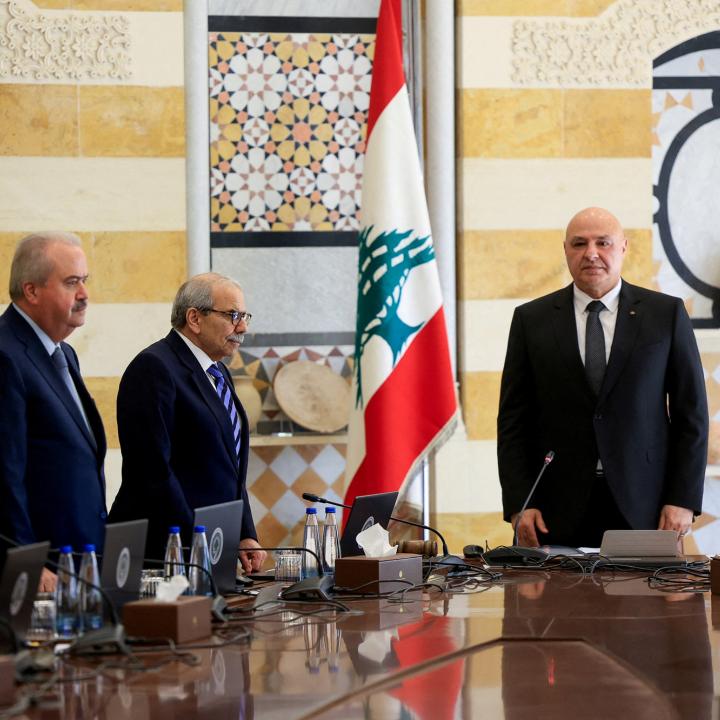
This shift was driven largely by President Joseph Aoun, who signaled in a November 21 speech that Beirut was ready to negotiate an agreement to end cross-border attacks, essentially endorsing direct dialogue. Prime Minister Nawaf Salam reinforced this shift by insisting that Hezbollah must disarm, arguing that its weapons neither deter Israel nor protect Lebanon. Even Speaker of Parliament Nabih Berri, a Hezbollah ally, backed the decision to broaden IMIM’s agenda by adding civilians.
Although expanded discussions improve the near-term negotiating climate and the chances for an Israel-Lebanon peace treaty down the road, two factors could destroy the new diplomatic breakthroughs: (1) further Lebanese mixed signals about “containing” rather than “disarming” Hezbollah north of the Litani River, an approach that would fall short of Beirut’s commitments under the ceasefire agreement, and (2) an Israeli military escalation in response to gaps in Lebanese compliance on the ground. The U.S.-French mechanism could provide all parties with the structure and clarity needed to respond to these challenges and make visible progress toward full disarmament.
Bridging the Perception Gap on the Military Front
Despite IMIM’s achievements, officials on both sides have expressed disappointment with the mechanism’s overall effectiveness. Israel distrusts Lebanon’s commitment to disarm Hezbollah and accuses it of responding too slowly (or not at all) to shared intelligence; Beirut has countered that the IDF often withholds information about upcoming military strikes, and that Israeli notifications have sometimes led the LAF to divert its limited resources to unnecessary searches.
Yet Lebanon should acknowledge that there is no alternative to the current system, since the LAF relies heavily on intelligence shared by the mechanism. From Washington’s perspective, the burden of proof lies with the LAF to demonstrate that it is implementing the disarmament plan endorsed by Beirut in September. One way to demonstrate the seriousness of Lebanon’s approach would be to lift the veil of secrecy surrounding this plan (see below), which has cast doubt on authorities’ willingness to implement it.
Recommendations
If the United States and its partners hope to avoid the looming scenario of ceasefire collapse and military escalation, they would need to approve and formalize a verification process for LAF actions, starting south of the Litani, and focusing on the following steps:
Expanding IMIM to monitor the disarmament plan and build confidence on both sides. During the latest IMIM meeting, Lebanon reportedly expressed openness to a proposal for monitoring LAF advances. This would be a welcome evolution—according to discussions with various officials, IMIM meetings over the past year have too often focused on acknowledging rather than resolving Israel and Lebanon’s differing perspectives on how and where to disarm Hezbollah. After evaluating each party’s assessment, the U.S. chair of the mechanism has been unable to fully confirm or contradict either one. Washington’s instinct may be to trust the IDF assessment, but its role as chair also entails giving serious consideration to the assessment of the LAF, an organization that U.S. officials want to reinforce and empower in order to degrade Hezbollah. Bolstering the LAF could indirectly strengthen Lebanese sovereignty as well, by protecting the country from malign Iranian influence.
Although Beirut has not publicly revealed its disarmament plan, media reports and comments from Lebanese ministers have suggested that the LAF mission proceed in phases. The first phase would focus on disarmament south of the Litani and would reportedly be completed by the end of 2025. Transitioning to phase 2—disarmament in areas north of the Litani—would require agreement on the LAF’s accomplishments in phase 1.
Currently, the only actor that Israel trusts in this process is the United States. The parties should therefore consider expanding the responsibilities of the existing U.S.-led mechanism by formalizing an approved verification process for the LAF’s disarmament mission, thereby testing the premise that the force is actually doing what it says it is doing to deal with Hezbollah sites in the south. Such an expansion would likely hinge on the LAF’s willingness to inspect “private proprieties.” But if the LAF can convince U.S. officials that it is implementing phase 1, Washington could then work on convincing Israel and transitioning to phase 2. The mechanism also remains the best venue for clarifying that the LAF’s ultimate responsibility under the ceasefire agreement is to disarm Hezbollah throughout the entire country.
For its part, Beirut is open to any proposals that spur Israel to take measures corresponding to Lebanon’s efforts. This would be consistent with the Lebanese disarmament plan, which reportedly specifies that progress from phase 1 to phase 2 requires sufficient moves by Israel. Such reciprocation is crucial because a fierce competition for legitimacy is currently raging inside Lebanon, and the best way to boost the executive branch’s credibility is by showing that its outreach to Israel has been the most effective way to safeguard Lebanese sovereignty. President Aoun and the LAF will require as much domestic credibility as possible to proceed with disarmament efforts in the north, which will present even greater challenges than the south. Conversely, if the mechanism is unable to deliver, Hezbollah will likely win the Lebanese battle of narratives by convincing enough citizens that Aoun has only strengthened Israel’s military posture.
To certify that disarmament has indeed been completed in the south, Washington may also need to expand the mission and size of the U.S. contingent in Lebanon (around thirty personnel at present). The Trump administration has shown a willingness to increase America’s monitoring presence in the Middle East when it sees a real chance of success on high-stakes initiatives, and now is the time to act on Lebanon.
Leverage existing structures. Partners like UNIFIL’s Force Commander’s Reserve can play a useful role in helping the U.S.-led mechanism monitor disarmament. FCR’s French and Finnish peacekeepers are able to deploy across UNIFIL’s entire area of operations (i.e., south of the Litani) and hold a better reputation than other UNIFIL components. France currently has 700 FCR peacekeepers on the ground, and Finland an additional 200.
Condition foreign funding on the LAF’s performance. Despite the general decline in U.S. foreign assistance worldwide, the Trump administration has continued to fund the LAF in order to demonstrate support for the crucial mission of disarming Hezbollah—especially after the army noted that it was missing capabilities needed to carry out that mission. Yet the pending U.S. National Defense Authorization Act (NDAA) has seemingly conditioned this support, referring to “options for suspending assistance” if the LAF proves unwilling to disarm Hezbollah.
IMIM can help bring more coherence to these two issues—Hezbollah disarmament and U.S. support to the LAF—by creating benchmarks tailored to the disarmament plan. In the immediate term, the parties could meet the NDAA requirement by conditioning U.S. funding on the LAF’s successful completion of phase 1.
Similarly, the long-discussed international conference to support the LAF—now expected to be organized in early 2026—will likely require efforts to address Saudi Arabia’s stated requirements for tangible progress on disarming Hezbollah. In preparation for the conference, a meeting is expected to take place next week in Paris, bringing together Saudi, U.S., and French representatives. More robust monitoring of the disarmament plan would undoubtedly help convince Riyadh that the time is right to help boost the Lebanese army.
Souhire Medini is a visiting fellow at The Washington Institute, in residence from the French Ministry for Europe and Foreign Affairs.