- Policy Analysis
- PolicyWatch 4210
Trump’s China Trip: Implications for the Middle East and Beyond
May 13, 2026
Also available in
Brief Analysis
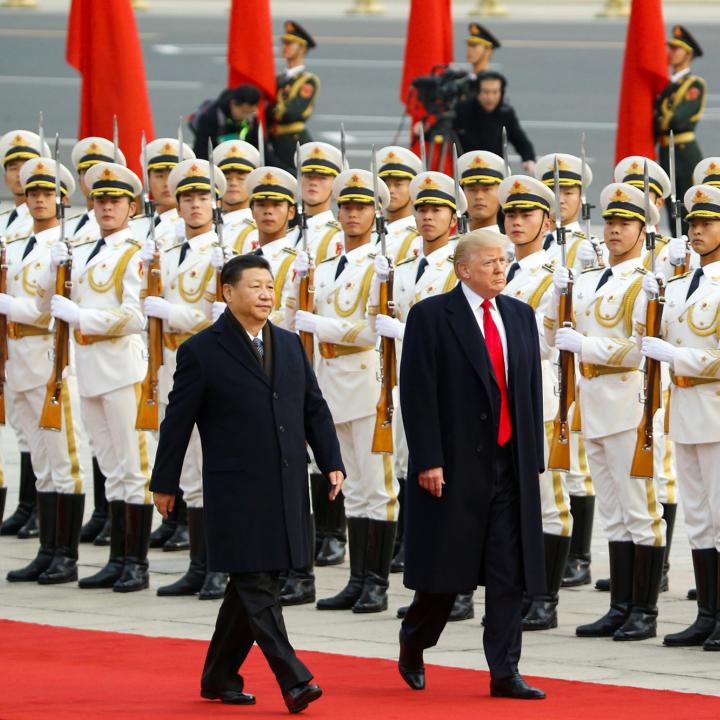
The first presidential visit to China in nearly a decade will cover trade, technology, and a range of other bilateral topics, including frank conversations on Middle East subjects such as Beijing’s support to Iran and the wider global repercussions of the Strait of Hormuz crisis.
The Elephant in the Room: China’s Support to Iran
By Grant Rumley
As this week’s summit unfolds in Beijing, President Trump finds himself in the unenviable position of seeking President Xi Jinping’s help in the Middle East. China is arguably the country with the greatest leverage over Iran, and U.S. officials have repeatedly called on it to use that leverage during the current war. Yet Beijing’s response has been cautious so far—its most notable intercession was reportedly pressuring Tehran to accept the terms of the April ceasefire. This suggests that Chinese leaders are looking to exact reciprocal concessions from the United States.
Beijing has demonstrated its wartime support for Tehran in two main ways: by continuing to purchase Iranian oil, and by providing a variety of clandestine assistance to the regime’s military efforts. In addition to its longstanding practice of sending dual-use components for Tehran’s missile and drone programs, Beijing has facilitated the provision of overhead imagery throughout the conflict, enabling Iranian forces to improve their information on U.S. and allied targets. For example, Iran has drawn from analysis and tracking data released by Chinese geospatial intelligence companies (e.g., MizarVision) and has even reportedly leased the high-resolution Chinese intelligence satellite TEE-01B. Washington has taken steps against both lines of support, from interdicting ships bearing Iranian oil to sanctioning MizarVision and other firms.
Meanwhile, Trump arrives in Beijing with the ceasefire on shaky ground. If hostilities resume, unilaterally countering China’s support to Tehran would be a resource-intensive proposition. U.S. forces needed for the blockade on Iranian ports and other potential operations may be strained to continue maritime interdictions, and China has proven increasingly willing to circumvent U.S. sanctions. Trump may therefore seek commitments from Xi to cease some aspects of support for Tehran if the ceasefire collapses. The question is whether Xi will try to dissuade Trump from resuming combat operations or simply ask for a U.S. concession in another theater in return.
Weathering the Latest Skirmish in a Ten-Year Trade War
By Henry Tugendhat
This week’s summit opens just after the United States announced its most serious Iran-related sanctions on Beijing to date, targeting one of China’s largest refineries and forty associated shipping companies. The sanctions address the fact that Beijing still has huge leverage over Tehran by virtue of its status as the largest buyer of Iranian oil. Yet there are no guarantees that this U.S. economic pressure on China will translate into pressure on Iran.
For one thing, ceasing oil purchases would mark a significant shift in Chinese relations with Iran—one that the Islamic Republic and other governments could perceive as betraying a partner and acquiescing to U.S. interests at a time when Beijing wants to present itself as a strong, reliable power. China may also conclude that angering Tehran would be more costly in the long term, since the regime seems likely to control future shipping flows through the Persian Gulf—the source of roughly 50 percent of China’s oil imports and a destination for many of its exports.
More broadly, Xi is unlikely to interpret the latest U.S. sanctions move as solely about Iran, since the new restrictions are poised to affect domestic energy supplies at a time of great economic stress for China. In Beijing’s view, these measures are an opportunistic U.S. attempt to carry on the tit-for-tat trade war that began ten years ago.
Certainly, the Trump administration’s negotiating position was weakened by the Supreme Court’s February decision to prohibit use of the International Emergency Economic Powers Act for tariffs. And President Trump may have postponed the summit from March to May while he sought another point of leverage. Last weekend, he resumed his attacks on the ruling, suggesting that it is still at the top of his mind as he begins the summit. In particular, he wants to avoid negotiating more strategically valuable tariffs related to semiconductors, solar energy components, battery manufacturers, and material inputs.
China has responded with so-called “blocking rules” that essentially prohibit its companies from complying with the new U.S. sanctions. This is the first time it has invoked these rules, and the resultant legal and diplomatic confrontation will serve as an important test case for China and other countries seeking to protect themselves against future U.S. economic pressure. Ultimately, however, Beijing wants to return to the trade relations it had before the first Trump administration, so it may view this week’s meeting as an opportunity to set a floor in the relationship from which it can rebuild its economic interests.
The Gulf Remains Key to U.S.-China Tech Competition
By Elizabeth Dent
Although the Iran war is expected to feature prominently on the summit’s agenda given its destabilizing impact on global markets and energy flows, the deeper issue at stake is the future of the Middle East’s technological and economic alignment. If Trump’s visit expands U.S.-China tech cooperation while protecting the most sensitive American technologies and commercial interests, it stands to benefit the Arab Gulf states in the long run.
For years, countries like Saudi Arabia and the United Arab Emirates have invested billions of dollars to diversify their economies away from oil and position themselves as hubs for artificial intelligence, tech manufacturing, and energy innovation. Washington and Beijing are vying for influence over that transformation, which will shape the Middle East’s digital infrastructure, security partnerships, economic deals, and geopolitical orientation for years to come.
During President Trump’s May 2025 trip to the Gulf, he announced billions of dollars in tech, defense, and critical-mineral deals with Gulf partners, deepening their alignment with Washington. This March, Emirati Ambassador Yousef Al Otaiba confirmed the first deliveries of cutting-edge AI chips as part of a deal with Nvidia, underscoring Washington’s continued commitment to advancing this cooperation with select Gulf states. The tech-focused delegation sent to this week’s Beijing summit signals that these issues will remain a U.S. strategic priority.
At the same time, the Iran war has exposed vulnerabilities in U.S.-Gulf relations. Gulf leaders were not consulted on the decision to launch the war, and Iran has fired thousands of missiles and drones at them since March, reinforcing their fears about bearing the main economic and security consequences of any regional conflict. The war’s widespread disruption has also led to the realization that discussions of future security relations will need to extend far beyond military alliances, to include the resilience of supply chains, energy infrastructure, and digital infrastructure.
If dealt with properly, these challenges will create new opportunities for the Gulf states, giving them an increasingly prominent role in shaping the global AI ecosystem. Their influence stretches beyond financing, offering access to large-scale power sources for AI infrastructure, funding and expansive space for data centers, and attractive regulatory environments for global tech firms. They also aim to carve out AI governance frameworks and digital infrastructure standards that give them outsize influence as other governments try to catch up.
In light of these factors, Washington is unlikely to press the Gulf states on fully rupturing ties with China, particularly now that they are increasingly basing their foreign policies on national interests more than other considerations. Accordingly, their strategic importance is poised to grow as they become trusted hubs for technology while maintaining economic relationships with the United States and China.
Beyond Iran: How Moscow Is Playing the Beijing Summit
By Anna Borshchevskaya
The Trump-Xi summit does not appear to hold any downsides for Moscow, since Russia, China, and Iran are aligned in seeking a diminished U.S. role in the world. Russia’s partnerships with these countries will likely endure regardless of the outcome, so Moscow appears to be looking beyond Iran as it evaluates Trump’s trip.
On May 9, Vladimir Putin announced that Russia is nearing a “serious” natural gas and oil deal with China. This statement was significant not only because of its timing just before Trump’s summit, but also because the U.S. military continues to blockade waters through which China gets much of its oil. Putin may be betting that Beijing will welcome direct Russian supplies via pipeline. Last September, the two governments signed an agreement to build the Power of Siberia 2 pipeline, which would deliver Russian gas straight into China. The project intends to shift Russia’s energy exports from Europe to Asia following widespread sanctions and other restrictions imposed after its full-scale invasion of Ukraine in 2022. Yet key terms of the deal—including pricing and timetable—still await confirmation from Chinese officials, who presumably prefer to avoid becoming so energy dependent on Russia that the relationship tilts back in Moscow’s favor.
This will be an important issue to watch during Trump’s visit. As mentioned above, China activated “blocking rules” shortly before the summit and ordered its refineries not to comply with U.S. sanctions over alleged purchases of Iranian oil, signaling that it can resist American pressure. Yet Putin may have calculated that Beijing will still be tempted by alternative energy supply lines provided by Russia.
If the Power of Siberia 2 deal advances, it would strengthen Moscow’s long-term leverage in its confrontation with the West. In particular, a guaranteed route for Russian oil sales outside Europe would help generate the resources Moscow needs to sustain its war in Ukraine.
Europe’s View: Trade Implications and the Hormuz Crisis
By Souhire Medini
As the summit proceeds, European officials will first and foremost be scrutinizing how any announcements on trade policy might affect the EU economy. They are also on the lookout for any insights that help them better understand the Trump administration’s strategy in the conflict with Iran, including its implications for their own approach.
Europeans share the U.S. assessment of Iran as a destabilizing regional force given the opacity of its nuclear program, its expanding ballistic missile capabilities, and its support for violent proxy groups. Thus, they will undoubtedly support the pending UN Security Council resolution on defending freedom of navigation in the Strait of Hormuz. Yet China and Russia deem the current Bahrain-sponsored draft resolution to be one-sided and will likely veto it.
Moreover, U.S. officials should understand that some of Europe and China’s most important interests are aligned in the current crisis given their severe exposure to the consequences of failing to reopen the Strait of Hormuz—consequences that are more limited for the United States, at least for now. To sustain its economy, Beijing needs to restore “normal safe passage” in the medium term, and the strait’s continued constriction has put many EU countries in similarly dire straits. This is why some European officials find themselves advocating for an outcome that China favors: genuine de-escalation that enables the strait to reopen, coupled with rejection of any permanent right-of-passage system. The latter issue grew more confusing after President Trump’s April remarks about a potential joint “toll” venture with Iran, so officials will be looking to see if any clarity emerges from this week’s discussions.
Trump’s trip also comes amid continued European efforts to operationalize their initiative for reopening the strait once conditions become more “permissive.” Strong coordination between this initiative and the U.S.-led Maritime Freedom Construct (aimed to support “Project Freedom”) will be essential to ensure that the two efforts complement each other—particularly given that China is unlikely to participate in either initiative.
This PolicyWatch was made possible in part by The Washington Institute’s Diane and Guilford Glazer Foundation Program on Great Power Competition and the Middle East.
About the Authors





Share