- Policy Analysis
- PolicyWatch 4207
Rebuilding West Bank Refugee Camps: A Shared Interest for Palestinians and Israelis
If coordinated properly, reconstructing—and rethinking—the northern camps destroyed during Operation Iron Wall could help improve refugees’ lives, reduce militant activity, and create a rare shared interest and perceptual shift between Israel and the Palestinian Authority.
More than a year after Israel’s Operation Iron Wall in the northern West Bank, the refugee camps there are still in ruins and lack viable civilian infrastructure. This calls for a general reassessment of the future of the West Bank camps, aimed at transforming them from densely populated spaces afflicted by poverty, weak governance, and militant activity into stable urban environments with better living conditions.
Rationale and Aftermath
Iron Wall, which began on January 21, 2025, was officially described as an effort to eradicate terrorist infrastructure. According to Israeli officials, it marked a shift in counterterrorism doctrine from the reactive policy of “mowing the grass” to a proactive strategy of “reshaping the space”—that is, attempting to alter physical and demographic conditions to prevent entrenched militant strongholds from reconstituting themselves.
A central feature of this policy was evacuating all camp residents—estimated by UN sources to number around 33,000, a figure Israel does not dispute—and preventing their return after active combat ended. According to data from UN agencies and Israeli human rights organizations, more than 1,450 structures were demolished, including most residential and public buildings. In addition, internal road networks were dismantled, access routes were blocked, and critical infrastructure was largely destroyed, including around thirteen kilometers of sewage lines, four kilometers of drainage channels, hundreds of drainage pits, and key electrical infrastructure such as substations and power lines.
Refugee camps have historically seen extensive militant activity due to their dense urban structure, poor economic situation, the limited access of Israeli security forces, the lack of full control by the Palestinian Authority, and the presence of armed groups embedded within civilian populations. Israel thus considers it essential to reduce the operational constraints imposed by such environments for the sake of long-term security and stability. Yet international actors and segments of Israeli civil society argue that this policy reflects not only security considerations, but also broader political and territorial objectives related to long-term control. Critics note that Jerusalem has offered no detailed explanation of the term “reshaping the space,” nor laid out any specific objectives or timelines. In their view, this vague terminology is enabling prolonged delays in the population’s return.
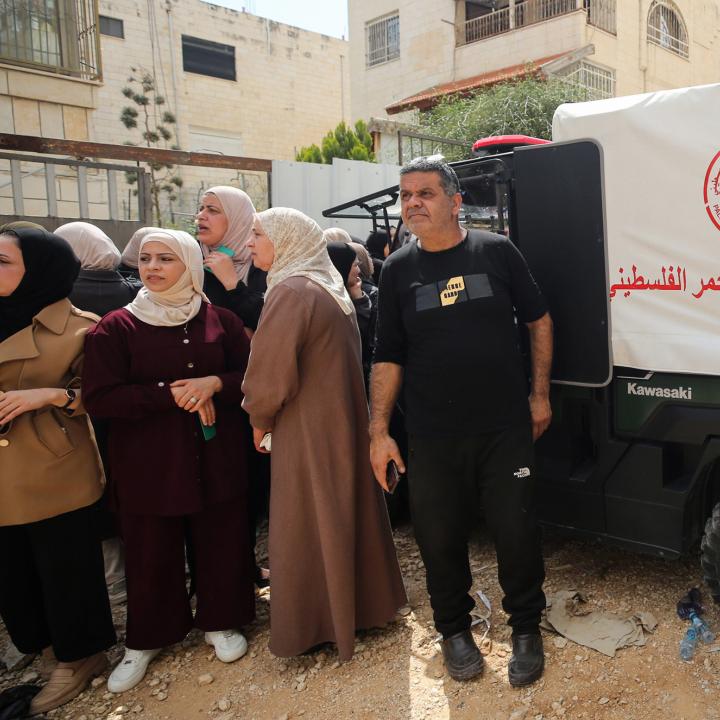
Since Iron Wall ended, the camps have remained largely uninhabited. The Israel Defense Forces have designated them closed military zones, and the absence of basic infrastructure has rendered return impossible. Displaced residents have been absorbed into nearby towns and villages through family connections, rental arrangements, or temporary shelter in public buildings. Humanitarian assistance is provided intermittently by the PA and international organizations, but host communities are increasingly feeling the strain from the increase in population.
Israel has not undertaken reconstruction beyond debris removal, and it does not intend to finance rebuilding directly, according to senior officials cited by Israeli media reports. Instead, Jerusalem seeks to condition reconstruction on a negotiated framework involving the PA and international actors. This framework would delay the return of residents until the following conditions are met:
- Completion of all “reshaping of the space” measures that Israel believes are required.
- Full coordination of infrastructure development with the IDF to ensure that Israeli forces have operational freedom of movement. This includes building electricity, water, and sewage infrastructure underground.
- A PA commitment to assuming full civil responsibility, including security enforcement.
Notably, Israel insists on excluding international organizations from operating in the camps, particularly the UN Relief and Works Agency (UNRWA). This reflects a deeper political disagreement: Israel seeks to reclassify the camps as regular urban neighborhoods, thereby dissolving their exceptional and symbolic status, while the PA aims to preserve their identity as refugee camps even if they are rehabilitated.
The PA’s formal position—reflected in a statement issued May 6, 2025, and summarized by the Palestinian news agency WAFA—emphasizes full commitment to the reconstruction and rehabilitation of the camps with international and regional support. It frames Israel’s attempt to remove UNRWA as part of a broader effort to dismantle camps and undermine the status of the refugee issue. However, there is no official PA position explicitly conditioning reconstruction on UNRWA’s continued presence, potentially leaving room for compromise.
Currently, there are no authoritative estimates of reconstruction costs from major international institutions, largely because of restricted access to the camps. However, unofficial estimates based on comparable cases (e.g., Gaza; previous reconstruction in Jenin) place the total cost between $100 and $300 million.
Recommendations
Despite the serious humanitarian and political challenges, the situation in the northern West Bank refugee camps presents a rare opportunity for structural transformation. Rebuilding the camps as functional urban spaces—with modern infrastructure, regulated services, and professional management—could improve living conditions for displaced populations, reduce pressure on surrounding communities, and limit the reemergence of armed groups.
At the same time, such a process could serve as a catalyst for strengthening PA governance. Effective leadership in reconstruction, service delivery, and internal security would demonstrate institutional capacity to both domestic and international audiences, enhance the PA’s legitimacy, and potentially position it as a credible civilian governance alternative in Gaza over the longer term.
For this to materialize, a structured implementation framework is required. Israel would need to define a clear end state for reshaping the space, establish a phased timeline for civilian return, approve urban master plans that incorporate security requirements, and facilitate international funding mechanisms. The area’s status would also need to be changed from direct Israeli control to Palestinian control, with sustained security cooperation between the sides.
The PA, for its part, would need to assume full civilian responsibility in the camps, including municipal governance, service provision, and security enforcement to prevent rearmament. It would also need to establish transparent financial mechanisms to manage reconstruction funds and demonstrate willingness to integrate the camps into the broader West Bank urban system.
In addition, a viable reconstruction effort would require a coherent and credible financing framework capable of ensuring transparency, predictability, and donor confidence. The most practical model would be a multi-donor trust fund managed by an international financial institution like the World Bank to centralize contributions and provide unified oversight. Funding from key actors—including the European Union, Gulf states, and other regional partners—would need to be tied to clear governance benchmarks and measurable progress in infrastructure, security, and service delivery. Disbursement would be performance-based, with funds released only when verified milestones are reached, to reduce the risk of corruption and ensure accountability. In parallel, technical assistance packages would be essential to strengthen the PA’s capacity for urban planning, procurement, and financial management, enabling it to manage reconstruction funds effectively and sustainably.
Another option worth considering is to task the Board of Peace with managing reconstruction of the refugee camps. The board’s mandate is not limited to Gaza, and the fact that it is led by the United States would give both Israel and the PA pause about opposing its involvement in West Bank reconstruction. For the Trump administration, such an arrangement could provide a visible policy achievement at a time when implementation of the second phase of its Gaza peace plan is progressing slowly. This approach might also help mobilize more funding. For example, Washington could redirect the PA clearance revenues withheld by Israel into a funding mechanism managed by the Board of Peace. If the funds were allocated to projects in the West Bank rather than Gaza, the PA might find it easier to agree to such an arrangement, while Israel would likely find it difficult to oppose the release of funds for a U.S.-led initiative.
Conclusion
The refugee camps have long been one of the most symbolically charged and politically sensitive issues in the Israeli-Palestinian conflict, but under the current conditions, they could become a practical arena for a limited convergence of interests. Coordinated planning, international financing, and a clear division of responsibilities between Israel and the PA could transform these fragmented and unstable spaces into regulated urban environments that better serve both security and civilian needs.
For the PA, successful reconstruction would give it a chance to demonstrate effective governance in areas that previously lacked such control, potentially strengthening its public legitimacy. For Israel, this approach could reduce militant entrenchment and create a more predictable security environment.
This process may also include a gradual reduction of reliance on UNRWA, serving as the first real test case of whether large-scale reconstruction of Palestinian refugee camps can be carried out without the organization. This would have significant implications for future efforts in Gaza and Arab countries with Palestinian refugee camps.
Since the Israeli-Palestinian political process is unlikely to be renewed in the foreseeable future and broader transformative moves in the West Bank are similarly unlikely, the refugee camps are one of the few issues on which the practical interests of both sides may align enough to enable a workable solution. Over time, this could lead to a conceptual shift in approaches to resolving the conflict and lay the groundwork for potentially broader structural changes.
Neomi Neumann is an adjunct fellow with The Washington Institute, focusing on Palestinian affairs. Her previous positions include head of the research unit at the Israel Security Agency.