- Policy Analysis
- PolicyWatch 4150
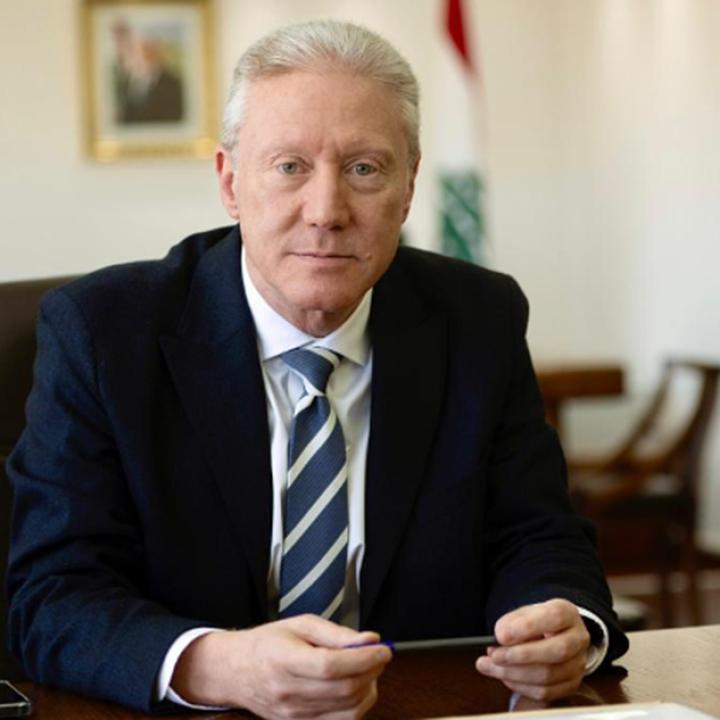
Lebanon's Outlook on Sovereignty, Disarmament, and Peace A Discussion with Foreign Minister Youssef Raggi
Watch video or read a summary of the minister’s observations on a multitude of crucial issues, from Hezbollah disarmament and long-term Israeli peace to relations with Iran, Saudi Arabia, Syria, and Turkey.
On December 23, The Washington Institute held a virtual Policy Forum with H.E. Youssef Raggi, Lebanon’s Minister of Foreign Affairs and Emigrants. Questioners included David Schenker, the Institute’s Taube Senior Fellow and director of its Rubin Program on Arab Politics; Hanin Ghaddar, the Institute’s Friedmann Senior Fellow; and event moderator Robert Satloff, the Institute’s Segal Executive Director.
NOTE: The following is a rapporteurs’ summary of the minister’s remarks; for verbatim quotations, please watch the event video above.
Hezbollah Disarmament
Despite economic and political challenges, 2025 has been a productive year for Lebanon. The new leadership is composed of competent and honest officials, and the government is coherent and focused.
The top priority is Hezbollah’s disarmament. The government took six months to reach a firm decision on undertaking this task. It was late, but the government is committed. Although the United Nations, the United States, and Israel also seek Hezbollah’s disarmament, Lebanon is moving ahead with this task because it is the will of the Lebanese people. There is consensus among the government and people that Hezbollah is an illegal military organization and needs to be not only disarmed, but dismantled. Hezbollah is free to engage in politics, but it is not free to maintain illegal arms.
The Lebanese Armed Forces (LAF) are in charge of the disarmament file. They provided the government with a plan divided into four geographic phases: (1) south of the Litani River, (2) between the Litani and Awali Rivers, (3) Beirut and its suburbs, and (4) the remaining areas of the country. Each area represents a different stage of the disarmament process, and the LAF is currently in the first stage south of the Litani. The LAF initially planned to finish this stage by the end of 2025, but efforts are ongoing.
Some in Lebanon believe the LAF is not progressing quickly enough and attribute the slow pace of the effort to insufficient political will. The LAF has a very difficult task and is facing a shortage of personnel and resources. It cannot simultaneously disarm and dismantle Hezbollah both south and north of the Litani. Therefore, as the LAF continues intensive operations in the south, it is working to “contain” the group’s weapons in the north. “Containment” is not an alternative to disarmament. When the LAF moves to the second phase, it will continue the disarmament process in each region until Hezbollah has been fully stripped of its weapons.
Hezbollah’s leadership assented to the removal of weapons south of the Litani, but it refuses to accept UN Security Council resolutions and the terms of the 2024 ceasefire agreement that stipulated full disarmament throughout the entirety of Lebanon. The texts are very clear; Hezbollah is either lying or doesn’t know how to read. Now the group is threatening “civil war” if the LAF proceeds with the process north of the Litani. Iranian leaders are also threatening violence. Warnings of civil war constitute a form of blackmail against the Lebanese government. Hezbollah is hoping to buy time, reconstitute, and continue its domination of the country. If a democratically elected government moves to disarm an illegal armed organization, it is restoring the principles of the constitution and the Taif Accord, not waging a “civil war.” In any event, the LAF is capable of confronting Hezbollah militarily if necessary.
Prospects for Lebanon-Israel Peace
Under Lebanese law, Lebanon remains in a formal state of war with Israel; consequently, any discussion of peace or cooperation is premature. Normalization comes after peace. Moreover, the issue of normalization remains largely taboo in Lebanon. While some argue that peace should be openly discussed at the official government level and within mainstream political discourse, this view remains marginal. The same holds for economic cooperation, which Israeli officials are currently promoting.
The appointment of a civilian diplomat to represent Lebanon in talks held under the ceasefire monitoring mechanism is a positive development, but at the same time, it is largely a cosmetic step. Beirut hoped the appointment would convince Washington that Lebanon is serious about disarmament; in turn, it hoped Washington would persuade Israel not to target Lebanese civilian infrastructure. Civilian representation on the mechanism will not widen the range of topics discussed, however; the work will remain focused on technical matters related to the ceasefire.
The official position of the government of Lebanon is to have peace with every country, including Israel, contingent on adoption of the Arab Peace Initiative endorsed at the 2002 Beirut summit, which specifies a two-state solution. Accordingly, any consideration of peace between Lebanon and Israel is premised on this outcome.
Regional Relations
Lebanon’s newly formed government seeks to maintain strong relations with all countries that respect its sovereignty and do not interfere in its domestic affairs. Iran has been a key provider of funds and material assistance to Hezbollah, contributing to the destabilization of Lebanon. While relations between Iran and Lebanon exist, preventing continued Iranian interference in Lebanon’s internal dynamics is a key priority of this government.
Saudi Arabia has historically been very supportive of Lebanon. Over the past fifteen years, however, successive Lebanese governments were aligned with the Iranian-Baathist-Hezbollah axis, a coalition that exported terrorism, Captagon, and instability. As a result, Riyadh scaled back its ties and involvement with Lebanon.
Today, Saudi Arabia has noted the positive changes in Lebanon, and relations have consequently improved. In addition to reengaging diplomatically, Riyadh has shown a renewed interest in assisting Lebanon’s financial recovery and reconstruction. That said, rebuilding would be premature at the moment; Hezbollah still wants to destroy Israel, and Israel is not finished targeting Hezbollah. Saudi Arabia has conditioned any assistance to Lebanon on Hezbollah’s disarmament and the implementation of economic reforms. Lebanon is doing both, but it will take time. Riyadh is waiting to see more progress.
Elsewhere, Turkey seeks to enlarge its influence in the Middle East. Ankara is trying to gain a foothold in Lebanon through its involvement with civic associations, especially in the north. Beirut had an issue with Turkey recently regarding the maritime border delineation with Israel. Ankara was displeased because the agreement did not take into account the interests of the Turkish Republic of Northern Cyprus. Alas, Northern Cyprus is not an internationally recognized country, so Lebanon could not negotiate with them.
Relations with Syria are the best they have ever been—Ahmed al-Shaara is the first leader in the country’s modern history to recognize the independence and sovereignty of Lebanon. The two states are now working to resolve some contentious issues, including Syrian refugees, Syrian prisoners in Lebanon, missing/disappeared Lebanese in Syria, and the delineation of formal borders. With time and persistence, all of these files can be settled. Shebaa Farms is another complicated issue, bequeathed to the current government by the Assad regime and the former puppet regime in Beirut. No one has decided yet to find a solution and determine whether the territory is Syrian or Lebanese. We will find a fair resolution for both countries.
Lebanon has excellent relations with the United States, which is a great friend. Washington has provided substantial support to the new Lebanese government and the Lebanese Armed Forces. The United States is also the only actor that has sufficient leverage with Israel to convince it not to target Lebanon’s civilian infrastructure. There is some disappointment in Washington that Beirut is not doing enough or moving quickly enough to disarm Hezbollah and exert full sovereignty throughout the country. Those who hold such views might be right.
This summary was prepared by Gabriel Wein and Wiam Hammouchene. The Policy Forum series is made possible through the generosity of the Florence and Robert Kaufman Family.