Devorah Margolin is the Blumenstein-Rodan Senior Fellow at The Washington Institute.
Brief Analysis
As Baghdad moves to the next phase for IS-linked detainees transferred from Syria, Washington should encourage repatriation, fair trials, and cooperation between partners on building a sustainable longer-term framework.
On September 1, Iraq announced that it had completed interrogations of more than 5,700 detainees linked with the Islamic State (IS), a task it accomplished just seven months after U.S. Central Command transferred them from northeast Syria amid the collapse of the IS detention system. Following years of international reluctance, Baghdad’s transfer and investigative process may come as a significant relief to victims and families seeking accountability for IS crimes, and to detainees who have waited indefinitely for their cases to be heard. Yet questions remain about evidentiary procedures, fair trials, the speed of the investigations, and the likelihood of international engagement.
As the process enters its next phase, Washington should treat it as an opportunity to advance a longstanding U.S. national security objective, since ensuring that detainees are properly handled is critical to preventing an IS resurgence. Moreover, the United States reportedly agreed to financially support detention and trial costs, while the Trump administration expects Iraq to meet its treaty obligations and is working with Baghdad and international partners to support “secure and humane detentions, investigations, prosecutions, and repatriations.” Although the multinational military mission in Iraq and Syria concludes this month, the political arm of the Global Coalition to Counter IS will continue. Washington should leverage its leading role in both bodies to facilitate concrete discussions on repatriation, appropriate trial procedures, and a sustainable framework for managing what will necessarily be a long-term process.
Who Are the Detainees?
After the territorial defeat of IS in 2019, thousands of men, women, and children who were connected to the group by membership, family ties, or other links were taken to detention sites in northeast Syria run by the U.S.-backed, Kurdish-led Syrian Democratic Forces (SDF). Women and young children were generally held in the Roj and al-Hol camps, while more than 10,000 men and teenage boys were held in other facilities. They hailed from various nationalities, including roughly 5,000 Syrians, 3,000 Iraqis, and 2,000 other foreign nationals.
Intended as a temporary solution, this arrangement persisted for years, leaving thousands of people at indefinite detention sites with no path to legal resolution or release. Because the SDF was a nonstate actor without legal authority to deport such individuals or hold trials, states were encouraged to voluntarily repatriate their nationals. Citing security and political concerns, many countries refused, including several in Europe; some even revoked the citizenship of certain detainees. States that did repatriate often prioritized children and women, neglecting men and teenage boys. Meanwhile, the SDF was accused of using false claims of IS affiliation to intimidate local opponents, and the crisis was further exacerbated by poor conditions, limited access to food and medicine, alleged mistreatment, and restricted international oversight.
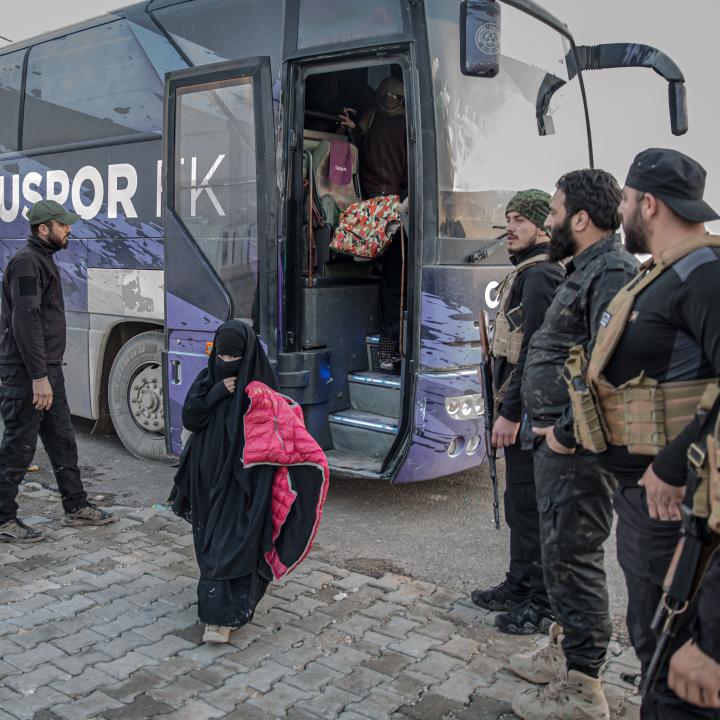
In January, facing further detainee breakouts following the Syrian government’s military campaign in the northeast, Baghdad asked Washington to facilitate the transfer of approximately 5,700 men to Iraq, reportedly including 3,497 Syrians, 470 Iraqis, 710 nationals from other Arab countries, and 980 other foreign nationals. These transfers highlighted official fears that Damascus could not manage this portfolio and might simply release potentially dangerous detainees, specifically Syrians.
Iraq’s Handling of the Issue
In January, Iraq’s National Center for International Judicial Cooperation (NCIJC), which leads the investigations, stated, “All suspects, regardless of their nationalities or ranks within the terrorist organization, are subject exclusively to the authority of the Iraqi judiciary, and our judicial procedures will be applied to them all without exception.” Prosecutions will rely on the government’s 2005 Anti-Terrorism Law No. 13 (which allows courts to sentence terrorist-affiliated suspects to death) as well as the amended Penal Code No. 111 (1969) and Code of Criminal Procedure No. 23 (1971). Notably, use of the death penalty conflicts with the laws of many detainees’ home countries.
Progress has been swift. In July, NCIJC officials stated that 85 percent of the investigations had been completed. In August, Damascus and Baghdad agreed to discuss the Syrian detainees despite their previous disputes over this issue. Iraq also announced that it was coordinating with sixty-one countries to reach repatriation agreements that would relieve pressure on its overburdened prison system, aligning with Washington’s goal of encouraging other governments to take responsibility for their citizens.
While Baghdad should be commended for its leadership role, scrutinizing the process is fair considering the country’s history. Its past mass trials of IS suspects, particularly from 2017 to 2019, drew criticism over hasty proceedings, accusations of coerced confessions, and the use of capital punishment. The latter concern persists today, along with questions about the legality of the detainee transfers and Iraq’s ability to absorb the caseload given its already strained prison system. The government also lacks legislation related to prosecuting “core international crimes” as defined by the International Criminal Court, namely, genocide, crimes against humanity, war crimes, and crimes of aggression. In other jurisdictions, combining these offenses with terrorism charges enables cumulative prosecution, providing a more holistic approach to addressing IS crimes.
Despite such concerns, investigations have continued and resulted in some releases. In March, NCIJC released two minors (from Finland and the United States) after finding no evidence of IS affiliation, and other cases involving minors have been identified. This month, Iraq announced that of the 3,497 Syrians transferred, it had found insufficient evidence to continue holding 457 and was preparing to return them home. Seven Iraqis were similarly released.
Other investigations involve individuals accused of committing IS crimes or holding high-profile roles in the organization, including leadership, security, religious, military, and media positions. Among them are individuals involved in financial, logistical, administrative, medical, technical, and other support activities. At least six cases are linked to the enslavement of Yazidi women.
Iraq has repeatedly engaged international actors on these types of investigations. Between 2017 and 2024, it worked with UNITAD, the United Nations team responsible for collecting and analyzing evidence on IS crimes committed in Iraq. Before the team’s closure in 2024, Baghdad asked it to share such evidence. More recently, Iraq signed a working agreement with the EU Agency for Criminal Justice Cooperation (EUROJUST) to exchange information on the investigation and prosecution of IS crimes. In one case, Iraqi authorities verified existing information and provided additional evidence to help with an IS trial in Slovenia, highlighting how its access to evidence will be critical to future IS prosecutions in Europe.
Policy Considerations
Washington has called IS-affiliated prisoners “the largest concentration of detained terrorists in the world” and made resolving their situation a priority across multiple administrations. With nationals from sixty-one states still detained, proper case resolution remains critical, in part to prevent battle-hardened IS ideologues from returning to the field. As the coalition military mission concludes and its political arm continues, Washington should use its influence with member states to advance this longstanding goal via the following steps:
Press for repatriation of detainees with “insufficient” IS links. The United States has long maintained that repatriation is the only sustainable solution, and although Iraq is now assuming responsibility for this process, it cannot resolve the problem alone—and should not try to do so. To support Baghdad’s efforts, Washington should continue pressing coalition partners to repatriate their citizens despite lingering reluctance. Case-by-case assessments are essential, and priority should go to those in which investigators have found insufficient grounds for continued detention, including minors, individuals accused of non-IS crimes, and individuals cleared of IS ties.
Pursue multilateral engagement on trials. Iraq’s declaration that all detainees, including foreign nationals, are subject to its judicial system has prompted mixed reactions abroad: some states want to repatriate their citizens, while others seek to leave responsibility with Baghdad. Last week, Iraq announced that foreign-national cases would be handled individually, including through bilateral agreements based on reciprocity. Such arrangements could allow individuals to face trial or serve sentences in their countries of origin while easing pressure on Iraq’s judicial and prison systems. For example, Turkey has begun repatriating citizens it was previously reluctant to take from SDF custody. Yet mechanisms are needed to ensure that states seriously investigate and prosecute repatriated individuals accused of IS affiliation.
As these discussions continue, the Global Coalition and other international organizations should support transparent discussions on trial procedures, prison conditions, and use of the death penalty for foreign nationals. States that prohibit capital punishment should be encouraged to allow their nationals to serve alternative sentences at home. For states seeking to prosecute nationals themselves, EUROJUST and/or other mechanisms can facilitate evidence sharing and help ensure fair trials. Moreover, U.S. partners like Germany and the Netherlands have previously taken the lead on accountability for IS-related war crimes, so they should be encouraged to help Iraq and other states strengthen their domestic laws enabling prosecution of core international crimes.
Leverage U.S. relationships with Damascus and Baghdad to strengthen cooperation. Coordination between these two partners is especially important given their shared experience with IS violence and the large number of Syrian detainees transferred to Iraq. Last month, they agreed to establish a committee to discuss these individuals, and Washington should use its relationships with both governments to support this process. Iraq’s decision to return 457 of the 3,497 Syrian detainees after finding insufficient evidence to hold them offers an early opportunity to build trust, and to address Syrian concerns that politically motivated detainees could face prosecution for IS crimes they did not commit. At the same time, Damascus must demonstrate through words and actions that it will seriously investigate and prosecute Syrian detainees accused of IS affiliation before additional returns proceed.
Establish a sustainable framework for the remaining detainees. The Pentagon’s Counter-IS Train and Equip Fund (CTEF) supported the original transfer of detainees from Syria, and this fund should continue offsetting some detention and trial costs under existing agreements with Iraq. But the burden should not be Washington’s alone. The United States should use the Global Coalition’s network of ninety countries to help Baghdad develop a viable long-term framework for the rest of the detainees, since the trial and repatriation processes could take years, and some countries may decide not to establish bilateral agreements with Iraq. This framework should include multiyear funding commitments from coalition partners, technical assistance, and evidence sharing.
Devorah Margolin is the Blumenstein-Rodan Senior Fellow at The Washington Institute and an adjunct professor with Georgetown University and Pepperdine University.