- Policy Analysis
- PolicyWatch 4197
Iraq Is at Another Crossroads with Iran-Backed Militias—and Washington
Although U.S. officials should keep pushing Baghdad to move against these groups, the Iran war has demonstrated the need to seek other avenues of pressure and recalibrate the bilateral relationship.
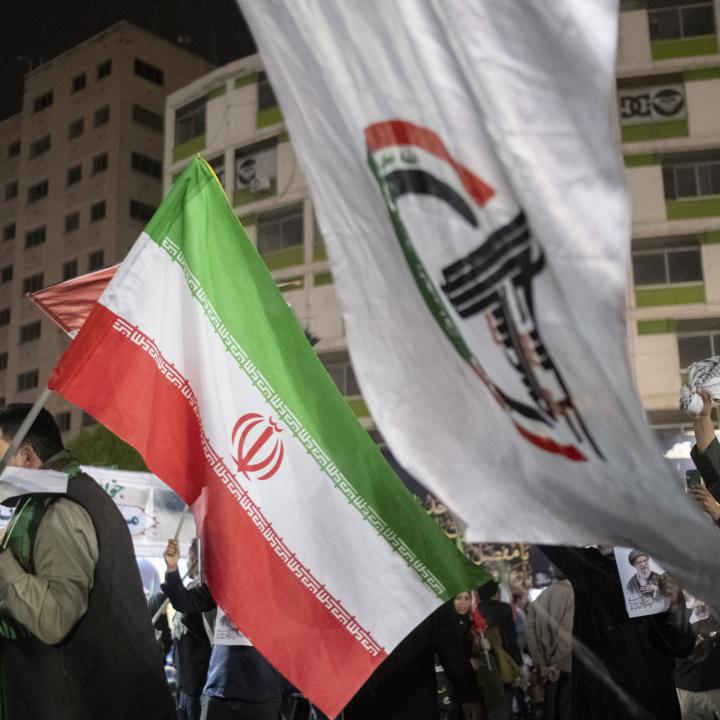
On March 28, Iran-backed militias in Iraq’s Popular Mobilization Forces launched a drone attack on the home of Kurdistan Regional Government (KRG) President Nechirvan Barzani in Dohuk, one of hundreds of strikes targeting Iraqi Kurds since the start of the Iran war. These militias have also joined their Iranian patrons in launching dozens of missile and drone salvos at other targets in Iraq, Jordan, Kuwait, and Syria over the past month, including U.S military and diplomatic facilities, energy infrastructure, and government security installations. Amid the fighting, Kataib Hezbollah (KH)—a leading U.S.-designated terrorist group that receives Iraqi government funding as part of the PMF—issued an ultimatum on March 18 demanding that the United States withdraw its personnel and shutter the embassy in Baghdad within five days, later extending this deadline as the regional crisis continued to develop.
In response, Baghdad has condemned the attacks on its territory but taken few if any discernible steps to prevent further violence or confront the perpetrators, most of whom share KH’s profile as U.S.-designated terrorist groups backed by Iran. As with Hezbollah in Lebanon, Tehran is leveraging its PMF proxies to drag Iraq into the war.
For its part, the United States has been conducting a concerted air campaign targeting PMF personnel and assets, and these strikes will continue for the foreseeable future. After the Iran war concludes, however, Washington will need to recalibrate its relationship with Baghdad to reflect the fact that Iraqi officials have accepted and even supported continued domination of the state by terrorist militias.
New Attacks, Familiar Pattern
Established in 2014 after the Islamic State (IS) routed the Iraqi army and occupied nearly a third of the country, PMF militias—most of them Shia groups—played an important role in regaining that territory alongside the U.S.-led coalition campaign. Yet once Baghdad declared victory against IS in 2017, it did not demobilize the PMF. Today, the militias total more than 238,000 fighters and command an annual government budget of $3.6 billion, divided among seventy-plus factions that include the prominent U.S.-designated terrorist groups Asaib Ahl al-Haq, Harakat Hezbollah al-Nujaba, and KH. Parties formed by these armed groups also sit in government with Iraq’s ruling Coordination Framework coalition.
Consistent with Iran’s position, the PMF has long opposed the U.S. military presence in Iraq, and in 2019—two years after American forces helped defeat IS—terrorist militias started attacking U.S. bases and diplomatic facilities. Washington repeatedly retaliated, hitting PMF bases and killing dozens of militiamen. Although U.S. strikes resulted in periods of quiet, the militias never fully abandoned their kinetic and political efforts to oust U.S. forces.
When Hamas attacked Israel in October 2023, militias launched new flurries of strikes in solidarity with their fellow Iranian proxy in Gaza. Months later, the Biden administration reached an agreement with Baghdad to withdraw the residual U.S. military force originally deployed as part of the anti-IS coalition, with the aim of transitioning to a bilateral contingent by the end of 2026.
PMF attacks on U.S. interests largely abated between 2024 and 2026, but the Iran war precipitated around 300 such incidents, including kamikaze drone and rocket launches against the U.S. embassy, the Baghdad Diplomatic Support Center, and the U.S. consulate in Erbil. So far, U.S. forces have successfully parried many of these attacks with counter-rocket, artillery, and mortar (C-RAM) systems and other assets.
The KRG has taken even heavier fire during the war, suffering more than 500 drone and missile attacks launched by Iran and its Iraqi proxies, some aimed at U.S. facilities, civilian areas, and Kurdish Peshmerga bases. Late last month, for example, an Iranian ballistic missile strike killed six Peshmerga soldiers. In all, attacks in the KRG have killed about ten civilians and wounded nearly five dozen others. Militias have also repeatedly hit the Lanaz oil refinery near Erbil and the Khor Mor natural gas field, interrupting production and causing power blackouts.
The rest of Iraq has not been spared either. On March 16, PMF factions launched explosive-laden drones at the Rashid Hotel in Baghdad, home to six diplomatic missions. Days later, a militia drone strike hit the Iraqi National Intelligence Service headquarters, killing one officer. A KH spokesman justified this attack on his own government by accusing agency officials of treason: “We have information that 100 percent of the Kurdish officers [at INSS]...are linked to [Israel’s] Mossad and the Americans.”
While America Strikes, Baghdad Defers
The Trump administration has answered the eruption of PMF attacks with airstrikes. U.S. operations have attrited key PMF personnel, including the KH military spokesman, the Anbar sector commander, and two Iranian advisors to the militias. American forces also reportedly targeted PMF chair Faleh al-Fayyad at his Mosul residence, though the strike was unsuccessful.
More than a month into the fighting, however, Baghdad has yet to take concrete steps to stem the aggression. On one hand, this inaction may seem understandable because PMF factions have a history of targeting Iraqi government leaders. When asked in a March 22 interview whether Baghdad could control these groups, Foreign Minister Fuad Hussein answered, “I don’t believe so...If it becomes a matter of control leading to conflict, I don’t know who holds the balance of military power—the government or [the PMF].”
On the other hand, the caretaker administration led by Mohammad Shia al-Sudani is demonstrating inordinate deference to these groups amid the predictably protracted government formation process that has followed last November’s parliamentary election. After a U.S. strike on a joint PMF-Iraqi military base killed multiple militia personnel, the prime minister reportedly summoned embassy official Joshua Harris to express his dismay. During a subsequent meeting of the national security cabinet—chaired by Sudani and staffed by Shia officials affiliated with the PMF—the militias were authorized to defend themselves against U.S. attacks.
Policy Recommendations
Iraq faced enormous challenges well before the war, and things are worse now. In addition to the stalled government formation process, oil production has been suspended due to the Iran crisis—a major problem in a country where oil sales account for 90 percent of government revenues and 62 percent of the population is employed in the public sector. Previously, more than a year of relative quiet had resulted in some preliminary progress toward attracting foreign direct investment, but Iraq is now being dragged into a war that will likely stymie any further efforts on that front.
Last year, the Trump administration repeatedly pressed Baghdad to disarm Iran-backed militias, and this consistent focus helped normalize discussion of disarmament among Iraqi citizens and officials alike. Yet Sudani’s government did not budge. Ironically, Baghdad has long deferred action against these groups in part because it worries about sparking wider violence, yet the result has been growing militia violence against any Iraqis who oppose their agenda. Increasingly, Iraq resembles Lebanon; if Baghdad does not act soon, Iraq, too, will become a failed state.
While the latest demonstration of Tehran’s dominance over Iraq—and Baghdad’s complicity—might tempt the Trump administration to finally quit the country altogether, that would be ill advised. Instead, Washington should push even harder for Iraqi officials to move against these militias, while also seeking other avenues of pressure in the likely event that Baghdad keeps deferring the issue:
- Target Baghdad’s direct funding for militias. By this point, the PMF is too large and too influential to fully disband, so the U.S. goal should be for Baghdad to excise the most problematic groups. The Trump administration can facilitate this effort by sanctioning all Iraqi government officials who approve or enable the funding of U.S.-designated terrorist organizations like Asaib Ahl al-Haq, Harakat Hezbollah al-Nujaba, KH, and others.
- End indirect funding for militias. In October, the U.S. Treasury Department designated the Muhandis General Company, a major Iraqi commercial entity controlled by the PMF. Yet the Iraqi government is widely believed to still be subcontracting projects to this conglomerate’s alias groups, thereby channeling substantial funding to the PMF. If Baghdad is flaunting U.S. sanctions or just not performing due diligence, Washington should hold it accountable.
- Reassess security assistance. The United States provides Iraq with significant security assistance, including more than $200 million in counterterrorism aid for 2026. Yet instead of using these funds to constrain Iran-backed terrorist organizations, Baghdad has given them exponentially more than this amount from Iraq’s own coffers and required national army units to share bases with them. The government has done much to fight Sunni terrorist groups like IS, but it must now step up against Shia terrorist groups as well—otherwise, U.S. security assistance should be curtailed or ended entirely.
- Seek Arab assistance. Although Baghdad has sought better relations with Arab countries in recent years, PMF units have targeted at least three of them during this war, in some cases launching attacks from lands granted to certain militias by the government. Accordingly, Washington should press Arab states, particularly in the Gulf region, to withhold aid and foreign direct investment from Iraq until the government ends its support for these groups.
David Schenker is the Taube Senior Fellow at The Washington Institute and director of its Rubin Program on Arab Politics.