- Policy Analysis
- PolicyWatch 4153
Iran at a Watershed Moment? The Case for Meaningful U.S. Action
Acting now offers the best chance to halt atrocities and shape a peaceful transition, while waiting would only ensure that the next phase of the crisis is bloodier for Iranians, more dangerous for the region, and more difficult to influence.
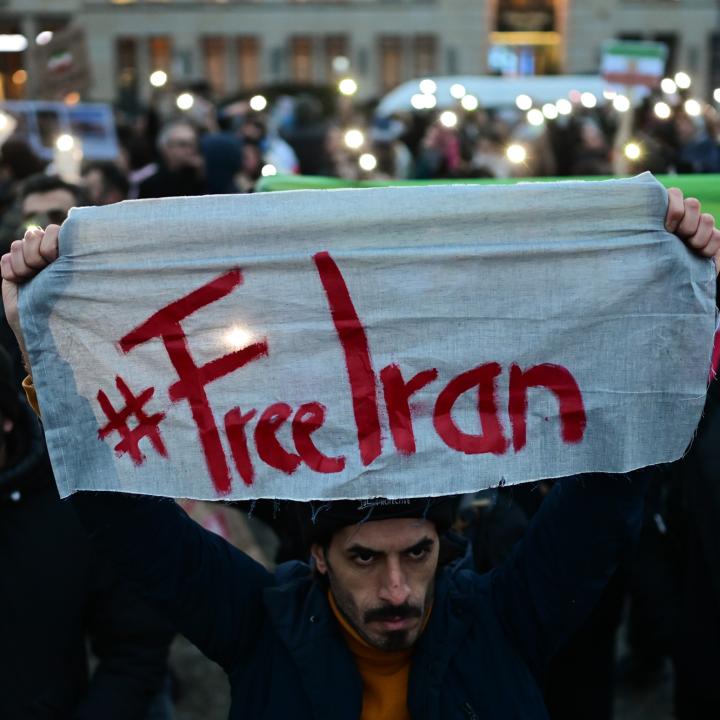
Iran is entering a decisive moment in which long-accumulating economic and political failures, chronic corruption, and a vulnerable internal security posture are converging with sustained public unrest and demand for drastic change. This convergence is not cyclical or temporary; it reflects a structural crisis that exposes the limits of repression as a governing strategy. The Islamic Republic now faces a narrowing set of options, all of them costly, and none likely capable of restoring durable stability.
For the United States, the issue is no longer whether Iran is unstable; it is whether the Trump administration will act in time to steer that instability away from mass killing and toward a peaceful political transition aligned with U.S. interests, regional security, and basic human dignity. Washington has both a strategic interest and the operational tools to act now, particularly in the realms of military deterrence, compellence, information access, and conditional engagement.
Not Just Bad Economics: A Perfect Storm of Mismanagement
The currency collapse that preceded the protests was merely the straw that broke the camel’s back. Iranians have suffered such extensive economic blows over the past year that their anger will likely continue generating periodic protests even if the current round is squelched:
- Last November, President Masoud Pezeshkian warned that the entire capital might have to be evacuated due to acute water shortages. After years of excessive consumption and dam construction, the country was thrown into crisis when the latest cycle of periodic droughts hit.
- For months now, electricity has been cut off for hours at a time, sometimes with no warning.
- Natural gas shortages—a major problem for electricity generation—have forced authorities to close industrial plants powered by gas and cut the wages of factory workers. With power stations burning heavy fuel oil in place of gas, urban pollution has become so bad that many schools have been forced to close for more than fifty days a year.
Although international sanctions and confrontations with the United States and Israel have weakened the regime in various ways over the years, last year’s uptick in external pressure was not the proximal trigger for the above domestic problems or the protests they have spurred. Put another way, as long as Iran’s regime-dominated business environment remains deeply corrupt and foreigners remain subject to arbitrary arrest, external measures alone—such as lifting sanctions—will never convince outside investors to provide the funds needed for fixing the electricity, water, and gas sectors.
The fiscal 2026/27 budget that Pezeshkian proposed last month only rubbed salt into the public’s wounds. After three years of limited salary increases, it called for adjustments that, by March 2027, would leave most workers’ incomes at less than half what they were in real terms in March 2023—and this came after the measure was modified to lessen the blow. Similarly, fears of renewed protests led the president to change the price of unrationed gasoline again, but it still costs less than 5 percent of the prices seen in neighboring countries—a practice that has led to so much smuggling and overconsumption that Iran now spends $6 billion per year on gasoline imports. Obviously, that money could do much to improve the dire electricity and water situations instead. Likewise, the government’s proposals for exchange rate reform are no more credible than past initiatives, all of which retained special rates benefiting the politically well-connected while shortchanging the fund that was supposed to compensate ordinary Iranians for the higher cost of essential goods.
It is no wonder, then, that the current wave of protests center on ousting the entire governing system rather than individual issues like fixing the exchange rate. A regime unable to provide water, power, clean air, fuel, or credible wages cannot plausibly claim competence, much less legitimacy. When subsistence collapses, coercion becomes the regime’s primary remaining instrument. Yet Iran’s leaders now face a reality they had long sought to defer: repression no longer appears capable of restoring stability. This problem will persist even if the current protests are contained.
A Military and Internal Security Watershed?
The internal security system—anchored in the Islamic Revolutionary Guard Corps (IRGC), Basij units, the six-brigade Special Guard Unit (part of the Police Command of the Islamic Republic of Iran, or FARAJA), and, when necessary, regime-backed Hashd al-Shabi militias from neighboring Iraq—remains powerful, but it is overstretched, politically exposed, and increasingly deployed against a society that no longer fears incremental escalation. So far, major cracks have not been evident within the coercive apparatus—higher-tier IRGC and Basij operatives showed no hesitation in shooting to kill after Supreme Leader Ali Khamenei ordered a swift crackdown last week.
Yet the severity of the crackdown itself may be an indicator of vulnerability. At one point, at least, the escalating protests seemed close enough to overwhelming the system that the regime felt compelled to use mass-casualty tactics, whose death toll is still being assessed but may be in the thousands already. It also activated a simultaneous nationwide telecommunications shutdown for the first time in its history, and the blackout more or less continues as of this writing, targeting internet service, cell phones, and even landline phones. Smaller-scale use of such techniques enabled the regime to survive previous crises, and the tactic may prove effective again today. Yet each instance has deepened the public’s alienation from and anger toward the leadership.
Indeed, authoritarian systems historically reach moments when violence ceases to function as a tool of control and instead becomes an accelerant of decay. Iran appears to be heading toward that threshold. The degree to which the regime is relying on mass blackouts, mass arrests, and lethal force against unarmed demonstrators reflects not strength and confidence but strategic anxiety. (Notably, the counter-demonstration that the regime recently organized in Tehran shows it is still trying to win the narrative battle)
Iran’s “external” military capabilities—e.g., missiles, drones, and proxy forces—do not offset this internal fragility. Whatever value they may have in deterring actors like the United States and Israel, they cannot restore domestic legitimacy or reverse economic collapse. Nor do they protect the regime from elite fragmentation or social exhaustion. Unfortunately, the regime seems to be finding uses for some of these capabilities (e.g., surveillance drones) as tools of domestic repression, and it could put more innocent lives at risk by employing them in lethal ways (e.g., attacking civilians with explosive drones and foreign militia forces).
Why Acting Now Serves Core U.S. Interests
For the United States, passivity carries growing costs. An economically failing regime and morally bankrupt leadership that survive through massacring their own citizens could emerge more vengeful and radicalized on the international scene, more dependent on coercion, and more inclined toward external aggression as a substitute for legitimacy. Conversely, early, meaningful, and measured U.S. signaling or other actions could constrain regime behavior, limit further bloodshed and persecution, and empower Iranian society to determine its own political future.
In the immediate term, Washington should take the following steps in coordination with its partners:
- Disrupt the regime’s domestic suppression network by aggressively employing cyber and electronic warfare to degrade regime command, control, communications, and surveillance assets used for repression. Much of this apparatus has become operationally centralized and dependent on data networks that are inherently vulnerable to disruption.
- Restore unfettered internet access for Iranians as a humanitarian priority, since reliable information access is central to preventing atrocities, documenting abuses, and sustaining nonviolent grassroots movements. This effort could be carried out on two fronts: (1) working in coordination with the American tech industry to provide and enable alternative connectivity and circumvention tools, and (2) using coercive electronic and cyber measures to compel the regime to lift its blackouts. At the same time, given that the regime has not blocked satellite television transmissions from abroad, Washington should help U.S.-funded broadcasters access whatever facilities would help them get information to the Iranian people.
- Establish a credible coercive airpower threat and prepare contingency options to prevent further atrocities. This should include reestablishing air supremacy and maintaining constant mid- to low-altitude intelligence, surveillance, and reconnaissance (ISR) over parts of Iran where mass killings continue, as well as over the western border to prevent Iraqi Shia militias from entering Iran and assisting the IRGC with crackdowns. Localized no-fly zones and even no-drive zones could help prevent the regime from moving assets or committing atrocities. They could also be tailored to prevent similar use of civilian aircraft, while more extreme measures could be considered if the regime persists in ignoring warnings (e.g., cratering relevant runways and roads or otherwise incapacitating airports). Whatever tactics are employed, the credible prospect of air supremacy over all or part of Iran—used selectively, conditionally, and with explicit links to civilian protection objectives—can serve as a powerful instrument of compellence without resort to ground conflict.
- Rapidly surge U.S. and allied air, missile defense, and strike assets into the region for deterrence purposes. This would signal readiness to protect U.S. forces and allies if the regime grows more aggressive in the region; it would also show Tehran that further atrocities against the Iranian people will carry immediate costs to the military and security establishment.
- Tie any U.S. diplomatic engagement with Tehran to verifiable cessation of mass violence, persecution of protesters, and other breaches of international law. If the situation escalates and regime collapse seems imminent, Washington should demand that Tehran commit to a peaceful political transition with the goal of establishing a true democracy in which Iranians can choose their own future. Engagement without such conditions would allow the regime to easily reverse any agreement when it feels strong enough.
- Warn Iran that the United States will maintain escalation dominance for the duration of the crisis if President Trump decides to intervene militarily. That is, if Iran retaliates against American strikes by, for example, attacking Israel, then U.S. and Israeli assets will respond even more heavily, coordinating their intelligence and operations to destroy additional regime targets like security headquarters and surveillance centers.
- Embark on stricter actions against entities that buy Iranian oil or do business with Iran. The 25 percent tariff that President Trump announced on January 12 is a good example if it can be implemented effectively. At a time when oil prices are likely to remain low, this could make life more difficult for the regime.
Farzin Nadimi is a senior fellow at The Washington Institute, specializing in the security and defense affairs of Iran and the Persian Gulf region. Patrick Clawson is the Institute’s Morningstar Senior Fellow and director of its Viterbi Program on Iran and U.S. Policy.