- Policy Analysis
- PolicyWatch 4168
Establishing the Security Conditions for Further Progress in Gaza
The security situation in the Gaza Strip is still tense after completing the first stage of President Trump’s peace plan, raising questions about how the parties will overcome the challenges of enforcing the ceasefire, disarming Hamas, transferring power, and launching reconstruction.
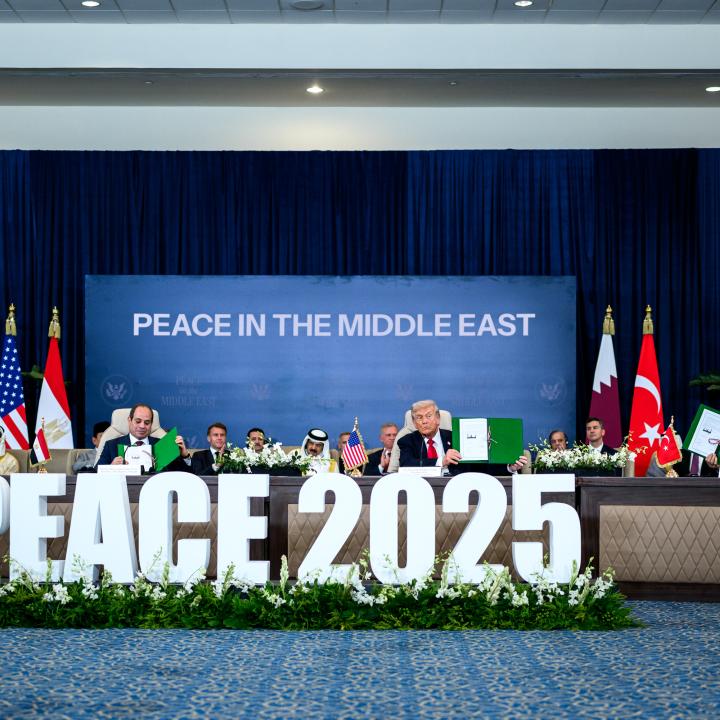
In recent weeks, several factors have created momentum—or at least the perception of momentum—on stabilizing the ceasefire in Gaza and initiating reconstruction. One is the completion of phase 1 of President Trump’s twenty-point peace plan; others include U.S. envoy Steve Witkoff’s statement on the transition to phase 2 and the announcement at last month’s World Economic Forum in Davos that governance mechanisms have been established for Gaza.
Yet the security situation remains tense, with four Israelis and nearly five hundred Palestinians killed since the ceasefire was reached in October. In addition, a wide gap persists between the Trump administration’s outlook (optimistic declarations, ambitious development plans) and the reality on the ground (extensive destruction, ongoing tensions).
At the heart of the many challenges that need to be met in phase 2 is uncertainty regarding the security situation—particularly the likelihood of fully implementing the commitment to demilitarize Gaza, which includes disarming Hamas. This issue is the primary threat to the stabilization process. It is also the reason for the significant delay in establishing the International Stabilization Force (ISF) and the Palestinian internal security force that are supposed to assume responsibility for such matters. A number of other issues related to implementation are likewise unresolved, including the funding and staffing of Palestinian governance mechanisms and the framework for transferring local authority from Hamas to these bodies.
Both Sides Want to Maintain the Ceasefire...
The progress achieved thus far in implementing Trump’s twenty-point plan—such as the return of all hostages, the Israeli military withdrawal to the “Yellow Line” demarcated by the ceasefire, and the reopening of the Rafah crossing—is largely a result of strong personal and political commitments from the president and his advisors. It is also a function of the shared Israeli and Hamas assessment that their current interests lie in maintaining the ceasefire rather than returning to war. Both seek to avoid confrontation with the United States, and they recognize that most regional actors are similarly interested in ending the war.
For Hamas, the Trump plan offers several possible benefits: personal and organizational survival; preservation of at least indirect influence in Gaza’s new governing system; potential gains from the reconstruction process; and international and domestic legitimacy from contributing to the plan’s success. For Israel, the ceasefire provides an opportunity to halt the erosion of its international image; improve its damaged regional relations; create breathing room for economic and military recovery; redirect attention and resources to threats in Iran, Lebanon, and Syria; and reduce domestic friction ahead of an election year.
...But Demilitarization Disputes and Other Obstacles Loom
Despite each side’s desire to press on with the Trump plan, progress in phase 2 may be halted by a range of disagreements between Israelis and Palestinians, and even among Palestinians. These include operating procedures and arrangements for the movement of people and goods at the Rafah crossing; the powers of the new National Committee for the Administration of Gaza (NCAG) in areas under Israeli control; the status of clan-based militias operating under Israeli auspices; the Palestinian Authority’s formal status in Gaza; and the preservation of a horizon for a future Palestinian state.
Above all, however, the durability of the process will depend on bridging the gap between Israel’s security demands and Hamas’s willingness to comply with them. Israel is expected to demand a supervised and verified process for dismantling the Hamas military infrastructure, initially focusing on tunnels, weapons production facilities, and heavy military equipment such as rockets, antitank missiles, and drones.
This would be followed by Hamas gradually relinquishing personal weapons, which various sources estimate to number in the tens of thousands. Yet the group will largely oppose this demand because it views personal weapons as (1) part of its right to resist the “occupation” until a Palestinian state is established, (2) a means of protecting its members from Israel or other actors in Gaza, and (3) a prerequisite for consolidating its position within the Palestinian political system.
Even if both sides ultimately reach an agreed formula on the disarmament issue—such as a transparent process for transferring weapons to a third party that would secure them under monitored conditions—they would likely do so more out of fear of losing the “blame game” with the United States and regional actors than out of genuine confidence in the viability of the process. It should also be noted that in return for handing over (or even just agreeing to hand over) its weapons, Hamas may demand recognition as a political party eligible to participate in Palestinian elections, which would grant it legitimacy and create a potential long‑term pathway for gaining control over the wider Palestinian political system.
The two sides also have substantive differences over how the pace of demilitarization should relate to the pace of reconstruction. These differences extend to the timing of Israel’s withdrawal from the Yellow Line (which encompasses around half of Gaza) to a future security perimeter (which has not yet been defined and could extend up to a kilometer into Gaza). Hamas, and Palestinians more broadly, will likely demand that substantial reconstruction projects begin quickly, and that movement restrictions be eased between the “red zone” (i.e., areas from which Israeli forces have withdrawn and where the vast majority of Gazans reside) and the “green zone” (areas still under Israeli control). In contrast, Israel prefers to keep the initial focus on rehabilitating essential systems such as education, health, electricity, and water. It is also likely to agree to reconstruction projects only in delineated areas that have been cleared of military infrastructure and terrorist presence, and where effective mechanisms have been set up to prevent the entry of hostile elements. In practice, this probably means just the Rafah area at first.
Phase 2 may be threatened by developments outside Gaza as well, such as casualty incidents in the West Bank or Jerusalem (particularly during the upcoming Ramadan season). In light of Israel’s upcoming elections, one can expect internal pressures to resume military operations in Gaza, or demands that Jerusalem withhold cooperation from the NCAG—especially after the committee revealed a new emblem that looks similar to PA emblems, implying a connection that has led to harsh criticism from the Israeli right. Furthermore, Iran and its “axis of resistance” might pressure Hamas to join another regional cycle of retaliation against Israel in response to the possibility of new military strikes against the Islamic Republic.
Conclusion
To allay these formidable challenges, Washington, Israel, and their partners will need to devise ways of maintaining continuous progress along three parallel tracks, even if this progress is necessarily slow at times:
- The political track. This track will center on enabling the NCAG to enter Gaza, completing the transfer of governing powers from Hamas to the new committee, and ensuring that the NCAG demonstrates it can govern effectively. In the near to medium term, simply enabling all NCAG members to enter the red zone and staff their ministries with appropriate personnel would be welcome progress. An even better outcome would be the NCAG initiating the operation of essential services in the red zone with international and regional assistance, including health, water, electricity, and education up to high school.
- The security track. This track should center on three goals: sustaining relative calm, achieving significant progress toward phased demilitarization, and enabling residents of Israeli border communities to return home. Specific objectives for the near to medium term should include final decisions about the ISF’s size, deployment timeline, and participating countries; the destruction of tunnels and weapon production sites in the red zone; the handover or destruction of Hamas heavy weaponry in at least one area of Gaza; and a halt to Hamas operatives appearing in public with their weapons.
- The economic/civil track. This track will require continuous, measurable improvements in Gaza's living conditions. Specific achievements in the near to medium term should include keeping the Rafah crossing open with significant traffic in both directions (i.e., at least several hundred people a day); the start of reconstruction and development work for at least one new neighborhood in the Rafah area; the availability of basic goods in local markets; and public opinion surveys indicating a relative improvement in residents’ satisfaction with local conditions.
In the final analysis, Israelis and Palestinians—particularly Hamas—will need to demonstrate determination and good faith in fulfilling their commitments, alongside restraint in their rhetoric and conduct on the ground. Furthermore, international actors led by the United States, as well as key regional actors like Egypt, the Gulf states, and Turkey, will be judged on several criteria: their ability to sustain meaningful political engagement; their capacity to mobilize significant economic resources to advance the transition process; and their ability to build a coordinated system of incentives and pressures that reduces each side’s capacity and motivation to deviate from agreements or seek exit ramps. Only a joint effort by all actors will give phase 2 a chance to succeed.
Neomi Neumann is an adjunct fellow with The Washington Institute, focusing on Palestinian affairs. Her previous positions include head of the research unit at the Israel Security Agency.