Pierre-Arnaud Blanchard is a visiting fellow at The Washington Institute in residence from the French Ministry for Europe and Foreign Affairs.
Brief Analysis
Because both U.S. plans in Gaza and the stability of the West Bank depend on a legitimate, reformed Palestinian Authority and a credible alternative to Hamas governance, national elections are essential—leaving the international community with little choice but to redouble its efforts and prepare for the rescheduled vote in 2027.
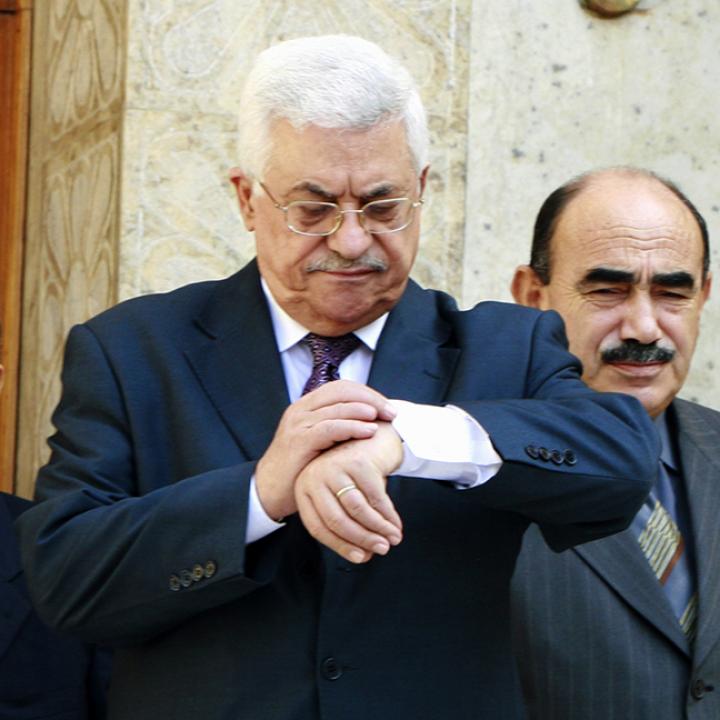
On October 8, Palestinian Authority Vice President Hussein al-Sheikh sent a letter to French Foreign Minister Jean-Noel Barrot stating that the Palestinian Legislative Council election scheduled for November 28 would be postponed, invoking “fundamental obstacles” imposed by Israeli authorities. First announced in July by President Mahmoud Abbas, the planned election was largely a result of steady pressure from several Western countries following last year’s recognition of the state of Palestine by France and others.
In recent weeks, warning signs pointing to a cancellation had mounted, prompting a last-ditch effort by EU High Representative Kaja Kallas to save the process via a phone call with Vice President Sheikh, during which she emphasized that elections are “long overdue” after twenty years. The postponement triggered harsh criticism from Australia, Canada, France, and the United Kingdom, who issued a joint statement emphasizing that “this delay will be deeply disappointing and once again deprive Palestinians of the opportunity to vote and will further erode public confidence in democratic institutions.” Their reaction was particularly bitter because prior to their 2025 recognition of Palestine, they had received written commitments from President Abbas on holding national elections.
The PA is now pledging that the parliamentary vote will be held in September 2027, and that it will coincide with a presidential election. Yet the postponement will carry difficult consequences for the Palestinian leadership, which already suffers from weak legitimacy at home and abroad.
A Repeat of 2021?
In recent days, Palestinian officials have emphasized the exceptional challenges hindering any attempt to hold an election in the current climate, including lack of access to Gaza, a PA budget revenue crisis, and escalating violence by extremist Israeli settlers in the West Bank. In particular, some officials have lamented the lack of active American support for this process.
Although skepticism remained high throughout the summer, the Palestinian Central Elections Commission (CEC)—a Ramallah-based body widely recognized for its competence and experience—repeatedly reassured observers that it would be capable of organizing the vote, including in Gaza, where 40 percent of the Palestinian population lives. The challenges were considerable and should not be underestimated, but the signs of progress were significant as well:
In the West Bank, the CEC organized local elections in April without major technical difficulties, despite facing serious budgetary issues due to the PA’s fiscal crisis.
In Gaza, the CEC successfully organized local elections in Deir al-Balah in April. Compared to a municipal election in a single locality, enabling 1.2 million Gazans to vote in a national election presents a far greater challenge given the displaced status of most of the population, the territory’s ongoing access restrictions, and the lack of a voter registry or voting infrastructure. Yet the CEC indicated that it was working on concrete solutions with local providers, backed by on-the-ground support from the UN.
In East Jerusalem, the PA had decided to avoid the diplomatic obstacle that reared its head in the 2021 election cycle, since the Israeli government would have opposed any form of vote there. Instead, the PA planned to limit the ballot to Jerusalem residents in adjacent municipalities such as Kafr Aqab and Abu Dis.
Why was this progress insufficient to keep the election on schedule? For one thing, few countries were pushing for this vote, diluting the concerted diplomatic action needed to overcome the known obstacles. But a more important problem was the fundamental lack of political will among the leadership of Fatah and the Palestine Liberation Organization (PLO), who feared a near-certain defeat. With the deadline for submitting candidates just days away, none of the major political factions—most notably Fatah—had submitted a list. As long as Fatah remains weak, divided, and seemingly unwilling to reconcile with prominent dissidents (e.g., Mohammad Dahlan and Nasser al-Qudwa), it will continue to dread electoral competition.
In many ways, the current situation mirrors that of 2021, when Abbas called off a parliamentary contest at the last minute despite strong European support for the process. Then, too, he feared that a fractured Fatah would lose badly, but his decision wound up widening the rift between the Palestinian people and their leaders, accelerating the decay of the PA’s legitimacy, and accentuating its authoritarian turn.
The French Perspective: A Missed Opportunity
In the current climate—characterized by political apathy in the Palestinian territories, the deterioration of PA institutions, protracted conflict in Gaza, and intensifying settlement expansion in the West Bank—French officials believe that a national election could spark positive political momentum. This belief is founded on several longstanding principles.
First, France and other countries view elections as a key element of any comprehensive initiative to find a credible political path out of the Israeli-Palestinian conflict and support the two-state solution. Last year, the “New York Declaration”—spearheaded by France and Saudi Arabia and endorsed by 142 states—called for general and presidential elections for two reasons: “enabling democratic competition between Palestinian actors committed to respect the PLO political platform,” and “allowing for a new generation of elected representatives to take responsibility.” Foreign Minister Barrot recently reiterated these points in the Wall Street Journal, writing, “Only a rejuvenated Palestinian Authority can represent the Palestinian people on the world stage and negotiate a lasting peace with Israel.”
Second, the French government insists that national elections are essential to preserve hope among the Palestinian population—in particular the “post-Oslo” generation—and avoid wider outbreaks of violence at a time when public distrust of the PA has reached unprecedented levels. According to the CEC, nearly 3 million Palestinians would have been eligible to vote in this election, including 1.6 million in the West Bank, 1.2 million in Gaza, and 140,000 in Jerusalem. And given that twenty years have passed since the previous parliamentary contest in 2006, more than 50 percent of the current electorate has never had the opportunity to participate in a national vote.
Third, Paris believes that elections are needed to open a new chapter in Palestinian political life after the terrorist massacres of October 7, 2023. The goal is to pave the way for governance that is free from Hamas control in conjunction with efforts to disarm the group. Hamas’s victory in the 2006 election plunged the territories into a deep political crisis, but many important lessons have been learned to prevent a recurrence of that scenario. For the first time, candidates from Hamas, Palestinian Islamic Jihad, and other terrorist factions would have been legally barred from running for seats following the electoral law reform enacted by Abbas this June. Delivering on Abbas’s commitment to French President Emmanuel Macron and Saudi Crown Prince Mohammed bin Salman, this reform introduced a clause requiring candidates to subscribe to the “political and national platform” of the PLO and “relevant international resolutions.” In practice, this would mean recognizing the state of Israel in its 1967 borders, renouncing political violence, and accepting previous PLO agreements and obligations. These requirements mirror the “Quartet Principles” set out in 2006, which led to the international boycott of the Hamas-led government.
Criticizing such requirements as “undemocratic” and “authoritarian,” Hamas boycotted the local elections held in Aprilunder a similar legislative framework. For the planned parliamentary election, the group would not have been able to participate directly. Instead, it tried to form a coalition with other actors (e.g., Fatah dissidents such as Dahlan) and nominate academics, technocrats, and businessmen. In short, contrary to 2021 (when current Hamas chairman Khalil al-Hayya was heading the list) and 2006 (when the group won the ballot), no Hamas official would have been a candidate this November. (The risk of potential Hamas interference in a vote is a separate question, see below.)
Given these restrictions, and combined with ongoing diplomatic efforts to disarm Hamas and establish alternative governance, elections should be viewed as another opportunity for marginalizing the group at a time when its popularity is rapidly declining. According to recent polls by the Palestinian Center for Policy and Survey Research (mid-October), the Jerusalem Media and Communications Centre/Friedrich-Ebert-Stiftung (August), and the Institute for National Security Studies (July), Palestinian respondents expressed low and declining trust in Hamas, while support was rising for independent figures, the two-state solution, and peaceful negotiations.
Finally, elections are essential for preparing an orderly post-Abbas transition and avoiding potential chaos. Elected in 2005 for a term that was supposed to end in 2009, Abbas is now one of the oldest leaders in the world. Succession plans remain unclear, jumbled by rival figures, an ambiguous legal framework, and the gradual rise of the president’s son Yasser Abbas. Parliamentary and presidential elections would create a clear institutional mechanism to prepare for the “day after.”
The Road to 2027 Elections: Complex, But Not Impossible
With a new date—September 11, 2027—announced for combined parliamentary and presidential elections, the international community must redouble its efforts to prepare for a legitimate vote and ensure it actually takes place. Although major skepticism persists, any further postponement would lead the PA into a disastrous political impasse, since the presidency is now also at stake. Intensive diplomatic efforts will be required to:
Structure a dialogue with stakeholders in the EU, the United States, the Board of Peace, and key Arab states to work on a joint reform agenda for the PA,including national elections. In addition to helping the fragile PA simply survive for another year, the goal should be to reform the institution and strengthen its capacity to administer postwar Gaza and manage reconstruction, in line with President Trump’s twenty-point plan. National elections should be regarded as a necessary tool for boosting the PA’s legitimacy and, consequently, its ability to return to Gaza and offer a credible alternative to Hamas governance.
Engage the next Israeli government on Palestinian elections. This topic could be an easy way to restore confidence and dialogue with European capitals after Israel’s October 27 election, as part of a broader dialogue on stabilizing the West Bank and Gaza.
Synchronize electoral preparations with the disarmament process, in part to address the risk that Hamas or other factions could attempt to disrupt or rig the vote. The new calendar provides an opportunity to integrate electoral issues with the disarmament process. This includes a potential role for the future Palestinian police force (to be overseen by the National Committee for the Administration of Gaza) and the International Stabilization Force in securing polling stations, with help from an international electoral observation mission.
Work with regional partners—particularly Egypt, Jordan, Saudi Arabia, and the United Arab Emirates—to actively support dialogue and reconciliation between moderate Palestinian factions, meaning thosewho support a peaceful political process and a two-state solution with Israel. These partners can also help the EU push the PA to prioritize reforms that address major popular grievances (e.g., bad governance, lack of transparency).
Marshal international partners to work together on technical solutions for organizing a credible ballot throughout the Palestinian territories. This includes intensive support from the International Gaza Support Center and the Israeli Defense Ministry’s Coordinator of Government Activities in the Territories (COGAT) to facilitate the entry of essential electoral materials (e.g., ballot ink, IT equipment) into Gaza, and to ensure calm during the vote.
Prepare to deploy a robust EU-led observation mission to monitor the elections in Gaza and the West Bank and ensure the integrity of the vote. As part of this process, international budgetary support should be provided to the PA’s Central Elections Commission.
Pierre-Arnaud Blanchard is a visiting fellow at The Washington Institute in residence from the French Ministry for Europe and Foreign Affairs.