- Policy Analysis
- PolicyWatch 4263
Settlements Trade Ban: Europe and Israel on a Collision Course Over the West Bank
Although the unprecedented decision to jointly prohibit trade with settlements raises difficult diplomatic and political questions amid a weighty Israeli election cycle, the announcement will also have important effects beyond that date, signaling that many countries will prioritize this issue in their relations with whatever government voters choose.
On September 8, the United Kingdom, Canada, and France sponsored a joint statement announcing their willingness to ban the trade of goods from Israeli settlements in the West Bank, co-signed by Denmark, Finland, Iceland, Ireland, Norway, Poland, Portugal, Spain, and Sweden. This move was supported by a separate statement from London, Ottawa, and Paris emphasizing that “the time has come to take further action to uphold our commitment to protect the two-state solution, our interests and to stand up for our values, before it is too late.”
These developments signal a significant policy shift, since they mark the first time that members of the G7 have announced such a ban. For decades, European countries had avoided a blanket prohibition on trade with Israeli settlements, instead issuing targeted measures such as denying preferential tariffs for goods originating from settlements or labeling them with a special tag.
In Israel, the announcements created diplomatic havoc, spurring a strong rebuke from officials and the broader public, particularly against the UK. The timing of the statements was met with harsh criticism as well given Israel’s imminent election. Why did these governments take this landmark step, and why now? More important, what implications might it hold for Israel’s policy in the West Bank, its relations with Europe, and the future of two-state diplomacy?
Diplomatic Confrontation Over the E1 Bloc
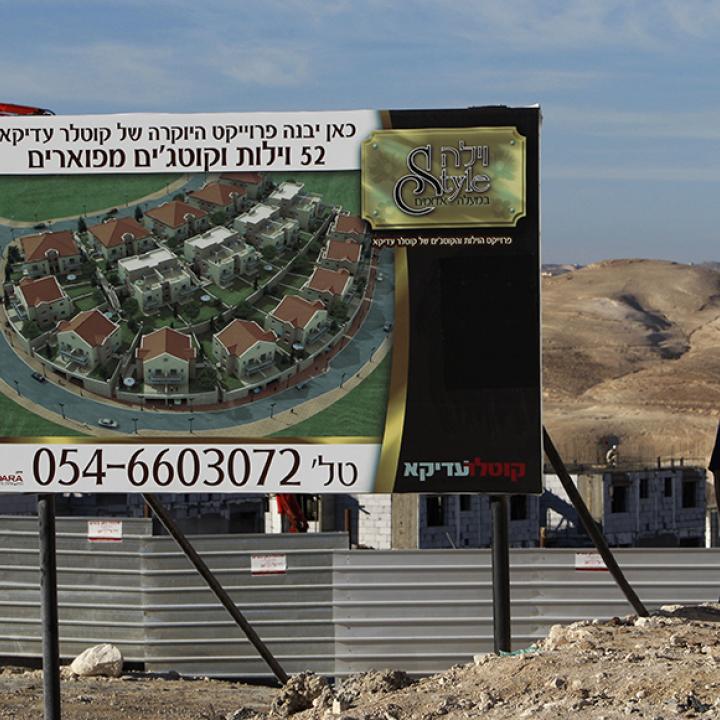
Following years of deepening diplomatic tensions over the situation in the West Bank, the joint statement was spurred in part by “unprecedented levels of settlement expansion,” including record numbers of new housing units, a surge in the construction of outposts, and more than a hundred new settlements legalized by the current government. Many of these new sites are deep inside the West Bank, far from the main settlement “blocs” close to the 1967 Green Line, and therefore inimical to any future revival of two-state negotiations.
The statement’s signatories are especially concerned about the E1 project—a far-reaching settlement corridor that would span from Jerusalem to the Maale Adumim bloc if completed. For years, European capitals have warned Israel that building E1 is a red line because it would drive a wedge between the northern and southern parts of the West Bank, potentially creating irreversible facts on the ground that could amount to de facto annexation. That message was reiterated in a statement issued this May by the leaders of France, Germany, Italy, and the UK.
Due to EU pressures and explicit opposition from several U.S. administrations, Israeli governments refrained from implementing E1 for more than thirty years, but the current government approved plans for the project in August 2025. This led to diplomatic rows with several Arab countries as well—for instance, Emirati official Lana Nusseibeh warned that “annexation in the West Bank would constitute a red line for the UAE” and “severely undermine the vision and spirit” of the Abraham Accords.
More recently, the Israeli Housing Ministry issued a tender on August 18 for contractors to bid on the construction of 1,234 housing units in E1, and also announced that bidding for the remainder of the 3,400 planned units would open in October. This marks a historic advancement in the project, moving it beyond the planning phase for the first time.
In addition, European officials noted the surge in extremist settler violence against Palestinians in the West Bank as a major driver behind the trade decision. Many Western capitals have grown increasingly frustrated at the current Israeli government’s general unwillingness to take meaningful measures against this phenomenon.
The Leap from Trade Restrictions to a Ban
Trade restrictions on West Bank settlements are a longstanding issue in Europe. Under the EU-Israel Association Agreement, goods produced in the settlements do not qualify for the preferential tariffs accorded to goods originating from within Israel’s internationally recognized borders. In 2015, EU countries took the additional step of requiring settlement goods to carry labels showing their origin to consumers rather than “made in Israel.”
More recently, several European countries have released business advice notices related to trade with settlements. In August, officials in Canada, France, Germany, Italy, the Netherlands, Norway, and the UK issued a public warning that “businesses should not consider bidding for construction tenders [related to E1]. They should be aware of legal and reputational consequences, including the risk of involving themselves in serious breaches of international law.”
Until now, however, most European countries had refrained from imposing a blanket ban—and several still oppose that measure, particularly Germany. To address concerns like extremist settler violence, they have preferred to use targeted tools like the EU Global Human Rights Sanctions Regime (aka the EU Global Magnitsky Act). Since 2024, the EU has adopted three packages of sanctions against violent individuals and supporting organizations (e.g., Hashomer Yosh, Hilltop Youth, Nachala), following in the footsteps of U.S. measures taken under the Biden administration.
Commotion Over Political Timing
The ban announcement has led to harsh criticism in Israel, with President Isaac Herzog accusing lead signatory London of “gross interference” in the upcoming October 27 Knesset election. Other observers argue that this timing could backfire by working against the objectives of the UK and its partners, since Bezalel Smotrich and Itamar Ben-Gvir—the sanctioned Israeli ministers most responsible for the surge in settlement activity—will no doubt try to use the ban to rally voters around the flag.
Notwithstanding these risks, London, Paris, and Ottawa felt a sense of urgency that they had to act now or never given their belief that the E1 project is entering a decisive phase. The deadline for bidding on the first set of 1,234 housing units is October 19, while the tender for the remaining 2,167 units will be opened on October 25. On the ground, some work has already begun on infrastructure related to the project. The perception in many European capitals is that the future of the two-state solution could reach the point of no return once the October 19 deadline passes, since contracts could be awarded at any time thereafter. Once third-party contractors are involved, any future government could invoke legal complications and other difficulties to avoid stopping the project.
Mindful of potential U.S. objections to the trade ban, European capitals informed Washington about the announcement in advance, with British Prime Minister Andy Burnham reportedly briefing President Trump himself. Remarkably, the administration has taken a rather neutral stance on this issue so far. President Trump and Secretary of State Marco Rubio refused to comment on the decision, with Rubio simply noting, “We share the goal of stability. We don’t want to see some uptick in violence...in the West Bank.” So far, the exact geographic scope of the trade ban remains uncertain, but U.S. officials may speak out if the statement’s signatories decide to include the Golan Heights (as the unilateral Dutch ban does), since that would directly contradict U.S. recognition of Israeli sovereignty over that area.
Assessing the Possible Impact
On general European trade relations with Israel, the overall impact of the trade ban announcement will likely be limited. The EU is Israel’s largest trading partner, importing $17.6 billion worth of Israeli goods in 2025. In comparison, the value of West Bank settlement goods exported to Europe is estimated under $290 million per year. According to the Manufacturers Association of Israel, goods from settlements account for less than 5 percent of the country’s total exports, and just $11.1 million of its $8.1 billion in total trade with the UK. Notably, the countries already implementing settlement trade bans in various forms—such as Belgium, Ireland, the Netherlands, and Spain—have cautiously avoided including services. The UK did not include a blanket ban on services, though it has mentioned the possibility of targeted sanctions against “specific companies and individuals providing services” (e.g., construction, financing, real estate). Nevertheless, if these measures are fully implemented in the months to come, they could harm specific Israeli businesses involved in the settlements, mainly in the agricultural sector (e.g., products like dates, avocados, wine, herbs) and some industrial exports (e.g., plastics, rubber products, cosmetics).
In Europe, the announcement will increase pressure on the EU to adopt new trade policies related to the West Bank. Currently, the union remains split on this issue—some governments (along with the European External Action Service) argue that a wider EU trade ban should be treated as a technical trade measure adopted by a qualified majority of member states, while others say it should be regarded as a sanctions measure that must be adopted unanimously. The European Commission has been cautious so far, suggesting a menu of options ranging from a specific import license system for settlement goods to prohibitive tariffs and partial or total trade bans.
At the diplomatic level, the announcement will likely escalate the long-growing tensions between Israel and certain European capitals over the situation in the West Bank. Israeli Foreign Minister Gideon Saar has already announced a series of countermeasures against the UK, such as closing the British general consulate in Jerusalem and expelling the UK support team to the Palestinian security forces. This trend will probably continue as European and Arab countries prepare to gather at the UN General Assembly around the anniversary of last year’s “New York Declaration” on the two-state solution, with dedicated meetings on the subject to be chaired by Saudi Arabia (at the ministerial level) and Canada, France, and the UK (at the head of government level).
In Israel, there is little prospect of any favorable policy change on West Bank settlement issues in the run-up to the election. Yet the European announcement could have important effects beyond that date, signaling that many countries will prioritize this issue in their relations with whatever government voters choose. These countries have made their expectations clear for years: they want Israel to freeze the E1 project, roll back the unbridled development of outposts, prevent any irreversible steps, avoid measures that could contribute to the collapse of the Palestinian Authority, and enforce a real crackdown on extremist settler violence.
At the same time, the actual scope of this trade decision has not yet been laid out. British Foreign Minister Edward Miliband hinted that specific trade ban legislation would be in place within six to nine months, and other countries will need time to draft and implement their own policies. Coming to agreed terms on a possible coordinated EU approach to this issue would also take time. In other words, actual implementation of the ban may coincide with the formation of Israel’s next government, leaving room and time for diplomatic channels on this issue to be reopened. Accordingly, there will probably be a window of opportunity to avoid an all-out clash while also taking effective steps to protect the future of the two-state solution.
Pierre-Arnaud Blanchard is a visiting fellow at The Washington Institute. A career French diplomat, he has worked on Israeli-Palestinian affairs at the general consulate in Jerusalem, served at the French embassy in Tehran, and coordinated policy teams responsible for Lebanon, Syria, Egypt, Jordan, and other countries.