- Policy Analysis
- PolicyWatch 4233
14 Points on the 14 Points: Assessing the Israel-Lebanon Framework Agreement
This landmark document offers a once-in-a-generation opportunity to build real peace between Beirut and Jerusalem, but progress needs to be swift and visible given the threat of violent opposition from Iran and its local allies.
After a rocky start to their fifth round of negotiations and a delay of several hours before the closing ceremony, Lebanon and Israel ultimately signed a “framework agreement” on June 26, marking a substantial step-up from the “statement of intent” they had been expected to endorse. This was the first accord between the two neighbors since the short-lived May 1983 peace agreement, and given its scope, ambition, and potential implications, it is perhaps the most significant since their armistice agreement seventy-seven years ago.
The text of the agreement is divided into fourteen points, a structure that not only echoes the recent U.S.-Iran memorandum of understanding, but also appears purposefully chosen to present an alternative path to that MOU in terms of addressing the Lebanon question. Here are fourteen observations on those fourteen points:
1. The term “framework agreement” was born in 1978 to describe the two halves of the original Camp David Accords, one of which evolved into the 1979 Egypt-Israel peace treaty. (The other half—on the Palestinian question—never reached fruition.) The phrase suggests a major step forward, though not a conclusive one. The previous four rounds of talks produced statements with varying degrees of specificity, but one can assume that implementing the new framework agreement will be the focus of Israel-Lebanon diplomacy for the foreseeable future.
2. While media reports have focused on the details of Hezbollah disarmament, Israeli withdrawal, and the creation of “pilot zones” for the deployment of the Lebanese Armed Forces (LAF), it is important to note that the agreement’s core strategic objective is to establish peace between the two countries. The words “peace” or “peaceful” are used ten times in the text, with paragraph 12 requiring the two sides to immediately begin the process of establishing “working groups to draft the full comprehensive peace and security agreement.” This puts to rest any intra-Lebanese debate about whether Beirut might set more limited goals for this diplomacy, such as renewing the bilateral armistice or seeking some form of nonbelligerency agreement. The goal is now clear: full peace.
3. The agreement’s use of the word “irreversible” is striking. This is an especially strong term in the diplomatic realm and has not been used in any previous Arab-Israel peace agreement. Yet it appears twice in this agreement, and in two very different contexts: paragraph 1 states, “This Framework...expresses a determination to make irreversible progress towards the comprehensive resolution of all issues between the two countries”; paragraph 4 states, “The Government of Lebanon reaffirms its resolute and irreversible commitment to restoring and exercising full sovereignty over all its territory.” This linguistic connection underscores the critical linkage between Lebanon’s assertion of full sovereignty and the goal of forging peace with Israel.
4. The text is a bit contradictory on whether this is a trilateral agreement or a bilateral agreement achieved with American support. Its official title is “Trilateral Framework,” suggesting that the United States is an equal partner. Yet paragraph 1 notes that “[b]oth countries affirm their intention to resolve [all] issues as sovereign states through direct bilateral negotiations, with the mediation and support of the United States.” However diplomats sort this out, the agreement’s numerous other commitments make clear that America’s role—from negotiation to implementation to defending the process from its adversaries—will be indispensable. (See point 11 below)
5. While peace is the ultimate objective, the pathway to that goal runs through executing the key operational principle outlined in paragraph 2: that both governments “commit to a reciprocal, sequenced process, with clear conditions, whereby the LAF will restore effective sovereign authority over all Lebanese territory, pending the verified disarmament of non-state armed groups and dismantlement of associated infrastructure, enabling the Israel Defense Forces (IDF) to progressively deploy out of the Lebanese territory.” This is the fundamental deal at the heart of the agreement—as the LAF fulfills its commitment to deploy in certain areas and disarm, dismantle, and prevent the regrouping of Hezbollah once there, the IDF will cede control and leave, with Lebanese civilians then permitted to return under “exclusive” Lebanese government control. There is no defined timeline for this process, but the sequencing is crystal clear. Israeli withdrawal is neither automatic nor assumed, and Lebanon makes no demand for an immediate, unconditional departure. Rather, IDF redeployment is envisioned as a rolling process whose pace and breadth are determined by the pace and breadth of the LAF’s own efforts. As the text states, only “successful implementation” will enable the IDF to leave.
6. The agreement does not define “disarmament” or “dismantlement,” but those terms are explained as follows in the subsequently reported security annex: “taking legal measures against all non-state armed personnel engaging in unauthorized activity, and destroy[ing] or render[ing] inoperable associated infrastructure, including but not limited to weapons, weapons caches, tunnels, and command centers, by those non-state armed groups.” As the process unfolds, it will be important to monitor whether dismantlement extends to Hezbollah’s weapons factories, drone assembly plants, training facilities, and other military infrastructure, and perhaps even its communications networks, financial institutions, and leadership facilities. As for disarmament, the security annex is silent on whether this process will be consensual, coercive, or both, opening the possibility of multiple tactics to achieve that goal. Yet one option is specifically ruled out: incorporating Hezbollah units into the LAF, an idea that has been gaining traction in some circles. According to paragraph 4, Beirut has committed to ensure that “non-state armed groups” will have “no military or security role and no armed capabilities anywhere in Lebanon.”
7. Paragraph 3 states that “pilot zones” will serve as “the mechanism for phased and verified redeployments of the IDF and the deployments of the LAF.” While Lebanon and Israel had endorsed this concept in previous talks, they came to Washington last week with very different ideas about implementation. Beirut originally proposed that the IDF withdraw from a zone along the border, with displaced Lebanese civilians then returning to that zone. Not surprisingly, Israel balked at the idea of beginning the process within firing range of its northern communities. Ultimately, they agreed on two zones further north in the “South Litani Sector.” They also agreed to add more pilot zones “by mutual consent.”
Relatedly, the security annex commits the two sides to establishing a novel joint initiative—the bilateral “Military Coordination Group for Lebanon” (MCG4L)—to “operate 24/7, managing deconfliction, verification, and overall implementation.” This step-by-step process of expanding LAF control while disarming and dismantling Hezbollah is eventually envisioned as extending “throughout Lebanon.”
8. While the pilot zones focus on disarming and dismantling Hezbollah in defined areas of territory, Beirut also made a broader commitment to starve Hezbollah of funding throughout the country. As paragraph 11 notes, the government pledges to prevent “funds from flowing to any entity, organization, or individual affiliated with non-state armed groups,” and “explicitly commits to prevent reconstruction funds from flowing to non-state armed groups and connected entities.” (Notably, the United States has joined in this commitment as well; see point 11 below.) Defining precisely who is “affiliated” with Hezbollah and what is a “connected entity” will be critical. Does this include the Council for South Lebanon, or the Amal movement led by Speaker of Parliament Nabih Berri? What about local Hezbollah mayors in communities south of the Litani? In any case, the principle adopted here is a powerful tool to help strangle the group financially.
9. One fascinating subtext in the agreement is that both sides repeatedly commiserate with each other’s difficulties and challenges, reflecting a deeper sense of mutual empathy than normally found in such documents. For example, one might think that the Israeli government would be indifferent to whether Lebanese civilians return to southern Lebanon and, similarly, that the Lebanese government would be indifferent to the situation facing Israel’s northern communities—they would normally be expected to focus on their own national priorities instead. Interestingly, however, the document reflects a sense that these discrete national interests are linked. In paragraph 8, for example, “the two countries recognize that the restoration of security in South Lebanon through the deployment of the LAF, the safe return of its civilian population, and the security of Israel’s northern communities, are essential to long-term stability and peace.” It is difficult to find this degree of empathetic understanding in any previous Arab-Israel peace agreement.
10. Critics of Lebanon’s negotiating acumen have pounced on the commitment made in paragraph 13 “to take good faith measures that demonstrate positive intent, including the cessation of all hostile or adverse actions in international political or legal fora, and pledge to work towards the search for and return of remains and the release of detainees.” Specifically, domestic opponents accuse the Lebanese government of giving away citizens’ rights to hold Israel responsible for the hardship, displacement, and deaths suffered as a result of military action in recent months. Yet this is a skewed misreading of a commitment that benefits both sides. For example, while it likely means that Lebanon will no longer partner with UN Human Rights Council investigations of Israeli actions, it also puts to rest Lebanese concerns that Israel would support potential U.S. congressional efforts to cut or severely condition bilateral military assistance to the LAF as penalty for its failure to act against Hezbollah. To be sure, this paragraph does not mean that Lebanon will suddenly change its position on the International Criminal Court case against Israeli officials or the International Court of Justice case charging Israel with genocide—but that is because Lebanon (like Israel and the United States) never ratified the Rome Statute and is not a party to the ICC, nor has it ever made an official intervention on the ICJ genocide case.
11. The U.S. role in the agreement is deep, as seen in numerous parts of the text. Stitching them together, the Trump administration committed to the following:
- providing “mediation and support” for Israel-Lebanon diplomacy (para. 1)
- supporting the drafting of the security annex (para. 2)
- verifying and supporting the pilot zone initiative (para. 3)
- leading the effort to enlist international and Arab support for this process (para. 4)
- supporting and participating in a “military coordination group” to ensure implementation (para. 7)
- rallying international partners to support Lebanon’s reconstruction (para. 10)
- working with Lebanon to prevent financial flows to Hezbollah and its affiliates (para. 11)
- facilitating Israel-Lebanon negotiations for a final peace agreement (para. 12)
In addition, the agreement mentions that “any new U.S. assistance” to Lebanon would be “strictly conditioned on verifiable milestones, full transparency, demonstrated results, and ongoing oversight”—concepts that, by implication, do not necessarily apply to existing U.S. assistance.
In publicly reported versions of the security annex, Washington’s role is surprisingly limited, mentioned only in terms of facilitating implementation and mediating dispute resolution. In reality, however, a more robust role is likely to emerge for the United States as the lead actor in the creation of a “mutually agreed-upon third-party entity” that will verify the “clearance of all non-state armed groups and their military infrastructure” in the pilot zones.
Two implications are clear from all these American commitments: first, that the United States—not the UN or some consortium of countries—bears responsibility with the parties for executing this agreement, and second, that the Trump administration needs to quickly stand up a substantial interagency team dedicated to full implementation of Washington’s commitments.
12. The authors of the agreement were unambiguous in rejecting the idea that Iran has a legitimate role to play in determining the future of Lebanon’s political or security affairs, despite this notion being inherent in the U.S.-Iran MOU. As stated in paragraph 6, “The Government of Lebanon rejects the claims of any state or non-state actor to use force on its behalf without its explicit authorization, and reiterates that any claim by any state or non-state actor to exercise a military or security role is illegal per the decisions of the Lebanese Government and contrary to Lebanese national interests.” It is no surprise, then, that Iran’s top agents in Lebanon—Hezbollah and Amal—have denounced the agreement in extreme terms. Hezbollah took to the streets to threaten violence against the government, while Berri labeled the document “sedition” and proudly advertised a phone call with his Iranian counterpart Muhammad Baqer Qalibaf, highlighting his close coordination with Tehran. The result is that Lebanon is now the unambiguous ground zero for the Islamic Republic’s claim to a broader regional role after surviving the Iran war.
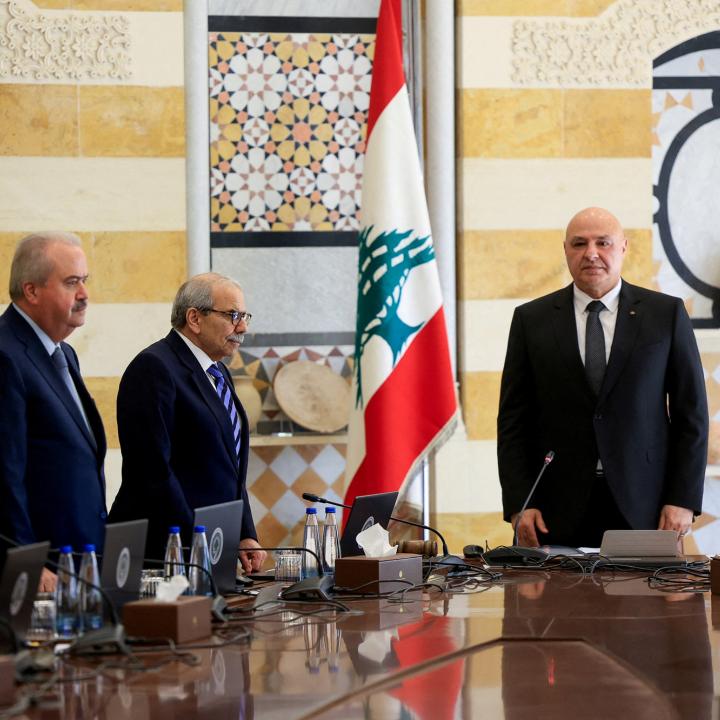
13. The Lebanese government’s courage and tenacity should not be underestimated. The path of least resistance for President Joseph Aoun and Prime Minister Nawaf Salam would have been to close ranks with Berri, stand with the U.S.-Iran MOU’s call for a full ceasefire, and support Tehran’s demand for unconditional Israeli withdrawal from all Lebanese territory. While this could have spurred Washington to cut off U.S. funding for the LAF, certain states in the region would likely have made up the difference. Instead, Lebanon’s leaders acknowledged that most of their public is fed up with decades of war and Iranian control, and they made the bold decision to reject Tehran’s entreaties and gamble on Washington, Israel, and the pursuit of peace. There is a long way to go, especially on implementing the pledge to disarm and dismantle Hezbollah, which Lebanese governments have been promising to do since the Taif Accord four decades ago. But this time the result may finally be different, since the die has been cast and the contest between proponents and opponents of the agreement has become a zero-sum game.
Hopefully, Israel’s government—which is facing its own domestic political crosswinds—will recognize the moment and act in both word and deed as the partner that this precedent-shattering agreement envisions. Among other things, this would include avoiding provocative statements and measures that complicate Beirut’s already tortuous path, coordinating closely with Lebanese political and security authorities on implementation, and quietly encouraging international donor efforts to support Lebanon’s reconstruction and rehabilitation.
14. As much as the framework agreement is a signal success for U.S. diplomacy—and especially for Secretary of State Marco Rubio—it has also laid bare an internal U.S. debate over whether Iran is solely part of the problem in the Middle East or possibly part of the solution. This is often depicted as a contest between Rubio and Vice President JD Vance, the lead defender of the U.S.-Iran MOU. As of this writing, President Trump has not publicly commented on the Lebanon agreement, though paragraph 14 expresses “deep appreciation” for his “vision and leadership.” This may suggest he is not yet ready to offer a definitive verdict on the issue—a potential source of concern for both Israel and Lebanon, despite Trump’s reportedly warm weekend phone call with Aoun.
Conclusion
The Israel-Lebanon agreement offers a once-in-a-generation opportunity to build real peace between these neighbors, but the way forward is fraught and fragile. With an array of opponents already declaring their intent to kill the opportunity in its crib, progress needs to be swift and visible.
Today saw an early positive step, as U.S. Central Command chief Adm. Brad Cooper visited Beirut to begin coordinating implementation of the security annex with LAF commander Gen. Rodolphe Haykal—a smart move given the latter’s record of prioritizing “civil peace” over measures to disarm Hezbollah. Washington should push for additional helpful steps, such as broader Arab and international endorsement of the agreement. But nothing will replace a key missing piece—effusive public embrace of the agreement by President Trump himself. Done artfully, in a way only he can do it, this could greatly boost Israel-Lebanon diplomacy without injury to the main body of the Iran MOU he negotiated, and without exacerbating tensions between his vice president and secretary of state.
Robert Satloff is the Segal Executive Director and Howard P. Berkowitz Chair in U.S. Middle East Policy at The Washington Institute.