Robert Satloff is the Segal Executive Director of The Washington Institute, a post he assumed in January 1993.
Articles & Testimony
As seen with Hamas during the Gaza war, media outlets and international officials are spreading untruths about Israel’s latest campaign against Hezbollah; thankfully, the playbook for countering them is clear this time.
Most Americans are understandably focused on the US war in Iran, but those with enough bandwidth to follow news of Israel’s operation in Lebanon will sense something eerily familiar. That’s because the Lebanon story increasingly resembles the distorted narrative that characterized Israel’s Gaza operation in the wake of the October 7, 2023, Hamas attack.
Here are three ways in which Lebanon sounds like a repeat of the Gaza war:
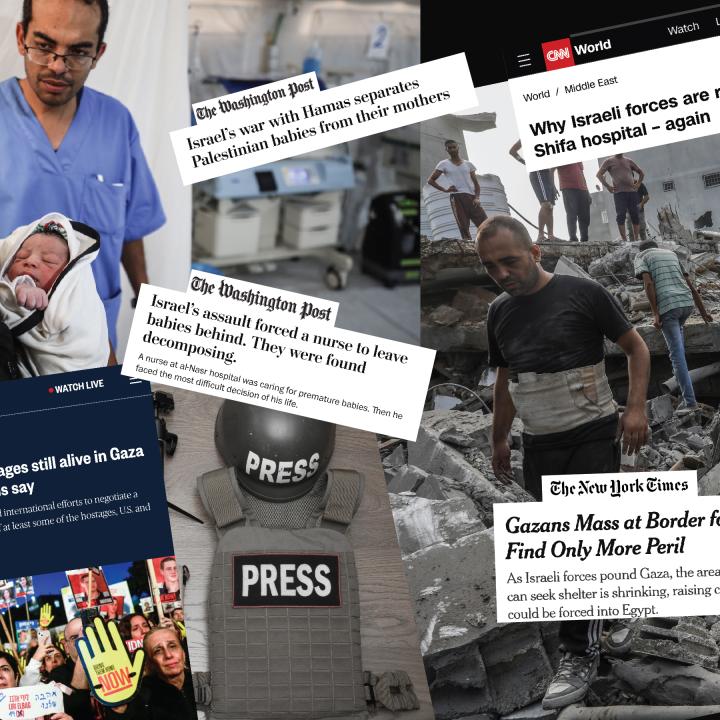
Whitewashing the provocateur: The Lebanon story, like Gaza’s, is a tale of legitimate Israeli retaliation for unprovoked attack. But just as Hamas eventually disappeared from many reports of the Gaza fighting, which often depicted a vengeful Israel purposefully killing innocent civilians, so too is Hezbollah disappearing from the Lebanon narrative. The most blatant example of this is a statement from the UN High Commissioner on Refugees—normally considered one of the most professional of the organization’s specialized agencies—on Lebanon’s emerging “humanitarian catastrophe,” which doesn’t even refer to Hezbollah. With the UN having blessed a version of the Lebanon conflict in which Israel bears sole blame, the floodgates are now open for others to follow.
Mixing combatants and civilians:For much of the Gaza war, one of the key bones of contention was the failure of so many media outlets to provide fatality data that differentiated between Hamas fighters and ordinary civilians. Reports from the Hamas-controlled Gaza health ministry of huge numbers of deaths never separated between Hamas fighters and civilian victims, masking Israel’s success in recording what appears to have been one of the lowest ratios of non-combatant to combatant fatalities in the history of urban warfare. This phenomenon of bogus statistics has already begun to take root in coverage of Lebanon. In a recent episode of its Morning Edition show, for example, National Public Radio broadcast fatality data straight from Lebanon’s ministry of health—controlled by a Hezbollah-affiliated minister—without clarifying that at least two-thirds likely were Hezbollah fighters.
Blurring the difference between journalist and terrorist: Just as numerous examples emerged from Gaza of the “martyrdom” of Hamas terrorists killed while under cover as members of the media, reportage in Lebanon is now focused on the killing of a prominent “journalist” from Hezbollah’s main television news outlet, called al-Manar. At least, in Lebanon’s case, Hezbollah isn’t even hiding its connection to the victim, going so far as to extoll the al-Manar operative as“an icon of resistance media.” But the New York Times, among others, presented the allegation of the victim’s terrorist links as a “he said/she said” between Israelis and Lebanese, never mentioning the key fact American readers should care most about—that al-Manar was itself named a “specially designated global terrorist entity” by the US government twenty years ago.
Add these factors together and it is no surprise that one hears ominous warnings about Gaza-level violence coming to Lebanon. Spanish prime minister Pedro Sanchez, Europe’s leading critic of both the US and Israeli military operations in the Middle East, recently accused Israel of seeking “to inflict the same level of damage and destruction” on Lebanon as it did in Gaza. Turkish foreign minister Hakan Fidan went one step further, warning about fears of a coming “Lebanon genocide.” Even mainstream American media, like NBC News, are getting into the act, suggesting that Israel is “replicating [its] ‘Gaza model,’” leading to the same “spiraling humanitarian situation with no end in sight.”
To be sure, certain loud-mouthed Israeli officials do their country no service by threatening to flatten villages along the lines of the “Rafah or Bayt Hanoun model,” as the defense minister has said, or vowing to extend Israel’s northern border to Lebanon’s Litani River, as the finance minister has said. Neither, however, plays much of a role in operational decision-making; through such statements, they compensate in volume for what they lack in real influence.
For his part, Israel’s prime minister has focused his public statements on the core mission of disarming Hezbollah, which Lebanon’s own government promised but failed to do after the November 2024 ceasefire, and maintaining a buffer zone in southern Lebanon to protect Israel’s northern communities, with not a word about expanding Israel’s borders northward. But those remarks are not nearly as provocative as those uttered by less important figures, so they will get less coverage.
Over time, the chances that the Lebanon story gets chiseled into public consciousness in the same warped way as the Gaza story are regrettably real. The antidote is laborious, time-consuming and decidedly unsexy—to cry foul and demand context. Viewers, readers, and listeners need to pounce any time they come across a story that fails to recall how Lebanon’s own US-equipped army refused to fulfill its promise to disarm Hezbollah, fails to highlight Hezbollah’s unprovoked missile attacks as the trigger for Israeli military action, or fails to separate Hezbollah fatalities from those of innocent civilians.
Thankfully, two-and-a-half years after the Gaza story unfolded, we know the playbook. We also know how difficult it is to correct a false narrative once it has taken hold. This time, it’s essential not to wait until the dust settles to make sure that doesn’t happen.
Robert Satloff is the Segal Executive Director and Howard P. Berkowitz Chair in U.S. Middle East Policy at The Washington Institute. This article was originally published on the Times of Israel website.