- Policy Analysis
- Articles & Op-Eds
How China Could Shorten Iran’s Path to Military Recovery After the War
Also published in Haaretz
Beijing has been mostly talk and little walk so far, but once the war ends, it may decide to help Tehran rebuild militarily in return for oil.
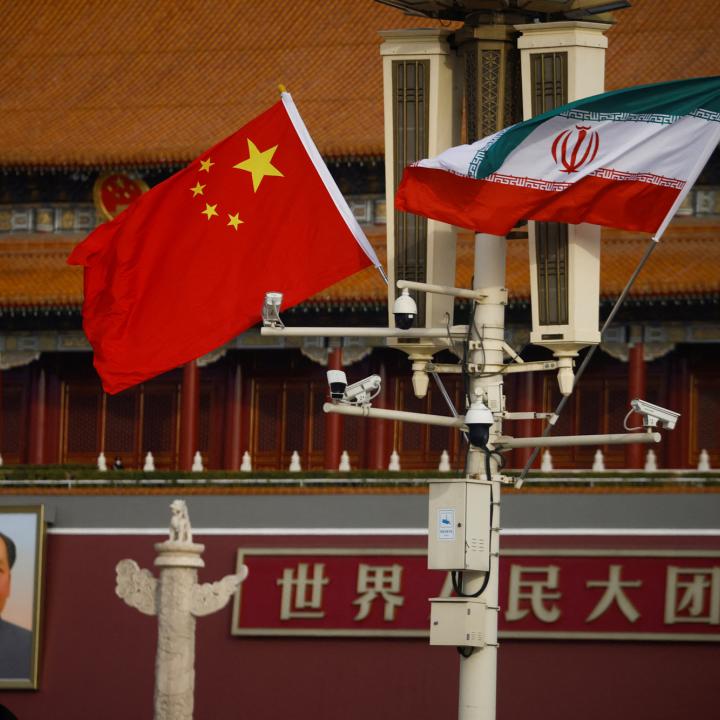
In the Middle East, China is an economic heavyweight, a political lightweight and a military featherweight. In the current Iran war, its policy is reflected accordingly—mostly talk, hardly walk, let alone militarily, but full of potential for the day after—to the point that it could quickly offset the achievements of the U.S.-Israeli war against Iran’s military industries.
With the outbreak of the U.S.-Israel war on Iran, China began a mostly declarative diplomatic effort. Its official representatives, led by Foreign Minister Wang Yi, strongly condemned the killing of Iran’s Supreme Leader Ali Khamenei, as well as what it termed as the aggression against Iran, its sovereignty and territory, in violation of international law and the UN Charter. Beijing called for an immediate cessation of the war and a resolution of the conflict through dialogue.
Later, China also condemned the attacks on the Gulf states and the region, but without mentioning Iran; it abstained from voting on a Security Council resolution condemning Iran. Wang has held a series of calls with his colleagues in the region, including Iran and Israel, while Beijing’s special envoy, dispatched to the Middle East, reiterated the same messages in his own meetings there.
In the military sphere, China refrains from any involvement in the conflict, and it is likely that reports of its supply of air defense systems to Iran are untrue. However, two Iranian ships reportedly left China’s shores carrying a cargo of sodium perchlorate, a precursor for missile fuel, which China had already supplied to Iran after the 12-day war in June.
At the same time, it was reported that the Liaowang-1 spy ship was operating in the Arabian Sea, a location that allows for close monitoring of the course of the war. This is an opportunity for China to learn about its main adversary—the United States—while it operates during an actual war. Could Beijing be supplying intelligence to Tehran, as Moscow does?
Iranian Foreign Minister Abbas Araghchi has said that Russia and China are “helping” Iran in the war, including through military cooperation, but it is not known exactly how Beijing is assisting Tehran.
Energy security is China’s central interest in the Middle East. About 40 percent of its oil imports pass through the Strait of Hormuz, and it also purchases about 90 percent of Iran’s oil exports, despite sanctions and at considerable discounts. Iran has hit oil facilities and ships in the Gulf, and announced the closure of the Strait, causing a significant disruption to the global oil market and a sharp increase in prices.
China, for its part, has sufficiently large oil reserves to last several months, but it has taken steps to ensure available inventories going forward, such as reducing refined petroleum exports. At the same time, the flow of oil from Iran continues during the war, amounting to about 1.5 million barrels, most of it to China. Chinese ships have not been attacked by Iran, while other ships are careful to identify themselves as owned and/or crewed by Chinese nationals.
All of these indicate some sort of arrangement for the continued flow of oil from Iran to China, and India recently followed in its footsteps.
In recent days, U.S. President Donald Trump has called on countries dependent on the Hormuz oil shipments, and specifically China, Japan, South Korea, France and Britain, to send ships to secure shipping through the Strait.
Later he also raised the possibility of postponing his visit to Beijing, which was scheduled in two weeks, either as leverage to pressure Beijing to take part in the effort to open the straits, or to avoid the fanfare of a ceremonial and lavish visit by the commander in chief in the midst of war.
Yesterday, Trump asked to postpone the summit by a month, because of the war. China, for its part, is interested in holding the visit, stressing the importance of leaders’ diplomacy in world powers relations, and looks forward to stabilizing trade and economic relations, following a recent preparatory meeting in Paris between the U.S. Treasury Secretary and his counterpart from China.
The likelihood that China will send naval ships to the Gulf to alleviate the challenges of a war declared by Trump remains low.
Yet, China will play a significant role after the war, with or without U.S. consent. After the devastation inflicted by the allies on Iran’s military industry, Iran will very likely seek to rebuild with the help of its partner China, and perhaps also North Korea, in return for oil.
In this respect, China might offset the war achievements of the United States and Israel, and shorten Iran’s path to military recovery. Washington and Jerusalem will have to work with Beijing on this issue, and the latter will surely have its own demands regarding China’s top strategic priorities.