Sarah Yerkes is a senior fellow in the Middle East Program at the Carnegie Endowment for International Peace.
Articles & Testimony
Even as the country's president shuns outside support, Western actors can use creative methods to engage reformers, support the Tunisian economy, and prevent instability.
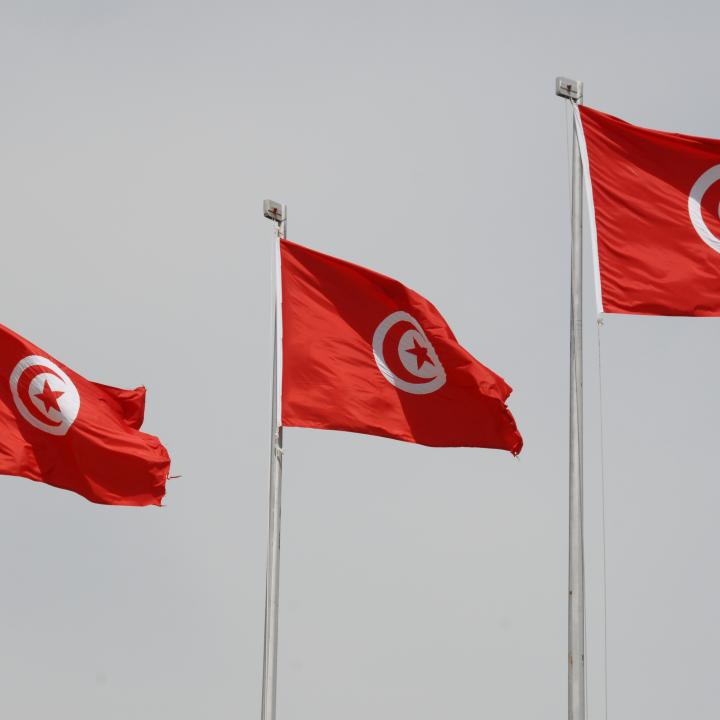
July 25 marked a grim milestone in Tunisia: Exactly five years since the end of the country’s brief experiment in democracy. In 2021, President Kais Saied staged a massive power grab by declaring a trumped-up state of emergency, firing several Cabinet members and suspending the country’s democratically elected parliament. His actions since then have combined escalating repression with international isolation. Many of those in the United States and Europe who supported Tunisia’s nascent democracy have enabled Saied’s authoritarianism by increasingly turning their back on the country.
Saied’s reversals occurred when Tunisia was benefiting from its dramatic democratic transition during the 2011 Arab Spring uprisings. Over the ensuing decade, a robust and powerful civil society helped bridge gaps between the Tunisian people and their elected officials. The government began implementing a decentralization plan to give local actors significant power over their own affairs. Saied won election in 2019, having promised to continue those decentralization efforts and fight corruption, restore economic growth, and reduce the socioeconomic disparities between the country’s marginalized interior regions and its coast.
But the high hopes that many Tunisians attached to Saied’s presidency faded with his self-coup on July 25, 2021. In the ensuing years, he has marginalized local officials, replaced the constitution and weaponized the judiciary to use against his political foes. Within months, Tunisia had gone from a struggling democracy to an autocracy with a closed civic space and virtually nonexistent channels of public dissent.
One of Saied’s most egregious actions, formally known as Decree-Law 54, was promulgated in 2022. It criminalized “fake news” and sentenced violators to five years in prison—or 10 years if the target of the story was a government official. This had a major chilling effect on Tunisian journalists and analysts. It also caught the attention of international human rights groups, which condemned Tunisia’s growing crackdown on voices critical of Saied’s government.
Many of the country’s democratic leaders—including former Prime Minister Youssef Chahed, former President Moncef Marzouki, and Saied’s own former chief of staff Nadia Akacha—fled overseas and were sentenced to heavy punishments in absentia. The forced exile of Tunisia’s political elite has hobbled serious political discourse in the country and made it far harder for the opposition to mobilize against Saied’s edicts. Other Tunisian leaders who remain in the country have been imprisoned on flimsy charges of conspiring against the state. Rachid Ghannouchi, the 85-year-old head of Ennahda—Tunisia’s largest and most influential party—has been sentenced to life in prison plus 30 years, on top of an earlier 20-year term.
In the years after the Arab Spring, Tunisia benefited from vastly expanded international connections, but that trend has reversed under Saied. He is said to trust very few people and seems to lack close relations with foreign leaders. He has frequently reshuffled his Cabinet, including replacing the prime minister five times since 2019.
The isolation and inner turmoil of his government contributed to the absence of a coherent strategy to address a growing economic crisis. Unemployment remains high at 15 percent, and the country is carrying high levels of debt. Wage growth is not keeping up with inflation, and shortages of medicine and food have been reported. According to the Heritage Foundation’s Index of Economic Freedom, Tunisia’s level of economic openness is now the lowest it has been since 1995. This year, Tunisians have marched in the street under the slogan, “The people are hungry and prisons are full.”
Despite the hardship, Saied has refused offers of foreign assistance, arguing Tunisia “does not accept anything resembling charity.” In 2023, he rejected 60 million euros in economic aid from the EU, though the European Commission later confirmed it transferred the funds anyway. Saied also barred members of the European Parliament from visiting the country. The total levels of bilateral assistance from the European Union have declined from around 300 million euros a year between 2017 and 2020 to around 150 million euros a year between 2021 and 2024.
Bilateral relations with most EU member states have also deteriorated, with the exception of Italy, which remains deeply concerned about migrant arrivals from Tunisia. Even relations with France, Tunisia’s former colonizer and an engaged partner for most of the post-independence era, have stagnated. Aid from the United States has also fallen sharply, a trend that began under former President Joe Biden as a response to Saied’s power grab, and has continued with President Donald Trump’s across-the-board cuts to foreign assistance.
The increased distance from Tunisia’s traditional Western partners has been fueled by Saied’s own extreme rhetoric, which is often laced with racism and antisemitism. For example, he has espoused conspiratorial and xenophobic views about migrants from sub-Saharan Africa, warning of a shadowy plot to send “hordes of irregular migrants” in an attempt to “transform the demographic composition of Tunisia.” And when neighboring Libya was hit by Storm Daniel in 2023, triggering floods that killed thousands of people, Saied claimed the storm’s name reflected the “Zionist movement’s” influence.
At the same time, Tunisia under Saied has not made a clear pivot toward alternative partners such as China or Iran, despite concerns from some U.S. lawmakers about Tehran’s alleged influence. The ChinaMed index, which tries to quantify China’s interest in cooperation with potential partners, ranks Tunisia significantly lower than other North African countries. In fact, Tunisia’s main foreign partner continues to be its larger neighbor to the west, Algeria, which Tunisia depends on heavily for gas and electricity.
Tunisia has also become weaker and less influential compared to its neighbors and regional peers. Morocco—another North African energy importer—has grown its GDP per capita from roughly $2,700 in 2010 to nearly $4,000 in 2024, while Tunisia’s own per capita GDP has stagnated at around $4,000. Meanwhile, Algeria has sought to become a global player in sectors such as energy and regional politics, and even fractious Libya has received increased attention from global investors as of late.
Letting Tunisia continue to slide deeper into isolation and autocracy would be a mistake for the international community. The country’s economy remains fragile, particularly as global energy prices rise again from renewed conflict in the Middle East. In that context, one external shock to an important sector, like agriculture or tourism, could trigger a nosedive. This in turn would likely cause a destabilizing wave of out-migration and increase regional extremist groups’ efforts to recruit in Tunisia, which was at one time the top contributor of foreign fighters to the Islamic State group in Syria and Iraq.
Five years after Saied strangled Tunisia’s young democracy, his actions have undoubtedly caused dramatic harm to the country, both for its people and the country’s traditional partners. Western countries were slow to accept the reality of Saied’s anti-democratic actions in 2021, adopting a “wait and see” approach that contributed to the ease with which Saied was able to take the country down an autocratic and isolationist path.
But even in the current environment, with the United States and its European partners spending less on international aid, there are steps they can take to pull Tunisia out of its isolationist bubble. Grants, support for conferences and technical assistance can be provided at low cost to democratically minded Tunisian actors advocating for economic and political reforms. Western countries can also work with the World Bank and the African Development Bank to contribute to projects that strengthen infrastructure and generate foreign investment as a way to stave off further economic decline.
The United States can leverage its deepening relationship with Algeria to quietly urge Saied to clarify a succession plan, as well as a plan for the peaceful transfer of power when his second term expires in 2029, given that he is constitutionally barred from running for reelection. And Western actors can continue to publicly and privately raise human rights concerns. This means criticizing politically motivated arrests and actions that further restrict civil liberties, such as laws that limit civil society.
Washington has a track record of privately pressuring Saied’s government to avoid radical measures, as it apparently did in fall 2023 to prompt Saied to reverse course on a bill that would have criminalized the normalization of relations with Israel. Ideally, though, policymakers would avoid values-based arguments and refocus discussions around the harm that Saied’s civil society crackdown has inflicted on Tunisia.
The last thing Europe and the United States want to see is another violent or unstable regime on Europe’s doorstep. Unfortunately, a failure to engage Tunisia’s internal and external decline before the end of Saied’s rule could do just that.
Sabina Henneberg is a senior fellow at The Washington Institute. Sarah Yerkes is a senior fellow in the Middle East Program at the Carnegie Endowment for International Peace. This article was originally published on the World Politics Review website.