Matthew Levitt is the Fromer-Wexler Senior Fellow and director of the Reinhard Program on Counterterrorism and Intelligence at The Washington Institute.
Articles & Testimony
Iran’s fractured opposition and years of repression make rapid regime change unlikely.
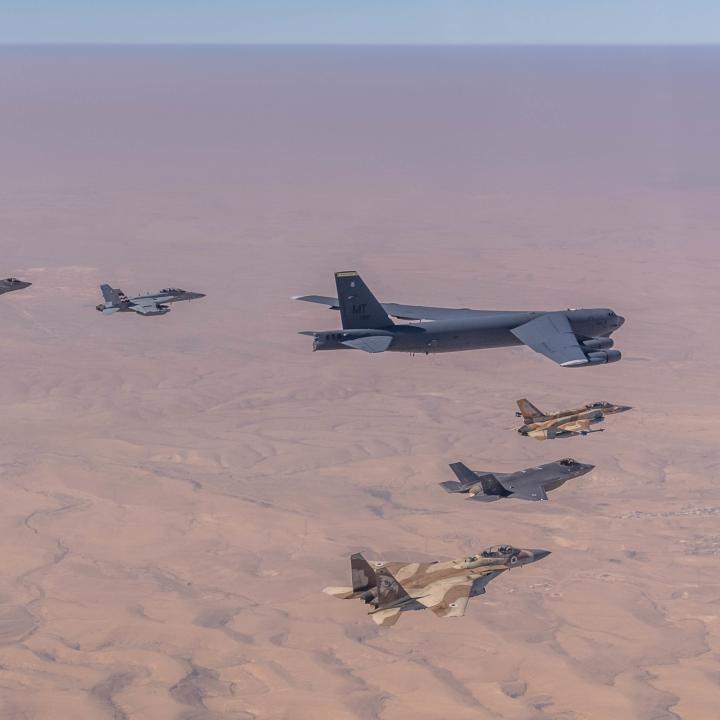
The Israeli and US joint military operation targeting the Iranian regime is unlikely to achieve regime change by air campaign alone. The more realistic goal would be to weaken and impose changes on the existing power structure. They just won’t be the kind of changes most Iranians are looking for, at least in the near term.
President Trump and other senior US officials have suggested a range of possible objectives going into this war, whether it was protecting Iranian protesters from a regime that killed its own citizens by the thousands in January, to countering an Iranian nuclear program that Trump said was “totally obliterated” last June, to destroying Iran’s ballistic missile capabilities. But that’s not all.
Announcing the beginning of major combat operations in Iran, Trump spoke directly to the Iranian people: “To the great, proud people of Iran, I say tonight that the hour of your freedom is at hand...When we are finished, take over your government. It will be yours to take...This is the moment for action. Do not let it pass.”
But his Cabinet members have hedged on regime change as a goal. Secretary of Defense Pete Hegseth insisted, “This is not a so-called regime-change war,” and Secretary of State Marco Rubio claimed the destruction of Iran’s ballistic missile program is the primary mission, adding, “We hope that the Iranian people can overthrow this government.”
But hope is not a strategy, and while Supreme Leader Ali Khamenei and other senior Iranian officials have been killed, the regime has shown no signs of falling apart, and the Iranian opposition has not yet coalesced into a viable alternative leadership.
An overwhelming majority of Iranians oppose the revolutionary clerical regime, but they have felt largely powerless to do anything about it. According to a 2023 poll by the research group Group for Analyzing and Measuring Attitudes in Iran, 81 percent of Iranians do not want an Islamic republic.
The following year, a poll conducted by the same group underscored the internal divisions complicating a smooth transition to a post-revolutionary regime. While 89 percent reported supporting democracy, 43 percent remained open to governance by a strong leader. But they knew what they did not want: Two-thirds opposed clerical rule, and more than 70 percent opposed military control.
Seeing these numbers, Trump appears to have calculated that once American and Israeli forces killed Khamenei and targeted Iran’s security agencies, Iranians would rise up and seize their chance for freedom. Perhaps he looked at Iran’s recent history of increasingly vocal protests in cities across the country and concluded they just needed a little support.
Indeed, over the past couple of decades, protests against the regime erupted over voter fraud (2009), economic hardship and corruption (2017-2018), fuel price hikes (2019-2020), water shortages (2021-2022), forced head coverings for women (2022-2023), and most recently a combination of social and economic issues. Gradually, Iranian protesters ditched calls for political reform within the clerical system in favor of calls for “death to the dictator.”
In recent protests, some Iranians chanted, “This is the final battle, Pahlavi will return.” But it is far from certain this will be the final battle, and less certain still that Mohammad Reza Pahlavi, the son of the late shah, has sufficient followers in Iran to unite the opposition together, even as a transitional leader. Pahlavi expressed hope that “maybe this is it. This is our chance now.” But so far, Iranians have not heeded his call “to go back to the streets.”
This may be the result of many years of violent suppression of political dissent by the Iranian government and its proactive targeting of any effort at organized political opposition, whether within or outside the borders of Iran. Indeed, in recent years Iran has significantly ratcheted up the pace of external operations, such as plots aimed at intimidating, kidnapping, or killing Iranian dissidents abroad. As a result, there is no united Iranian opposition but rather an ecosystem of disparate actors who share the goal of ending the clerical regime but agree on little beyond that. All of which suggests that despite so-called decapitation strikes targeting Khamenei and other senior Iranian officials, those hoping for a quick end to the revolutionary regime are likely to be disappointed.
That could change if Israeli and American airstrikes comprehensively target the leadership, facilities, and capabilities of the Iranian security agencies involved in domestic repression, creating space for Iranian political opposition to grow without fear of violent repression. An Israeli information campaign has highlighted such efforts, including an Israeli Persian-language social media account that posted a picture of a bombed police station, stating, “We are providing the brave people of Iran with the conditions to take their destiny into their own hands.”
A weakened clerical regime is likely to be dominated by the Islamic Revolutionary Guard Corps, which has every incentive to employ extreme violence against the Iranian people to protect its ideological interests and privileged position. But it is possible that the joint US-Israeli air campaign against Iran could eventually undermine the clerical regime’s hold on power and set in motion a process in which it loses the ability to effectively intimidate and suppress dissent, freeing Iranians to take to the streets in sustained protest. Already, the Revolutionary Guard and its Basij militia, as well as other security agencies involved in domestic repression, have been severely hit, losing leadership, facilities, weapons, and, perhaps most important, the aura of invincibility.
The strategic, political goals of the Iran war may not be fully articulated, but the Israeli and US militaries have distinct target sets. “Our military objectives are crystal clear,” Admiral Brad Cooper, commander of US Central Command, asserted, adding “we’ve just begun.”
Which suggests that while the Iran war may not lead to near-term regime change in Iran, it will almost certainly impose change on the existing Iranian government. By destroying the regime’s ballistic missile program, further degrading its nuclear program, targeting its leadership and commanders, and systematically bombing its military, security, and intelligence agencies, the United States and Israel could leave Iran no longer in a position to wreak havoc on its neighbors in the region or its citizens at home. In time, perhaps this could also create the space within which an organized political opposition could coalesce to take on the clerical regime from within.
Matthew Levitt is the Fromer-Wexler Senior Fellow at The Washington Institute and director of its Reinhard Program on Counterterrorism and Intelligence. This article was originally published on the Boston Globe website.