- Policy Analysis
- Articles & Op-Eds
What the Islamic Republic Learned About Repression From Syria
Also published in New Lines Magazine
Tehran helped the Assad regime crush unarmed protests with staggering violence; now it has turned those same tactics on its own people.
“Death or Khamenei,” threatened a banner placed prominently at the entrance of Tehran University on Jan. 21, about two weeks after Iran’s bloody crackdown on widespread protests against the regime. A reference to the since-killed Supreme Leader Ayatollah Ali Khamenei, the message chillingly echoed the infamous slogan of Iran-backed loyalists to the Syrian dictator Bashar al-Assad during the Syrian uprising: “Assad or we burn the country.”
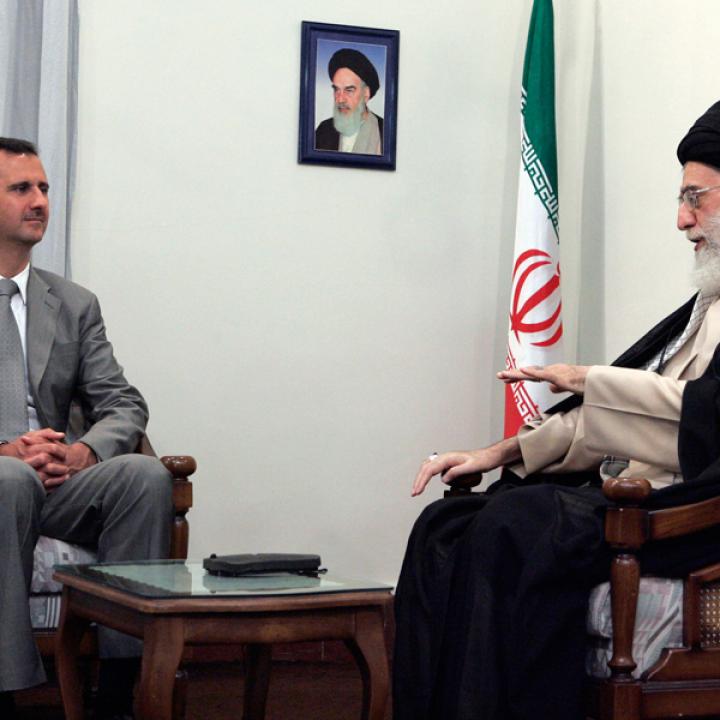
Indeed, some of what unfolded during the Dec. 28-Jan. 9 protests bears an unsettling resemblance to Syria early in its own revolt, when Iran’s Islamic Revolutionary Guard Corps (IRGC) provided intelligence and logistical and moral support to Assad. Like Assad, the Iranian regime responded to mass dissent by committing atrocities that amount to crimes against humanity, while advancing a narrative that protesters were foreign-backed “terrorists and spies.” These parallels matter because the mechanisms of repression that were tested and learned in Syria indicate how far the leaders of the Islamic Republic are willing to go to ensure their continuing power.
Before Operation Epic Fury began on Feb. 28, Iranian officials and regime-aligned analysts leaned heavily into rhetoric that echoed Syria’s civil war. The protests, they claimed, were not organic but the crafty work of foreign agents working for enemies—namely the United States and Israel—determined to break Iran up into fragments and plunge it into chaos by ousting its government.
Ironically, this narrative conveniently ignores Tehran’s own role in Syria for more than a decade before Ahmad al-Sharaa and his Islamist rebel group, Hayat Tahrir al-Sham, ousted Assad in December 2024. The IRGC Quds Force was instrumental in propping up Assad, their top regional ally, enabling numerous massacres of Syrian civilians. Iranian officials, such as the IRGC’s new commander Ahmad Vahidi and Foreign Minister Abbas Araghchi, seemed to copy and paste Assad-era rhetoric, blaming “terrorists” and the Islamic State group for the deaths inflicted by state security forces—the IRGC and its Basij paramilitary force. The fearmongering by Iranian officials was meant to silence Iranian protesters and those operating in the “gray space”—Iranians who don’t want the clerical establishment but worry that protests will fail and leave them in prison. Meanwhile, those already on the streets chanted, “Basij, IRGC, you are our Islamic State.”
The most recent protests were part of a long-term antiregime movement that has explicitly demanded the overthrow of the Islamic Republic—one that has ebbed and flowed since the December 2017-January 2018 protests and famously came to a head during the 2022 Woman, Life, Freedom uprising.
What distinguishes this latest round is the scale of the killing by security forces. The regime’s lackeys wielded knives and machetes alongside military-grade weapons, firing indiscriminately at peaceful protesters and also bystanders running errands. This violence mostly occurred under the cover of a communications shutdown designed to conceal the regime’s atrocities and blunt the outrage of the Iranian people, some of whom have been so brutalized that they opted to sing and dance in protest rather than mourn their slain loved ones, suggesting that the fear machine of the Islamic Republic might finally be losing effectiveness.
And as fear dwindled, fury rose in response to the Assad-style atrocities. Iranians reported that protesters’ corpses were treated like lumps of meat, dumped in piles from ice cream vans and meat trucks, forcing relatives to search for their loved ones in the most dehumanizing way. One father reportedly spent at least 12 minutes looking for his dead son, calling out repeatedly, “My dear Sepehr, where are you, son?” A channel associated with state media took it upon itself to mock the deaths of the protesters by asking a macabre multiple-choice question: “Which refrigerator does the Islamic Republic keep the bodies in?”
Authorities reportedly charged exorbitant sums to families of killed protesters and even forced them to sign paperwork that claimed they were martyred members of the Basij. The Assad regime also used to control public displays of mourning for those killed by its own security (or by IRGC proxy Hezbollah or by Russian airstrikes), forcing grieving families to limit or cancel burial rights and to falsely proclaim that their loved ones were “killed by terrorists,” the de facto way of referring to antiregime dissenters, or that they merely died in a random “accident.” In Iran, forcing mourners to count their dead among the Basij may help explain the rise in the death toll among Iran’s security forces—207, according to the nongovernmental organization Human Rights Activists in Iran (HRAI). Reports emerged that families of detained protesters were forced to attend state rallies marking the anniversary of the 1979 Iranian Revolution on Feb. 11 if they wanted their relatives to be released or spared from execution, or to have their sentences reduced. And yet, despite this repressive atmosphere, Iranians continued to defy the regime. In mid-February, they marked 40 days since the deaths of protesters, and in some cases were fired upon by security forces, while there were further protests at numerous prominent universities across Iran at the end of the month—even as the threat of war loomed over the country.
Iranians reported that authorities also pushed for “dafneh dasteh jami,” or mass graves, to hide the true death toll from the uprising. Some corpses weren’t even given the dignity of a body bag, presumably because authorities ran out. Some protesters who dared to enter a hospital with injuries, knowing they could be arrested afterward, were reportedly shot point-blank in the head; they were discovered at the morgues and forensic centers with catheters and medical devices still attached. Doctors and nurses were also detained for treating protesters. The messages that poured out of Iran in January were always the same: What the media reported was only a sliver of what transpired across all 31 provinces.
According to HRAI, at least 6,488 protesters were killed, with another 11,744 cases under review—now delayed by the war—with more than 53,000 arrests. The U.N. special rapporteur on human rights in Iran, Mai Soto, suggested that the number may exceed 20,000, while anonymous senior officials within the Health Ministry said it may exceed 30,000. By even the most conservative estimates, the regime killed more people in December and January than during the 1979 revolution itself. “You have to go back to Agha Muhammad Khan in the 1790s to witness a similar intensity of violence meted out by the Iranian state against its people,” Ali Ansari, director of the Institute for Iranian Studies at the University of St. Andrews, told me.
The numbers surpassed those from the first few months of the Syrian uprising in 2011, as a friend of Syrian background recently lamented to me. But these unprecedented numbers would come as no surprise to Syrians assaulted for more than a decade by the IRGC. Syria was a practice run for what to do at home when the Islamic Republic faced a threat to its continued existence.
Nor was this the first time the regime committed crimes against humanity. The U.N. Fact-Finding Mission on Iran concluded that such crimes also occurred during the 2022 uprising. Decades earlier, the clerical establishment carried out the mass execution of thousands of political prisoners, which became known as the 1988 massacre—an episode that human rights organizations say rose to the level of crimes against humanity.
If trust between the Iranian people and the clerical establishment was lost years ago, it has now been permanently severed with the regime’s crimes on full display. The Islamic Republic crossed a threshold of no return, much as, in the minds of many Syrians, the Assad regime did in 2011, when it began firing live ammunition on peaceful protesters, and then on their funeral processions. Despite his brutality, Assad failed to extinguish the Syrian uprising and instead plunged the country into civil war, inviting assistance from foreign actors like Iran and Russia, while unleashing airstrikes and chemical weapons on his own people.
If the Iranian regime succeeded in violently (and temporarily) suppressing the latest round of mass protests, it now finds itself facing another war, this one on a larger scale and with seemingly no endgame. President Donald Trump and Israeli Prime Minister Benjamin Netanyahu have, on numerous occasions, framed the war as about regime change—feeding into the deepest fears of Iran’s leaders. Reports that Iranian Kurdish groups may be receiving arms have triggered alarm bells about allegations of separatism, while Trump has suggested the map of Iran will “probably not” look the same after the war—the “Syrianization” of Iran.
For now, the war—with the constant roar of jets overhead, some residents fleeing the capital and strikes hitting all parts of Tehran, including oil depots that momentarily turned the capital into an apocalyptic movie—has kept people largely off the streets. More than 1,351 civilians have reportedly been killed (including at least 207 children), according to HRAI, which underscores the scale of destruction. Yet moments of defiance are still occurring. When Khamenei was killed, antiregime Iranians in various parts of the country flooded the streets and danced in celebration, waving white napkins and honking their car horns. And when Khamenei junior was ordained heir apparent, some even promptly chanted “Death to Mojtaba” from their windows.
Meanwhile, there is a heavy and bullish security presence on the streets, and flag-waving pro-regime rallies to intimidate. The inherently paranoid regime has plunged Iranians into digital darkness through an internet shutdown while sending numerous threats via text message about killing anyone who dares to protest.
Iranian state media has signaled that, too. One presenter threatened that after the war ends, the security apparatus will pursue “every single one of you” inside or outside the country, warning dissidents that they would “make your mothers mourn.” Authorities have also threatened diaspora Iranians with transitional repression similar to Assad regime tactics, including asset seizures, travel bans, harassment and retaliation against family members in Iran—some of which is already starting to happen. The national police chief, Ahmad Reza Radan, has gone further, declaring that protesters would be treated like an “enemy” and that forces under his command have their “fingers on the trigger.”
Since January, antiregime Iranians have increasingly worried about a Venezuela scenario, in which the United States strikes a deal with the clerical establishment, thus enabling even harsher repression of the Iranian people.
Last year, the Islamic Republic carried out the highest number of executions since the 1980s—some 2,066, according to the Washington-based Abdorrahman Boroumand Center for Human Rights in Iran. Even before the war began, it was on track to beat that number, with at least 587 since January. Many rights organizations fear that repressive tools could rise dramatically in wartime conditions, recalling the mass killings of political prisoners in 1988. One Iranian who briefly managed to get online wrote: “Even though another country is attacking us, I’m still more afraid of the officials in my own country, and I don’t even know what to do with that feeling.”
For years, protesters have sought the end of a system that has proven beyond repair and incapable of reform or compromise. If the Islamic Republic emerges from the ashes of this war and continues to survive, it will turn an even more brutal brand of its ire inward, against the people, unleashing violence and repression not seen before.
This article was originally published on the New Lines Magazine website.