
About the Authors

Brief Analysis
What are the prospects for liberal democracy in Iran, and what can the international community do to help the ongoing protest movement? Watch video or read a transcript of this special event.
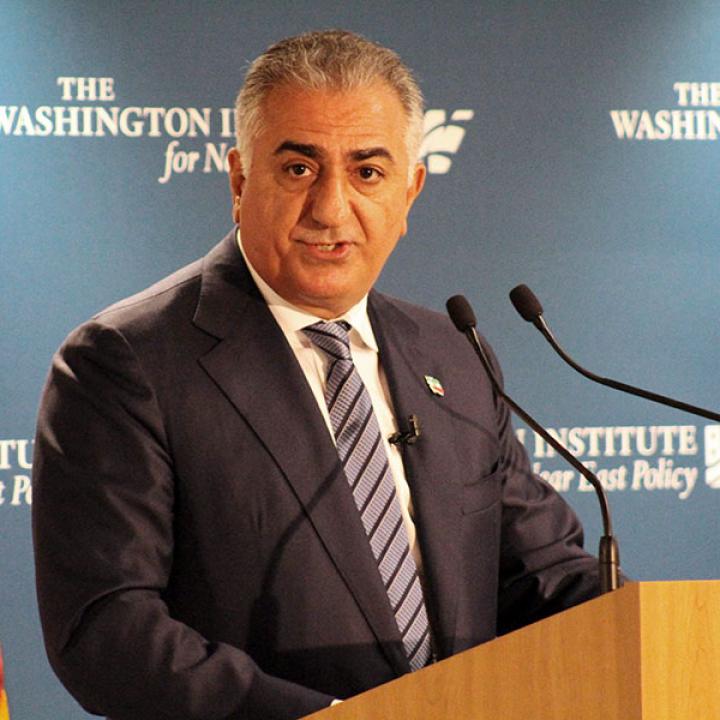
On December 14, 2018, Reza Pahlavi, son of the late Muhammad Reza Shah Pahlavi, addressed a Policy Forum at The Washington Institute. The following is a full transcript of the event, including a Q&A session moderated by Institute fellow Mehdi Khalaji.
Mehdi Khalaji: In roughly two months, the Islamic Republic of Iran will celebrate the 40th anniversary of its founding in Tehran. Since its inception, the regime of the velayat-e faqih, or the guardian jurist, has brutally crushed dissent and employed anti-Americanism as the guiding principle in its uncompromising foreign policy. The international community, responding through a combination of both appeasement and pressure, has been distinctly unsuccessful in prompting a change in Tehran’s regional behavior. And no opposition movement has thus far emerged to threaten the viability of the regime.
Today, the Washington Institute for Near East Policy is pleased to host former crown prince Reza Pahlavi, the son of Muhammad Reza Shah Pahlavi, to discuss the current state of the regime in Iran and the prospect for political change. Mr. Pahlavi is a prominent opposition figure and has consistently called for replacing Iran’s current regime with a secular liberal democracy. Please join me in welcoming Mr. Pahlavi.
Reza Pahlavi: Good afternoon. I’m very happy to be here today and I express my gratitude to The Washington Institute for hosting this discussion. Organizations like The Washington Institute continue to play a critical role in advancing scholarship and understanding regarding the modern Middle East. Their contributions to the formulation of foreign policy can be particularly meaningful, especially during the more sensitive or turbulent periods in our region’s history.
I would like to begin by invoking a popular protest slogan that is heard often these days in universities, factories, mosques and streets across Iran. I quote my compatriots: “Our enemy is right here; they lie when they say it’s America.” Perhaps no other rallying cry communicates more effectively Iran’s wholesale rejection of the Islamic Republic.
From its inception in 1979, the Islamic Republic sought to subvert Iran in order to advance its own ideological, economic and security interests. It changed our centuries-old flag and suppressed our ancient traditions. It purged our universities and persecuted or killed our artists. It institutionalized inequality and discrimination based on religion and gender. It destroyed the very soil, air, and water that comprises Iran in the physical sense. And it plundered, voraciously, stealing our people’s private property, appropriating major Iranian businesses and siphoning off revenue from trade in our natural resources.
With wealth taken from the Iranian people, the regime worked to spread its brand of hate and destruction throughout our region and to cause instability and conflict worldwide. It established paramilitary organizations and other non-state actors to serve as proxies for the destabilization and subversion of our neighbors. It threatened the world with weapons of mass destruction. It fomented and prolonged sinister wars that have left hundreds of thousands of Muslims dead and made millions of others refugees. And it both sponsored and conducted terrorism, killing countless innocents in the Middle East, Europe, South America and the United States. Thankfully, its two most recent known foreign terror attempts were uncovered and prevented in Europe.
The Islamic Republic took our land and our nation hostage. At least until now, it has survived, but only through fear, repression and violence. But Iran and Iranians have had enough. In the face of seemingly insurmountable obstacles and untold risks, the Iranian people have opened a new era of opposition to the regime. In towns and cities across Iran every day, they are confronting it tirelessly and courageously. Through public protests, labor strikes and innumerable acts of civil disobedience, they are expressing their rejection of its every principle, element and faction. They want their freedom, their dignity and their country back.
To the international community, the promise of my compatriots’ movement represents a historic opportunity to achieve an enduring solution to the numerous threats emanating from the Islamic Republic. In fact, this is an opportunity to transform the Middle East, because a democratic Iran will be representative of its people, and a representative Iran will be a very different force outside its borders. Consider whether a democratic Iran would promote Shiite revolutionary politics, prop up terrorist organizations like Hezbollah, Hamas or the Houthis, facilitate the shameful mass murdering of innocent Syrians or Yemenis, or threaten Israel with destruction. Of course not!
A representative Iranian government will reflect the culture of Iran and the feelings and aspirations of its people. Envision an Iran that works closely with its Arab neighbors to stamp out terrorism and extremism in the region; that welcomes Israeli scientists to help with its water crisis; that embraces American and European investment in the boundless potential of its economy; that shares its most brilliant minds with the great centers of learning and development in the West; that exports its dazzling art and beautiful music; and that honors its country’s spirit of love and tradition of friendship toward foreign nations.
Again, I point to the actions and words of my compatriots. In universities in Iran, students sidestep or leap over American and Israeli flags painted on the ground—this is both a remarkable rebuke toward the regime and a moving illustration of Iranian goodwill. In their protests, my compatriots chant: “Syria and Palestine are the reason for our misery”; “Leave Syria alone; think instead of conditions at home”; “Neither for Gaza, nor for Lebanon; I’ll die only for Iran”; and “We may die, we may die, but we will reclaim Iran”.
For almost 40 years, I have worked toward a single objective: a secular democratic Iran built upon the pillars of human rights and rule of law. I have insisted that the Islamic Republic poses an existential threat to Iran and its people, and that the Islamic Republic cannot be reformed. I have been steadfast in my belief that a secular democratic Iran may be achieved only through non-violent means. And I have been unwavering in my faith that the Iranian people can and will be the principal agents of change. But international attention and support remain critical.
Dr. Martin Luther King is one of my personal heroes. As I work to build international support for the Iranian people’s struggle, I often recall his famous covenant that “we will remember not the words of our enemies, but the silence of our friends.” In that vein, I want to make clear that the Iranian struggle should not be viewed through the prism of domestic partisan politics in this or any other democratic nation. This is a struggle about human dignity and liberation and it deserves equal and unqualified support across the democratic political spectrum.
At no time in its almost 40-year history has the Islamic Republic been as unpopular and vulnerable as it is today. Foreign policy toward Iran should be mindful of the reality that my compatriots are presently in the throes of a national struggle to reclaim Iran from the Islamic Republic. My focus is on guiding this process of change so that its outcome is secular, democratic and lasting. Thank you very much.
Khalaji: Let me thank you again for accepting our invitation and giving us this opportunity to discuss this issue further with you. The anniversary of the Islamic Republic will be in about two months. Many people agree that Ayatollah Khomeini was an outstanding leader in converging all political dissent and opposition groups who were working against the shah’s regime. He led the revolution and succeeded. After forty years, what lessons can we draw from his experiences as a political leader for someone who wants to change the regime today?
Pahlavi: First of all, I do not think we can compare the circumstances and climate back then to those of today. Let us not forget also that one of the key factors that transcended the individual was the element of religion. Something that despite 14 centuries of the Islamic religion in our country was not quite understood the way people understand it now. It had to come to an actual inquisition of the Islamic kind for people to understand the importance of secularism in the context of separation of religion from governance as a prerequisite to democracy and equality. In so far as Khomeini did in fact bring in an ideology and political Islam as opposed to what the faith was supposed to be like, and after 40 years of suffering under this dominant religious ideology, I think Iranians today are at the end of a tunnel and think that what will bring us to an era of change is not just the work of a few individuals, but it takes a whole village to bring this about. I think Iranians today, particularly the younger generation, are far more proactive in knowing that in order to achieve everything, you can no longer sit back and expect one person or entity to do everything. It takes a lot of us to bring about change. And if there are some leaders who play roles in terms of leadership and guidance, which is of course necessary, it is certainly helpful, but it is not limited to that. Khomeini was able to be the agent of contradiction to the status quo. The opposition thought at the time let’s get rid of the shah and see what happens. What we say today when discussing the future of Iran is to say it is not just enough to say we don’t want this regime anymore, but what do we want instead? This time understanding fully what it is we want to achieve, what it will take, and as you all know, Iran is very diverse in terms of its political spectrum—left, right, monarchists, republicans, federalists. But one thing is certain: the majority are secular democrats and they understand that today our job is to figure out what is more important. Our priority in terms of our national interest that is the common denominator of all these diverse groups, which is why we can work together in unity; or is it going to be the game that the regime has tried to impose on us all these years and force a secondary issue of ideological debate between a particular aspiration versus another, forgetting about the most important issue of our national interest. This is what it is all about. Back then nobody was worried about participation—it was just, “Let us get rid of this regime.” Nobody knew what the Islamic regime was supposed to be like. By the time they realized, it was too late. This time, we want to do it clearly using our own political historic experience as well as other countries that finally overcame the hurdle of dealing with totalitarian or authoritarian systems and understand what is the benefit with replacing it and with what and why we have to be committed to it. I think today the situation requires the participation of a multitude of actors, players. We each have a role to play, including yours truly.
Khalaji: Islamic ideology is similar to communism in the fact that communism was an idea that was born in Europe, but realized in Russia. The idea of the Islamic republic or Islamic government was born in Egypt by the Muslim Brotherhood, but it was realized in Tehran, in a country that is proud of its pre-Islamic civilization and identity. Why is that? How do you explain that?
Pahlavi: I think Iran was the best platform for launching this missile at the free world by Khomeini against the interests of the Iranian people and those of our immediate neighbors and around the world. He could have done it from Tunis, from Syria, or even from Iraq. But Iran presented all the means necessary to be at the service, unfortunately, of this imposed ideology. I want to say something here that I think is more important for all of us today to understand—something that around the world remains the same obvious issue: the dominance of any ideology exclusively, religious or otherwise, is a recipe for disaster. We saw it in the case of communism in the Soviet Union. We clearly see it in the case of Iran. How do you explain that Muslims are much freer living in countries like Canada and the United States than in their own so-called Muslim countries? What is the element that is different here? The answer is simple: a guarantee by the constitution of freedom of religion as one of the liberties that people have [applause]. That does not exist in Iran today. Today if you are a Baha’i, you cannot study. If you convert to Christianity, they will execute you. You do not even have the basic circumstances where a Sunni, a Baluchi, or a Kurd can have his own mosque to pray in. There is discrimination of the worst possible kind—and we can begin with women. There are so many other examples. And when people look at all of this, whether it is their ethnicity, their religious beliefs, their sexual orientation, or political ideology, what is going to give the Iranian people in the future a guarantee of equality under the law and eliminating any form of discrimination while guaranteeing maximum participation? It can only be a secular, democratic system. That is why people today gravitate around why we need to get rid of this regime and why we cannot attain democracy without putting an end to this regime.
Khalaji: What do you mean by secularism? The Pahlavi dynasty is known for its distinct secularization program since Reza Shah Pahlavi. We saw this backlash from society and the emergence of the Islamic Republic. What do you think good secularism could be in a future Iran?
Pahlavi: I think it is important for those who have religious aspirations—devout Muslims in this case—that being secular does not mean you are anti-religious. Did Europe lose its Christianity after the inquisition? Of course not; secular values and guarantees of equality and non-discrimination cannot be done when one religious ideology think that it has superiority over another faith or another belief. It goes without saying. That is what people have learned under this regime. If you talk to people today in Qom, if you talk to traditional clerics who were never a part of this regime, if you talk to people like Ayatollah Sistani—their narrative will be very different than what Khomeini tried to impose on Iran—and for that matter, in the Islamic world. I do not think even within our religious establishment that the traditional clergy has any misunderstanding that, particularly in the case of Shi’ism, there cannot be any governance of religion or religious elements. In fact, it goes against the very tenants of Shi’ism. The only people who are supposed to be the representatives of god on earth are those who have not committed any sins. We know there are only five of them. And they are not around by the way. [applause] [laughter]
So let us go to the twenty-first century of where Iran could be. The secularization and modernization of Iran is something that people today when they compare to where we are see that what created an obstacle and rewound the clock to the dark ages has been the appearance of this so-called religious government. In fact, Iran could have realized all its potential had it not been for a revolution that executed so many people who had worked tirelessly to build that country and forced a massive exodus and brain drain of people who were persecuted because they were a member of the previous regime or because they were Jewish or homosexual or what have you. Iran today should be like South Korea. But instead we have become North Korea. Is it because we lack the resources? Is it because we lack the human potential and ingenuity? Iranians are running half the show in most foreign countries that they have become citizens in. Look at America alone. Why are they not back in Iran? Why do they not have the opportunity today to help their country be the best it could be? It goes back to this element and obstacle that is discriminating. I have no doubt that the minute the situation changes, everything that has meaning for the people on the streets—I am not talking about an intelligentsia debate of the values of democracy and human rights—but to the man on the streets, to that worker who has not been paid his salary for the past six months, for people who have to sell their organs in order to survive, they understand that this potential for Iran’s economic recovery and well beyond that cannot happen while you still have this regime. If we are good students of what actually happens to us, I think the light at the end of the tunnel will show that Iran this time will understand the virtue of secularism, not just because they happen to have two modern-thinking monarchs who in their era did whatever they could, which is why they are chanting their names today in good remembrance, but also because they realize that without this our society will not progress. This is a demand that I can sense every single day as I talk to my fellow compatriots. And yes we will absorb also the fact that we can be modern and secular without having to lose our traditions, including our various religious traditions.
Khalaji: Your father was a secular shah, but he was calling himself the king of Shia because the monarchy in Iran, even in pre-Islamic Iran, was getting its legitimacy from religion. So there was an alliance between the clerical establishment and the monarchy. So if you become the king of Iran, what would your source of legitimacy.
Pahlavi: We cannot compare what happened a century ago during the constitutional revolution because if you follow it more closely, you know that when we had an amendment to the Iranian constitution a year following the drafting of the first constitution, some kind of compromise was reached with the religious establishment to try to preserve this newly brought about constitutional system against an absolute monarchy. The unfortunate compromise was to allow for the five mujtahids to be sitting in parliament, ruling over whether certain laws would be compatible with sharia law. This was the beginning of the flaw of separation of church from state. But do you think the kind of secular arguments and debates Iranian have today in Iran or outside beyond the breaking of the taboos of talking about religion existed at the time? Of course not. When my father tried to bring in emancipation of women and their full participation in their own system, when he brought land reforms and put an end to feudalism, who were the elements that resisted these changes? It was the clerical establishment, including Khomeini. Did people then understand the importance of having to stand up to the clergy? No. My grandfather was so tough vis-a-vis the clergy. But do we have to use the same means to achieve the same ends today? No. It must be built in our collective national psyche and appreciation of democratic governance and the guarantee that the rule of law is ultimately what the constitution prescribes. I have always said that I believe it is the constitution that defines us, that regulates us, that governs over us. That is a choice the Iranian people will be able to make once we are rid of this regime so that those who are in charge of drafting a future constitution will build in all these safeguards. I believe that we should have our constitution based on the universal declaration of human rights because in one shot it will be dealing with so many issues that our society had to face for centuries including the modern era as it relates to children’s rights, women’s rights, ethnics—whatever it is under the rainbow we can think of—built in as a guarantee so that it is not by virtue of legitimacy claimed by one individual with some kind of arrangement with some governing ideology. We have reached a stage, I dare say as modern Iran could be in the future, that we ought not to have an official religion, or an official anything. The rule of law should guarantee any Iranian to have the liberty of his or her beliefs as long as their beliefs are not imposed on any other person. It is basically pluralism and the respect for agreeing to have diversity amongst ourselves. What unites us and guarantees us—each single one of us, whether we are Turk, Arab, Muslim, Christian, atheist, straight or gay—everything will be guaranteed by the rule of law. That should be what establishes the guarantees, not one individual or institution but the law of the land.
Khalaji: Let me ask the last question about the past and then go to the future. You were seventeen years old when the revolution happened. Since your father passed away, you became the head of the family. You became politically active while the other members of your family were not that much active. Especially the women in your family are not politically active. You have three daughters, your wife, and even the queen has not played a bold political role in the last 40 years. Why are women in your family not politically active? How do you assess your record in the last 40 years?
Pahlavi: I am glad you are asking this question. I think a lot of people have yet to fully understand what is actually my role. I have some kind of historical meaning in terms of someone who need not take a political position or advocate a particular ideology or political system of thinking in order to be known. My role first and foremost is not political. My role is to be able to help a diverse set of political ideologies to understand the priority we face today about the commonality of interest in a democratic Iran in the future. I don’t have to take a position on whether someone is a socialist, conservative, monarchist, republican, federalist, centrist, or what have you. That is not my role. My role however is to help as much dialogue and unity of purpose to what is today our first and foremost priority, liberating our homeland. There will be ample time to debate. That is not my cup of tea. Political parties will form, they will debate policy. As a result, governments will be formed. The composition of parliament will be changed, as we have seen in this country over the midterm elections. That is like in any other democratic country. It is not my role to take a political position, and virtue by that understanding, you should expect any member of my family to do that either. On the other hand, we could be advocates on many subjects that touch Iranian society today. My daughters the way they can, my wife the way she can, my mother the way she did and still can. We are here to assist and to help and to support our compatriots. At the end of the day if you are talking about what future form Iran will have, again that is something the Iranian people will have to decide. From the day I started this struggle after my father passed away, when I was in Cairo, I made it a life’s mission and set a limit and a finish line for myself as my sole and only political role: to help Iran be liberated from this current regime. I saw it maybe earlier than others. Some people have finally tuned in and realized that reform is unattainable and therefore today, many former reformists are converging with us who from the beginning were advocating a secular system rather than a religious dictatorship to get to that point and let the people of Iran in a truly free and fair election decide their fate. The day—and I have said it for 38 years and will continue saying this—the day Iranians go to the polls to make that decision, I will consider that mission accomplished in life. So that’s what my function has been all these years. I’ve been in dialogue with a variety of political groups inside and outside of Iran, and trying to see how we can preserve that priority in our minds, appreciating and respecting our diverse viewpoints, but understanding the only time we can benefit from the rights to differ is after we have struggled with the same cause to attain liberty, without which we won’t be able to have these debates and differences. That’s why we have to give—hold hands and get this done because our country is at stake, our future is at stake. And I think it behooves those of us who have any kind of moral impact or political influence in people’s thinking and actions to remind them of the priority and what is in our best national interest and that is exactly what is the tug of war and the basic conflict that I have had with this regime. Our prioritizing national issues and the regime trying to force Iranians to fight among each other to try to basically forget about what the commonality of interest is. So that’s in a nutshell how I will ask you to understand what my role is. Not being a political one but one that is more above the fray and neutral, trying to bring as many elements to work together for a common cause.
Khalaji: You initiated some dialogue between some opposition groups in the past. Almost all of these efforts failed. Why do you think time this time it would succeed? Another question is that every revolution needs financial resources. Ayatollah Khomeini was a marja—he was getting religious taxes from people. In the sentries with the rise in oil prices, there were lots of money injected into the market and the money from market went to Khomeini’s pocket and he overthrew the regime. Besides the political elite, which seem to keep a distance from you, do you think that there is an economic class that will support you and support the cause of regime change in Iran?
Pahlavi: Well, the premise of the question is not totally accurate. As I said, I have had dialogues over the years with numerous representatives of various political groups or orientations both at home and abroad. It has only increased over the last few years and particularly the last couple of years because, again, let’s not forget one thing—until only a couple years ago, half of the nation, no matter how disenchanted they were with the system, would still put some faith in the current Iranian administration to maybe bring about something. But the past two years, you can ask any Iranian that’s monitoring closely—and I am sure there are many in this room that do that professionally every day—I am sure you have noticed how different the read on the streets are as opposed to a few years ago. It’s a different ballgame. Sometimes you have to have circumstances be available in more than one category for something to successfully happen. It’s not enough to have an organized position. It is not only enough to have protesters in the streets without political leadership. It’s not enough only to have an entente with no international support. There are many elements that have to happen at the same time for something to happen. I mean, if NASA was going to give up when they launched their first rocket and it failed and not try it again, we would not be where we are today. In politics, sometimes you have to try and try again. The difference is that today we all know that not rising up to the challenge is contributing to a post-regime state of chaos. That’s really where the bad news is. I’m not worried about whether this regime will collapse or not. That’s a given. What we ought to worry about is are we going to be facing a controlled implosion with the recipe of a secular outcome as opposed to the remnants of the IRGC thinking that, like in the post-Soviet Union collapse there will be a state of anarchy and they will have a justifiable, this time neck-tie-wearing, dictator as opposed to turban-wearing dictators. But in the end, it is still controlling the national resources of the country but not in the interest of the general population. You also mentioned something very interesting. Look, we have been seeing a policy that included economic sanctions on Iran and, yes, the Iranian people have suffered but so has the regime.
But in the area of constructive assistance, not much has really been done. Right now as we speak, we have elements that our representatives or financially or by virtue of family relations, linked to this regime who are roaming freely, including in America, and there are many resources and assets that the regime has plundered in Iran that they have reinvested to their own gains that could be frozen and controlled and given to the democratic forces instead of being at the control of the regime. Talk about creating wealth when there is no wealth within Iran. There are so many areas where misplaced funding can do harm as opposed to the right targeted sanctions that could help us. During the previous administration, what happened? Almost $1.7 billion in cash was given to the regime during the JCPOA. Was it spent on the Iranian workers, was it spent on Iranian schools? No. It probably ended up in Syria or elsewhere. These are the kind of questions that the opposition is asking when it comes to resources that could be made available and potentially it exists. It doesn’t come from thin air. But these are elements where if properly utilized will be the difference between the regime continuing to plunder the nation and sustain itself as opposed to making a move that will be I think very seriously monitored and encouraged by Iranian dissidents at home and abroad that finally we are getting the help we really need. Despite the regime’s censorship, the regime’s pressure on the people, despite their means to control or to influence or to infiltrate foreign-based media that’s broadcasting programming into Iran, let’s see where the real changings are happening. Otherwise, giving the Iranian people lip service that we are with you but not doing anything constructive to actually help them is going to be yet another false promise and disillusionment will follow. So we have an opportunity here to control the outcome by making sure it doesn’t end in the wrong hands, but it doesn’t happen by itself. You have to make you a decisive choice of working with the forces that represent change. Let me give you a very final simple example. During the period that led to the outcome of collapse of the Soviet Union, beyond the Soviet Union itself, it was not without working directly with movements such as Solidarity in Poland, individuals such as Vaclav Havel in Czechoslovakia, or for that matter ANC and Mandela in South Africa. It was a direct engagement with the forces of change. Not limited dialogue only with the regime and its representatives and hoping you can get answers to the problem from people that are part of the problem as opposed to people that can be part of the solution. These are the areas where we need to go beyond just analysis of, you know, topography of Iran and where people are today. There is a constructive way and I hope this will be taken into account by decisions that foreign governments are making today in how they can cope with the situation as they are facing more and more implosion by the regime. However, everybody is holding their breath. What can happen next? If we don’t address it, if we don’t work the problem, it’s a recipe for disaster.
Khalaji: Let me come back to the role of foreign countries. The picture you provided about the situation in Iran seems very optimistic. I think you portray Iran as if Iran is in a pre-revolution condition while there is a big difference between what we see now in Iran and what we saw in Iran in the last years of the shah. First of all, the beneficiaries of the Islamic Republic consist of millions of people in Iran and on the other hand, the repressive machinery of the Islamic republic is working. Despite the sporadic protests since last winter, we see that the Iranian government was able to control everything. So why do you think that the government is facing a fatal crisis, which makes it vulnerable in the face of opposition?
Pahlavi: Well, let me make sure I understood what you said correctly. The situation in Iran in terms of being revolutionary, you’re suggesting that it does not exist because there is repression?
Khalaji: Yeah. I mean the government seems very self-confident in oppressing the opposition and actually having control over all this, you know, sporadic protests that happened here and there. And in its foreign policy, why do you think the Islamic Republic is so vulnerable in the face of efforts made by opposition or despite all the foreign pressure?
Pahlavi: Well, I think this would be a first if we began to believe that oppression is a sign of confidence. I think oppression is a sign of complete insecurity. If this regime was so confident, why would it allow a Vahid Nasiri to die in jail? [applause] Why would it be afraid to allow Iranians to hear the news and have free access to the internet and not filter various popular platforms such as Instagram or Telegram? This is not a sign of confidence. That’s a sign of losing control. And more oppression means we don’t have an answer for it. No. I think we are in fact very close to the state of explosion but there are some ingredients that have yet to be utilized in order for us to in fact take the next step towards a transition from this regime to the next. And the most important component in all this is, yes, the role that the military and paramilitary forces could play in this transition. Which is why one of my messages has been very specific to military or paramilitary elements, that you could be part of the solution, that you need not go down with the ship, that Iranians cannot hope to achieve freedom on the basis of violence, hatred, and revenge, which is I have been an advocate of civil disobedience and nonviolence as opposed to vigilantism and people taking up arms and killing a few Basijis and not expect that the children of those people will one day come and murder your children and therefore it’s an endless cycle of violence and we will never achieve stability and security. But to say that, yes, there will be a place for somebody who today is a revolutionary guard or is a Basij, who is as disillusioned as the rest of us are—and that there will be a future for them. And there should be a place for them. They should know the first elements that can guarantee the stability and security of Iran are in fact people like themselves. But do they want to be members of a newly established dictatorship against the people or be in fact there to help their people, be their shield so that a Bashar Assad-style genocide does not happen in Iran against the opposition. That in fact it is with the people that they can defend the people from the last remnants or last desperate attempts by the regime to crack down on the opposition. As we speak, this is happening. At least I am privy to it on the basis of direct communication I am having more and more every day with representatives of the military and paramilitary forces. At some point when people on the streets know that these are people who will no longer accept to do the dirty job for the regime—that in fact they will be on their side—they will be more hardened. At that point the Iranian middle class and intelligentsia will understand: maybe now the risk-reward warrants us to take more risks and join with the silent protesters on the streets so we facilitate this transition. That Santiago moment is going to happen. We are very close to it
Khalaji: Let me ask you the last question before we open the floor to Q&A. What kind of policy do you think, especially the Trump administration, can take in order to support the democratic movement or so-called democratic movement if it ever exists in Iran?
Pahlavi: Well, messaging is very important. Communication is a vital key and daily need for coordination and communication of Iranians between themselves and with the outside world. One thing that could certainly be helpful is to tell all the media that are supposedly broadcasting program to Iran to take the Hippocratic Oath, meaning, first do no harm. These are agencies that American taxpayers or British taxpayers have been funding but basically have been heavily penetrated by reformist elements that are basically there to support the regime. That’s something that as a matter of policy you could change instantly. That’s one aspect. [applause]
Number two, as I said, it’s the freezing of the assets of elements that are well-known by the regime to the benefit of supporting instead forces within Iran who definitely need help because let’s not forget something: the price Iranian demonstrators are paying today is extremely high. Not because they could lose their jobs or lose their lives, but their families, their wives, their children’s lives are at stake, or their husbands. And they can’t go on forever fighting not knowing there will be some kind of resources helping them and assisting them. Rechanneling of these issues and a revisiting of exception to certain elements of sanctions that have been blanketly punitive. It is like fishing, sometimes when you do tuna fishing you catch some dolphins in the net. How do you separate the bad guys from the good guys? That has to be re-thought a bit more. Of course, there are so many other issues. But it will take too much time for me to rehash. So I think media is one aspect. Working with the dissidents and political organizations. And above all, a request I hear every single day—one of the things my fellow compatriots ask me to say every chance I get, including in a meeting like this one, is let the world know what we’re going through. I brought a list which is a sample of all sorts of links, especially members of the media; highly encourage you to go out there. This is not like the time when I was in Cairo when the first message I sent was from a telex machine. There were no such things as iPhones that could you turn on in the middle of the desert and get all sorts of platforms and instant messaging and what have you. Today the world, particularly the media, cannot claim that we don’t know what’s happening in Iran. There is such an abundance of information out there. The analysis of information and what people will want will tell you pretty much what is their expectation, and for that matter what they expect foreign governments to do for them. In today’s Iran, Iranians knows full well that fighting this regime will be much more difficult without foreign support, without foreign governments helping. And yes, we are not at all frazzled about by getting foreign support because that doesn’t mean interfering or imposing a future for Iranians. We say help us liberate ourselves with no caveat and no strings attached. We want to have our self-determination and it has happened before in history when countries have been liberated without people having a price to pay in terms of foreign domination in one form or the other. I think democratic countries today—America is perhaps the most important one of them—can decide whose side they’re on. During the green movement, what was the leading slogan in Iran? People were saying: Obama, Obama, are you with us or with them? What does that mean? That means, do something. Take a position. And when the answer was we don’t want to interfere in your domestic politics, it was a bucket of ice water on the head of so many people during that time and that generation. Do we want yet another generation to come to the streets, to chant slogans in English and in French and in foreign languages? They are not practicing their linguistic skills. They are sending you a clear message. As long as we understand it will take that kind of intervention and intervention is different than interference. I’m talking about assistance and support. I hardly think that we will be able to get that level of engagement that the country needs to the detriment of the nation and to the benefit of the opportunists. On the other hand, if there’s actual dialogue—for the first time in 40 years—official government dialogue with representatives from the Iranian secular democratic opposition at home and abroad, as opposed to limiting dialogue only with the regime and its representatives, then I think we will get much quicker to an answer for how to resolve the problem and how can we work jointly amongst those of us fighting for freedom, irrespective of foreign governments and irrespective of the administration in play. This is something that is part of the expectation. If I were today talking to anybody in the White House or at state or congress, my message hasn’t changed. It’s always been the same. Talk to the people who are your—how can I say—your natural allies, because the strategic interests of this country and that of Iran is one of the same. As opposed to this regime, which completely the opposite of it. So have a dialogue with those of us who happen to advocate the same interests that’s in your strategic advantage as opposed to those who from the get-go were against it. The time has come for that. That is part of the expectation that all of us have and I think there are enough people in this world who will understand this is an opportunity not to be missed and I hope we will achieve that.
Audience Question: It is said that the opposition in Iran lacks organizational structure. Do you think that’s a fair comment? How big a problem do you think that is? What do you think can help bring organization and structure to the opposition in Iran?
Pahlavi: As I said, it has a number of components. First and foremost is the ability to organize and that cannot happen with some degree of structure. It depends on communication and the ability to disperse information both at home and abroad and be able to establish dialogue. Any assistance given in terms of technology, in terms of access, in terms of not allowing the regime to disrupt and/or curb such communication will be of vital importance. I remember a couple months ago I was talking to somebody who was an expert in terms of what can be done for internet access and at some point a company like google came up and the fact they can circumvent the regime’s attempts to bar access to the internet by satellite or what have you. And the problem was really with the legal department of that company saying, hey, we cannot do that because this is a violation of our sanction policies. I think these are the kind of things that will help us have better means in terms of our activities, and organization, in terms of political coordination, is, of course, another aspect of how we can communicate those who are active outside with those who are active inside. And there are all sorts of different issues for access depending on the point of focus of one particular group versus the other, in terms of coordination and assistance to the current day, everyday actions that people are taking on the streets. To that extent, there’s been some element of success. It’s the next step that’s more important. In other words, preparing the state for transition. And that’s the part where there has to be more of a tangible mechanism of representation as diverse as possible of the secular democratic forces both at home and abroad so once this regime collapses, people can be familiar with the faces or the people or the groups that will be able to manage this transition. One of the key questions for those of us to be successful in bringing about a temporary provisional government that will be in charge of two things: running the country temporarily for a couple years while the whole process of constitutional debate goes on and preparing the state for the first available opportunity to conduct elections so that parliamentarians who will be charged with drafting the future constitution can go about their job. It will take coordination and representation and collaboration of all the democratic forces to bring about that element. At this time, all I’m asking the democratic opposition is to find common projects of how they can assist and support the existing movement and actions that are happening in Iran today. But we ought to be thinking a little bit ahead of that as well. This is part of the conversations I am having with most of them. At some point you have to fill the void and that cannot happen by accident. And that’s part of the confidence level that people can have that we don’t have to start guessing. We need to have a better understanding of what can be the useful actors. To that degree, the current intelligentsia within Iran who has been suppressed or is a bit bashful or shy or timid about showing their face will eventually find their moment and I think most of the leadership we’re talking about is going to come out of people who are faceless now but we know exist.
Audience Question: Thank you very much. Barbara from the Atlantic Council. Very nice to see you again and appreciate your remarks. Couple of questions. Are you meeting with officials in the Trump administration to talk about these goals of yours at this point? Are you concerned that the sanctions policies put in effect by the Trump administration are actually hurting the ability of people to demand their rights because they’re worried about everyday survival? And finally, you made a reference to assets that could be somehow seized and used for the opposition. It seems as though we have frozen every conceivable asset that Iran has in this country. So what are you referring to? Thank you.
Pahlavi: Well, there are many other aspects of such assets I think can be salvaged. I don’t have the details for you. I will be happy to get back to you on that from our experts. I have yet to have any meeting with any member of the current administration on the executive side. I have throughout the years communicated our ideas with members of congress, both in the house and senate. I think at the end of the day it’s important that the core group of legislators in this country, backed by public opinion, be more persuasive of anybody in the position of decision-making in this country as to which direction their policy should be aimed at. I think there are many more people around the world, including Americans that I talk to that realize that the silent cry of the Iranian people have—it’s about time that it is heeded. Until now there has been a limited attitude, not just of the American government irrespective of who’s in the White House, but the West in general. A lot of it I think is based on this false premise of expecting behavior change by a regime whose DNA simply does not allow it to change its behavior. If they stopped doing what they do, they would no longer be the Islamic regime. As such, everything that followed forty years of the Islamic regime was based on the false expectation that we can perhaps persuade them through diplomacy to come to their senses and reach a state of compromise. Now we have come to the stage where the system is about to implode. People are on the streets. It’s no longer acceptable. We cannot just hope to obtain different results by following the same process. Something has to change. And in that case, dialogue is very important. That’s all I’m asking for. An opportunity for decision makers to talk to those of us who can in fact explain where we think it could be impactful, where it could be helpful in order to bring about the change that we are hoping to achieve in Iran. If the administration is prepared to talk, that’s great. We welcome the opportunity, and I will be happy to offer as many opinions I can as to who I think the administration should be talking to both inside Iran and outside Iran beyond the regime and its representatives. The impact of sanctions, again, if the objective of the sanctions is behavior change, as opposed to ultimate regime change, these are two different approaches altogether. I will throw in there smart sanctions, targeted sanctions. The sanctions overall have affected the regime, of course, but they have also heavily affected the Iranian people. People at this time say, how long do they expect us to tighten the belt if you are still talking to our oppressors as opposed to helping us get rid of them altogether? How about targeting the IRGC and the leadership more? How about the personal assets and bank accounts of the current leadership? That’s where they will say ouch. And go after the kind of assets that are still available to them but not to the Iranian people or for that matter the opposition. You know, these are issues that need to be discussed and solved. Where is it that a modification in certain policies will bypass issues that limit us to do anything? I’ll give another example because of the sanction policy. Let’s say you want to send money to Iran, that’s not an easy thing to do. If you want to register an organization, the minute the word Iran comes to the name, the transaction is red flagged. Transactions are stopped. These are the kind of things that penalize dissidents more than the regime. Because often they find a way to circumvent that. Does that mean that sanctions are pointless? No. But I will add to the fact that until now sanctions were imposed with the intention of behavior change and no political leader has yet to come in America, in Europe, or elsewhere to say, yes, we want to see regime change in Iran. Not by our doing. But by helping the Iranian people make that decision. You cannot come to a decision. You cannot come and say we support the Iranian people but we don’t want regime change. How the hell do you want us to get to democracy while this regime is still in place? That’s a little bit of a contradiction. So I think not just the rhetoric, but the actual revision of some policies could certainly work out some of the problems we have in there and maybe some other ideas that could be added.
Audience Question: Thank you. I wonder if I could ask you to be a bit more explicit in how you envision the scenario which I assume is a scenario of a bloodless revolution. You’ve talked about the United States officially saying they endorse regime change, more targeted sanctions. But can you tell us a little bit more how you envision this actually coming about? And just as a follow-up question, because you spent a lot of time saying that your role was to try to bring the disparate elements together, can you talk about the assessment of the MEK and whether that’s part of the problem or part of the solution?
Pahlavi: I’ll answer the second part of your question first. The continuing problem we have, or you can see with the MEK, is that they have yet to agree to work with democratic forces. Why? You should ask them. Maybe it’s because by doing so they’ll lose the integrity and control of their structure. The policy should be one of supporting a democratic process. I don’t think that any political organization in any country will benefit by being labeled or brandished by any foreign government. That goes without saying. And this is not what we are asking either. We’re simply saying that the foreign policy of what we hope will be that of the United States and its western allies, democratic allies, will be to say we would support a process of democratic elections in Iran whereby the Iranian people can in fact achieve self-determination and we will respect the outcome of their choice. That will be something that will be welcome by every element of the political spectrum who is not with the regime. It is important because they realize, my fellow compatriots that until now the regime has always tried to sandwich them from the rest of the world by putting themselves in between. And that we have actually seen meaningful change occur when there was a direct engagement with dissidents and political actors inside and abroad when change occurred in different countries. I don’t think the Iranian people expect any less nor any more. Just doing this, by the way, will be a huge sea change by what many of my compatriots have seen until now and their message through me or without me, as I said I invite you to go, you know, study on your own, is an expectation of a prise d’opposition as the French will say—we want you to do more rather than just say we support the Iranian people and the democratic aspirations. What exactly are you doing about it? These are the questions people inside Iran are asking. They want to have more tacit support, whether it is engaging with civil society within Iran, by trying to bring more logistical support, whatever you want to call it, so that we can in fact implement a variety of actions that need to happen within Iran and will help bring in a peaceful transition. The key word is minimizing the cost of change to the Iranian people. That’s been my philosophy. It’s not change at any cost. And most importantly, I have yet to see a scenario of change leading to a democratic outcome by means of violence. Usually we see one form of dictatorship replacing the previous one. No. This time we are absolutely transparent about it. We want to make sure that Iranians understand that they have the maximum degree of empowerment so that they can be the decision maker and final arbiter and that requires a more engaged approach and actual elements of support. This should be the subject of discussions and ideas that can be shared with our counterparts in the free world as to exactly how they can help us do that, both in this phrase, during the transition phase, and in the long run.
Audience Question: Thank you. One of the big differences from 78’—79’ and now is that the security forces are loyal and cohesive now and they were not necessarily back then. You said you were messaging to the security forces. What else besides messaging can peel them away? And what do you envision can entice them? In 2019, 2020 as the sanctions pressure grows, their loyalty is going to be put to the test. Will they fire on their compatriots? Will they shoot their fellow citizens if they are not getting paid? What else will entice them not to do that besides not having a paycheck? Perhaps truth and reconciliation commission. What else is out there?
Pahlavi: Yeah, certainly understanding that it doesn’t sacrifice for only some of us preaching the necessity for national reconciliation and amnesty. I think this has to be a policy adopted by the majority of our citizens, to understand that sometimes as hard as it is to swallow your pride and the pain that you had to endure because of the violation of your rights or how much harm has been done personally to one’s family or others that in the best interest of the nation at some point a reconciliation and compromise in terms of agreeing to be not vengeful but put an end to the cycle of violence is ultimately not only important in bringing an atmosphere of stability, because I think the most important element that any citizen anywhere in the world will first ask for is I want to have personal security for my life and my assets. And if there is a climate of uncertainty and instability and disorder, it doesn’t matter how many democratic forces you have at play, that won’t change. And we cannot achieve this transition without trying to get the majority of these elements on our side. And these people understand that at this point many of them have not necessarily been criminally involved in this repression but are not seen with a good eye by many of the people. They want to have a guarantee of survival from the regime. That’s critical. That’s what I talk about with them and with the people trying to convince both sides that you have to work together here. People have to send signals to, let’s say Basijis and the IRGC—and vice versa, that we can stand together as opposed to continue being versus each other. Let’s not forget one thing. It’s only the top echelon of these sort of mafia-like paramilitary organizations that benefit from the continuation of this regime. But the majority of elements within the Basij or the IRGC are not necessarily benefiting. Some of them have to work secondary jobs. They are not getting paid enough to do the dirty work on top of it. So there is a breaking point. And as we speak, especially in the few last months, as I said, I have had more and more communications coming from fairly highly situated in terms of rank elements that are sending these messages that we want to be able to be part of the solution. What do we need to do? How can you communicate the fact that we want to be with the people and the same thing I say to the people, you have to send, respectively, your signal to these elements that we are not here to get you or to take revenge upon you. We want to have a peaceful transition. Yes, the criminals will have to account for one day in a court of law. But the majority of these people cannot be held directly responsible for having committed a crime or simply because they have to follow up orders. It’s not an easy proposition. It’s always easy to be emotionally sometimes driven. But I think a certain degree of rationality and deeper thinking prevails. That it takes so many of us to guarantee there is going to be a controlled outcome by each playing our respective roles. We are in a mode of defiance right now, but as soon as the regime collapses we are talking about reconciliation. Reconciliation is very important because as long as people have faith in their system, as long as people know they are truly represented, as long as people know that the law of the land will guarantee your rights, then you have the highest degree of incentive to serve your country. The opposite, of course, exists. But in order to get there, we can’t simply say, we are going to close our eyes, open our eyes and, hey, all of a sudden we have a different system. No. We have to work it. And this collaboration, this dialogue is what is happening as we speak. And right now the grassroots are ahead of the game, to be honest with you. I think the streets of Iran are way ahead of the game insofar as the diaspora, insofar as the opposition, insofar as the intelligence is concerned. But intelligentsia is now starting to catch up. So the time will come when the majority of the various actors who each have to play their part in this transition are going to show up. We’re beginning to work this issue. Yes, it is crucially important at this stage for those who are involved in political guidance and organization to make sure that while they work on common projects to address today’s immediate need of what do we do now between now and until the regime implodes or collapse, what do we do after? How do we work the transition? As I said earlier, how do we propose the mechanisms that will be representative of that transition so that we can include as much participation and shared while divided responsibilities about various actors and players inside and outside Iran. This is going to be an ongoing process. God knows how long between now and the collapse of the regime or how many months after the transition. But I’m confident that we are not going to in most cases reinvent the wheel. We will use a variety of models. We are going to think of, for instance, example of specific institutions that have done work and research. There is an institution in Sweden, for instance, that has studied how to deal with exactly the substance we are talking about—the reintegration of paramilitary forces in a post-dictatorial regime to the benefit of a newly democratic system? These are things that have been studied and researched, that exist and that we can use as guidelines—suggested models to implement in our country. Or for instance, what happens during the transition insofar as until we finally have a secular democratic order, people will die, there will be divorces, there will be marriage settlements, and there will be inheritance. Are we going to use the Islamic Republic laws or find other means of dealing with that during the transition? There are so many questions like this that comes into mind that we need to, of course, address. So it’s quite a complex proposition, come to think of it. But back to your question that is really critical. Yes, I think what will bring down the cost of change and the certain degree of confidence, not just for people not to face an obstacle during change, but a guarantee of more stability and order after the change is the implicit participation and collaboration of the existing military and paramilitary structures in Iran, without which our job will be much harder.
Audience Question: Thank you so much. It’s a privilege to hear you always. My question is about the potential for chaos and anarchy that you described and ways to prevent that which you’ve spoken about extensively. Specifically about American civic institutions, how can they be more helpful? What can we do to make them more helpful? During the fall of communism, the AFL-CIO was intimately connected to solidarity, American Federation for Teachers. For that matter, during the 1979 revolution, American—all kinds of Americans, ordinary Americans were very much in tune with the revolution. Why aren’t they now? What are we doing wrong that American civic institutions don’t feel like Iranian teachers are their brothers and sisters? Thank you.
Pahlavi: First of all, that’s exactly one of the key issues you mentioned practically can happen is the solidarity of all sorts of organizations with the Iranian people. You mentioned labor forces—absolutely. Right now as we speak is the most prominent example of defiance and demonstrations and strikes that’s going on. It has been going on for almost a year now. And, yes, I think it will be a tremendous boost of not only morale, but beyond that even tangible support we can hope such organizations, especially labor unions, could demonstrate in becoming more vocal or active in trying to do what they can in support of Iran. But again as I said perhaps part of the reason where there is a limit to what can be done is the obstacle that the current sanction policies have created for the inability to in fact do something. Until we see some significant change in something that will keep the bad guys at bay, but help the good guys do their job needs to be rectified and until then, I think we will see not much done practically speaking beyond just some verbal or moral support. Maybe that’s one way to solve some of the problems so that such organizations worldwide could in fact be more engaged with helping Iranian civil society and for that matter NGO’s and what have you.