- Policy Analysis
- Articles & Op-Eds
Trump Told Iranians to Keep Protesting. Then He Abandoned Their Cause.
Also published in MS NOW
With the regime still in place, the war has left ordinary Iranians worse off, and U.S. policy has compounded their sense of abandonment.
As reports emerged that the United States and Iran were finalizing a memorandum of understanding, the Iran-based dissident rapper Toomaj Salehi posted a short video reacting to the news—and his continued opposition to the Islamic Republic. “Iran’s freedom has never been dependent on the will of another country,” he said. “So this path won’t reach a dead end—whether through war, an agreement or even the support of other countries.” Defiantly, he noted, “Iran’s freedom-seekers are still alive.”
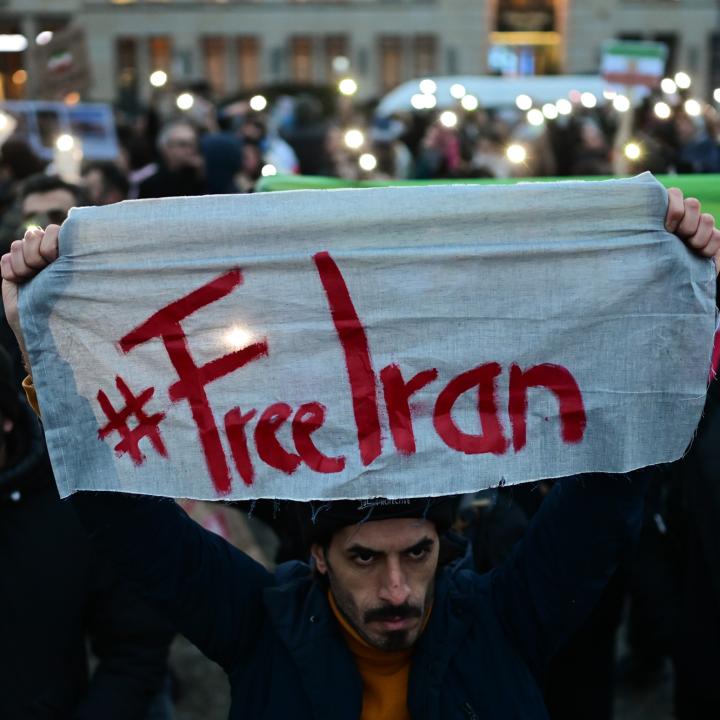
While the world waits for details of the agreement electronically signed this week, what’s sinking in for some Iranians is the realization that regardless of who occupied the White House—Democrat or Republican—during the 47 years of the Islamic Republic, Iranians who joined in cyclical anti-regime protests were, in the end, fighting alone. And today, Iranians are worse off than they have been in decades.
Anti-regime Iranians have been on an emotional roller coaster for months. Protests that began in late December turned into a bloody January uprising in which security forces killed thousands of civilians. President Donald Trump urged the Iranian people on Jan. 13 to keep protesting, promising that “help is on its way.” Many of those Iranians who took to the streets—some of whom openly called for multilateral foreign intervention because they realized they couldn’t overthrow their oppressors alone—have endured countless hardships over the past 15 tumultuous weeks. Meanwhile, they watched as U.S. officials negotiated with the regime that had slaughtered fellow Iranians, including children, and even said they would be honored to meet those leaders.
When Trump began attacking Iran on Feb. 28, he cited regime change as a core objective. In video remarks announcing military strikes, Trump told the Iranian people that “the hour of your freedom is at hand...When we are finished, take over your government. It will be yours to take. This will be probably your only chance for generations.” Some Iranians initially welcomed the foreign intervention, notably when Supreme Leader Ali Khamenei was killed.
But even for them, the conflict quickly became a source of regret. Daily life in Iran grew difficult, especially in Tehran, where nonstop U.S. and Israeli bombardments left residents of the Iranian capital unable to sleep. In early March, Israeli strikes on oil depots plunged Tehran into darkness like a scene from an apocalyptic movie and blanketed the city in pollution and oil residue. It was a turning point for many Iranians, who saw the attack as an assault on the wealth of the Iranian people rather than on legitimate military targets.
As the conflict continued, Iran’s civilian infrastructure has been increasingly damaged—not just the accidental U.S. strike on an elementary school in Minab, but also, more recently, drinking water structures. With each week, amid the chronic roar of jets and drones buzzing overhead, reality set in: This wasn’t the surgical campaign some Iranians had hoped for, nor the brief assault that Trump promised. An estimated 1,700 civilians have been killed, according to the U.S.-based group Human Rights Activists in Iran.
The economic consequences for Iranians have also been severe. The conflict is estimated to have cost at least one million Iranian jobs, with 20% of workforce losses tied to the state-imposed internet shutdown—the longest global outage. Ordinary Iranians, already struggling under systemic mismanagement and corruption as well as U.S. sanctions, have felt those burdens compounded by hyperinflation that has rendered the Iranian rial effectively worthless. When internet connectivity returned recently, some posted images of their empty refrigerators.
Worse, the Islamic Republic appears to be emerging as the conflict’s biggest victor. Having survived yet another war launched by the U.S. and Israel, the regime has morphed into a more emboldened and hard-line version, with repression climbing and executions carried out at rates not seen since the 1980s.
Human rights could have been a priority. The Trump administration incorporates human rights into its diplomacy when it chooses to—it has discussed political prisoners with Cuba, for instance. But the U.S. didn’t emphasize human rights in the negotiations with Iran.
Meanwhile, U.S. funding cuts have affected key civil society organizations just when they’re needed most, including hindering groups that document human rights violations and those that provide tools like VPNs that help Iranians get online when connectivity is available. The U.S. has also withdrawn from multilateral institutions such as the 41-government body Freedom Online Coalition, which could help shape the regulations for new technologies like direct-to-cell (another tool that can help Iranians access the internet during state-imposed blackouts).
Meanwhile, opportunities for Iranian dissidents to find refuge in the U.S. have also taken a hit. Some asylum-seekers have been deported—including a pro-democracy activist sent to the conflict-ridden Central African Republic. Iranians on work visas and students at elite universities such as Harvard and MIT—some of whom exercised their right to free speech by joining diaspora anti-regime protests in January—fear their visas won’t be renewed.
Taken together, the war and the broader U.S. treatment of Iran issues have left many in and outside Iran wondering whether the U.S. remains committed to supporting the Iranian people at all. The conflict has left Iranians worse off on every front, and U.S. policy has compounded their sense of abandonment. We don’t yet know whether the memorandum of understanding will hold and evolve into a lasting agreement. What is clear, however, is that the Trump administration has heinously damaged U.S. credibility with what had been one of the world’s most pro-American populations.
In the forthcoming 60 days of negotiations, the Trump administration could still put human rights on the table alongside other security priorities—such as by pushing for a moratorium on executions and the release of political prisoners in Iran. At home, it could restore funding for civil society organizations and ensure that Iranians can stay in the U.S. The Islamic Republic hasn’t won the war against freedom-seeking Iranians, but so far the regime seems to have won this latest battle for its survival.
Holly Dagres is the Libitzky Family Senior Fellow at The Washington Institute and curator of The Iranist newsletter. This article was originally published on the MS Now website.