Salma Annasse is a 2026 Soref Fellow at The Washington Institute.
Brief Analysis
At a time when every other route to a new Gaza police force is blocked by disputes that may not be resolved anytime soon, moving forward with Moroccan training of Palestinian recruits inside the Yellow Line is a promising alternative given everything the kingdom brings to the table.
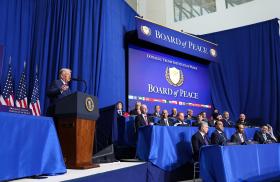
This month, media reports have indicated that the U.S.-led Board of Peace (BoP) is finally taking steps to deploy the first small batch of troops from the International Stabilization Force (ISF) into the Gaza Strip. Yet this welcome news comes with major caveats, suggesting that the months-long impasse over implementing the next phase of the Trump administration’s twenty-point Gaza plan may persist unless officials can find workarounds.
One caveat is that the initial deployment will be limited to the Rafah area on the Israeli-controlled side of the Yellow Line, where few Gazans actually reside now that war and reoccupation have split the Strip in two. Moreover, the parties remain mired in a dilemma over how to fulfill the Trump plan’s call for disarming Hamas and deploying a new Gaza police force, which the BoP regards as “essential to replacing armed factional control.” While Israel insists that it will not allow Palestinian police into the Strip before Hamas disarms, the BoP is apparently expecting this force to help the technocratic National Committee for the Administration of Gaza (NCAG) safely and effectively decommission Hamas weapons. To unlock this dilemma—or, at least, to ensure that properly trained police units are inside Gaza and ready to go once agreements are reached on wider deployments, disarmament, humanitarian recovery efforts, and other matters—officials should look to Morocco, a widely trusted BoP member whose Arab police instructors and military personnel are already involved with preparatory ISF arrangements on the ground.
Breaking the Deadlock
In the year since the Trump plan and UN Security Council Resolution 2803 called for the creation of a new Palestinian police force in Gaza, recruitment has gone well, with Egypt agreeing to train the cadets and Israel vetting more than 19,000 applicants as of this September. Yet Israel refuses to let vetted recruits leave Gaza for training, while Cairo refuses to run further courses until Jerusalem guarantees that trainees will be allowed to return to the Strip. Egypt did manage to train a few candidates who were already outside Gaza when they signed up, and these personnel are now receiving salaries from the Palestinian Authority. Israel still rejects a PA role in Gaza, however, and in any case insists that Hamas be disarmed first.
This deadlock could be alleviated by taking advantage of Morocco’s novel role in Gaza. Specifically, officials could:
Identify an initial group of police trainees from among the batch of Gaza-based recruits already cleared by Israel, sidestepping the disagreements over PA recruits and Egyptian reentry permits.
Train this batch in or near the first ISF deployment zone—that is, on the Israeli-controlled side of the Yellow Line, separate from any wider deployments on the Hamas-controlled side. This would have the additional benefit of greatly reducing potential Hamas threats against nascent police units.
Keep the new officers’ weapons in ISF custody until they deploy.
Hold off on police deployments until any remaining Hamas military capabilities in the first pilot zone are decommissioned and verified under ISF supervision. Deployments could then expand zone by zone.
What Morocco Brings
Morocco’s ISF contingent is well placed to spearhead this police training plan. Approved by King Mohammed VI under a participation agreement signed in July, this contingent comprises around 500 personnel in total, according to conversations with a BoP official. They include senior officers from the Royal Moroccan Armed Forces, who are serving with the ISF’s joint command; cadres from the General Directorate of National Security (DGSN), the kingdom’s national police; officers from the Royal Moroccan Gendarmerie; and personnel to run a military field hospital. These forces were trained in Morocco under ISF supervision beginning in late August and have since deployed to ISF headquarters in southern Israel. Kosovo is the only other country with personnel there so far, and only Rabat’s contingent includes police instructors.
Morocco has long demonstrated the capacity to train police at scale. Last year, the Royal Institute of Police in Kenitra and seven other schools across the kingdom conducted basic training for4,693 new officers. Morocco also has experience training foreign officers. In 2022, the Kenitra institute trained Guinean inspectors and commissioners in public order, lawful policing, human rights, and criminal investigation—all relevant skills for the type of work that Gaza’s new force will need to carry out. In addition, the institute has conducted judicial policing courses with senior officers from the Abu Dhabi Police and worked with international partners on a UN counterterrorism investigations course. Moroccan instructors could bring this experience directly to the proposed training site inside the Yellow Line, and their shared language with Palestinian recruits would enable effective instruction to begin right away.
In terms of funding, Morocco would cover the salaries of its police instructors, who are already serving officers. And because they would deploy within the kingdom’s existing ISF contingent, they would share its housing, transport, and protection resources. Moroccan troops could guard the training site, while Morocco’s field hospital could treat instructors, recruits, and their families. The Israel Defense Forces would presumably guard the outer perimeter and coordinate movements through a liaison office. Other basing and operational costs could be drawn from two existing sources: the $200 million that the U.S. State Department committed to the ISF for equipment, infrastructure, vehicles, and related needs, and the $100 million that the United Arab Emirates reportedly gave for police training.
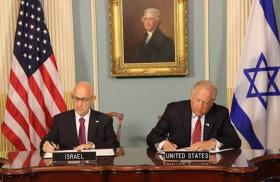
Another benefit of relying on Morocco is the kingdom’s deeply institutionalized relationship with Israel’s defense establishment and robust record of multilateral military cooperation. In 2018, Rabat worked with Egypt to bring a military field hospital into Gaza through the Rafah crossing. In 2021, it signed a defense memorandum with Israel calling for cooperation on intelligence, training, and defense industry initiatives. In June 2023, Israeli soldiers trained alongside Moroccan forces in the annual U.S. military exercise African Lion; three years later, the kingdom was hosting the exercise itself, welcoming around 5,000 personnel from more than forty countries. And during the Gaza war, Moroccan aid was the first to reach the Strip overland after being transferred through Israel in March 2024.
Bilateral cooperation has taken additional strides in 2026: Rabat and Jerusalem emphasized training cooperation in the Joint Military Commission action plan they signed this January; Moroccan officers have worked at ISF headquarters since June; in July, about thirty of these officers toured areas of Gaza where ISF troops are expected to operate; in September, the two governments agreed to exchange ambassadors; and on November 9, Amir Baram, the director-general of Israel’s Defense Ministry, visited Rabat for meetings that reaffirmed many of the above issues.
Morocco is also uniquely well-suited to this situation because the Palestinian police recruitment process was opened to women. The kingdom has been integrating women into its own police force since 2007, and this experience could help build a more representative Palestinian force.
An Antidote to Hamas Threats?
Training inside the Yellow Line would not completely eliminate the risk of Hamas attacks on police or ISF personnel. Although the group has publicly indicated that it will not target the ISF, there is no guarantee this will hold. Yet while some contributing countries might reconsider their deployments if their personnel come under attack, Morocco’s past experience in foreign peacekeeping operations suggests that it would stay the course. For example, more than 1,300 Moroccan troops have continued to serve with UN missions in the Central African Republic and the Democratic Republic of Congo for years, despite losing three of their comrades to ambushes in Bangassou in 2017.
Hamas might also attempt to foment local public hostility toward a police force formed behind the Yellow Line by portraying it as an Israeli-backed entity, much like it did with Israeli-armed rival groups in Rafah last year. Yet as an Arab partner with an established role in providing assistance to Gazans, Morocco could help counter this perception. For instance, King Mohammed chairs the Organization of Islamic Cooperation’s Bayt Mal al-Quds Asharif Agency, which spent approximately $12.2 million on projects in Gaza and Jerusalem in 2024-25.
In addition, Morocco could help ease concerns about Hamas potentially infiltrating the police and ISF after Israel’s preliminary vetting. The kingdom’s instructors would work alongside recruits throughout the training and initial deployment period, giving them an opportunity to identify and report any signs of Hamas influence. Over time, they could also make the program less dependent on foreign instructors by adopting a “train the trainer” model, similar to the UN Training model Rabat helped deliver in 2025. Preparing graduates to teach subsequent groups would give Palestinians a greater stake in the program and ensure it does not remain foreign-run. And as more Palestinians take on training and leadership roles, the force could become more rooted in the communities it serves and help build public trust. This would also support the development of a new governing authority capable of maintaining order, thereby allowing for wider Israeli withdrawals.
Conclusion
At a time when every other route to a much-needed Gaza police force is blocked by disputes that may not be resolved anytime soon, moving forward with Moroccan training of Palestinian recruits inside the Yellow Line is the only viable option. Fortunately, it also happens to be a good option given everything the kingdom brings to the table: namely, experienced, Arabic-speaking instructors to train Palestinian recruits; capable troops to protect the training mission; a field hospital to support all of these personnel; good working ties with both Israel and Egypt; and financial contributions that could cover significant parts of the mission’s costs. Well-trained Palestinian police would then be ready to take over security in the first pilot zone once Hamas hands over its weapons there—an approach that would put the onus on Hamas for any further delays in the process.
Salma Annasse is a Soref Fellow at The Washington Institute, focusing on Moroccan policy research, Middle East security, civil society engagement, and Track II diplomacy.