David Schenker is the Taube Senior Fellow at The Washington Institute and director of the Linda and Tony Rubin Program on Arab Politics. He is the former Assistant Secretary of State for Near Eastern Affairs.
Articles & Testimony
Given the heavy damage inflicted on more vulnerable facilities closer to Iran, Jordan has emerged as perhaps the most critical center for America’s regional military activities for the current crisis and beyond.
US military bases in the Arabian Peninsula were pounded during the war with Iran. Shortly after the onset of “Epic Fury,” the Combined Air Operations Center (CAOC) at Al Udeid airbase in Qatar—command post for all US and coalition air operations in the Central Command area of responsibility—was destroyed in a missile attack. Iran also targeted and degraded key US facilities in the United Arab Emirates, Kuwait, Bahrain, and Saudi Arabia. Most of the more than 13 US military bases hit by Iran during the hostilities were in the Gulf adjacent to Iran and within striking distance of its large supply of short-range missiles and attack drones.
While the extent of damage to US bases—estimated at up to $5 billion—may have exceeded expectations, the vulnerability of these facilities was anticipated. Indeed, prior to the war, most US troops and assets were dispersed to facilities far removed from the front line. The redeployment was consistent with US contingency planning during the Biden Administration—or earlier—to mitigate tactical and logistical complications posed by the proximity of facilities to Iran. The so-called Western Basing Initiative relied on US access to facilities in Saudi Arabia like King Fahd Air Base and Logistical Support Area Jenkins near the Red Sea. Perhaps the most important relatively safe western base for US operations, however, has been Muwaffaq Salti Air Base in Jordan.
The devastation of Washington’s Persian Gulf bases and the key role played by the Kingdom in US operations against Iran is likely to have long-lasting implications for future US military deployments and basing in the Middle East. Long before the war, Jordan was a critical if underappreciated US partner. Since February 28, the kingdom’s stock has risen dramatically in Washington.
Washington’s mil-to-mil relationship with Amman began in 1994 after Jordan and Israel signed the Wadi Araba peace agreement. Since then—and particularly after King Abdullah II, the former commander of the Jordanian Army’s Special Operations, ascended to the throne in 1999—US financial support and military cooperation have deepened considerably. During the US invasion of Iraq in 2003, the Kingdom provided basing for US aircraft involved in the operation. Nearly a decade later, US troops and aircraft were stationed in Jordan to participate in coalition military activities against the Islamic State in Syria and Iraq.
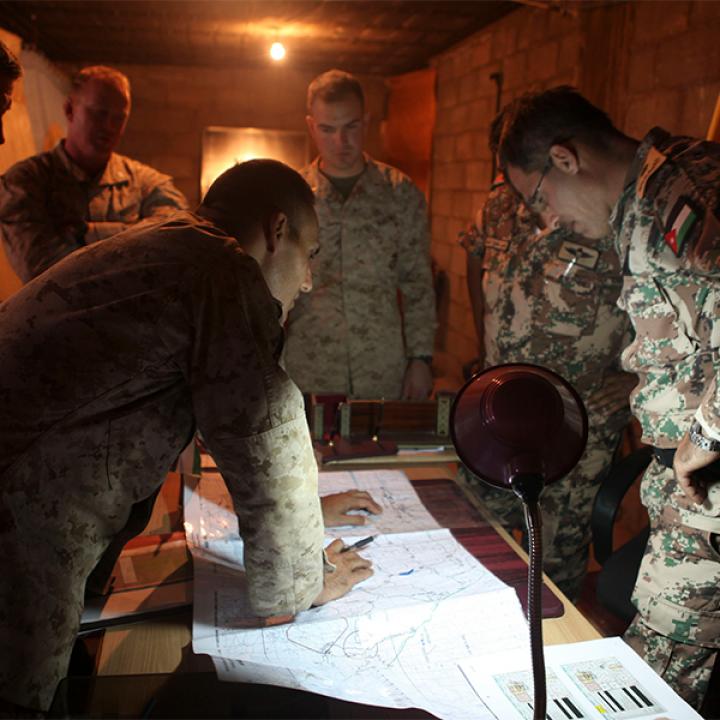
In 2021, seemingly in preparation for Epic Fury, the US and Jordan signed a defense cooperation agreement allowing US forces access to twelve facilities in Jordan, including five air bases. Today, Jordan has emerged as a critical—if not the most critical—US logistics and operations base in the war with Iran.
Before the start of hostilities, Muwaffaq Salti Air Base served as a key logistical hub for US C-17 airlifts; as of February 2026, some sixty US combat aircraft were stationed at the base. In recent years, the US also deployed a broad range of advanced anti-missile interceptors in Jordan, including Patriot missiles and Terminal High-Altitude Area Defense (THAAD) systems, to protect both the kingdom and Israel from drones and missiles fired by Iran and its Iraqi proxies. In April 2024, these systems—as well as the combat aircraft of the US, Israel, and some European states—downed hundreds of incoming projectiles over Jordanian territory. During Epic Fury, Iran and its Iraqi proxies launched more than 200 drones and missiles at US forces and Jordanian targets in the kingdom, the vast majority of which were downed.
Of course, while Jordan is more secure, that security is not foolproof. In mid-July 2026, three US soldiers were killed and several wounded when an Iranian missile evaded interceptors and hit Muwaffaq Salti. Back in November 2016 during the campaign against ISIS, three US Special Forces servicemen were killed by a rogue Jordanian guard at King Faisal Air Base. The Green on Blue attack was attributed to anti-American sentiment, and the guard was sentenced to life in prison. Notwithstanding these tragic casualties, however, the kingdom has proved far safer and more resilient under fire than US bases located in the Gulf. Indeed, in March at the very beginning of the war, 6 US servicemembers were killed in a single strike on a command center in Kuwait.
As the King Faisal Air Base incident suggests, not all Jordanians are pleased with the US military presence. Periodically, the kingdom has seen protests surrounding US deployments. During the Syrian civil war in 2013, the King requested that a contingent of American soldiers exercising in Jordan remain after the drill to help secure the realm. In response, dozens of tribal origin “East Bankers”—traditionally the monarchy’s leading supporters—wrote an open letter to the King describing US troops as “a legitimate target for all honorable Jordanians.” More recently, this past July hundreds of Jordanians signed onto a public missive disparaging the US military presence, arguing that it served “no national interest” and threatened to drag the kingdom into a “regional conflict.”
Despite a lack of widespread popular support for US basing, the Palace has cast its lot with Washington. To be sure, the Government has sought to downplay the US presence in order to insulate the kingdom from Iranian attacks: in July Jordanian Foreign Minister Ayman Safadi said “there are no US bases in Jordan,” but rather American soldiers within the framework of long-term military cooperation. Safadi was right—with the possible exception of the Tower 22 logistics outpost in the northeast of the kingdom—the US has no dedicated bases in Jordan. Still, the US presence has opened Jordan to extensive Iranian strikes.
To be fair, long before Epic Fury—by virtue of its 1994 peace agreement with Israel and longstanding strategic relationship with Washington—Amman was already in Tehran’s crosshairs. The threat increased after Jordan helped defend Israel during Iran’s April 2024 missile and drone barrage. Today, not surprisingly, Iran is even more hostile toward the kingdom. In addition to firing missiles and drones into Jordan, Tehran is looking to undermine US-Jordan ties. After the July 2026 missile strike on Muwaffaq Salti, for example, Iran’s Islamic Revolutionary Guard Corps issued a statement thanking Jordanian informants for providing targeting details to Iran aiding the attack. The IRGC is also urging Jordanians to demand the departure of US military personnel from the kingdom.
The IRGC push to end the US presence in Jordan is part of Iran’s effort to end US basing in the Middle East. Indeed, Tehran made this demand early on during the negotiations to end the war. (Shockingly, Iran somehow managed to incorporate a vague reference to a US withdrawal in the final text of the now defunct agreement, with the Trump Administration agreeing to “remove its forces from the proximity” of Iran within 30 days). However, while the US military may not soon fully return to its frontline bases in the Gulf, it’s not leaving the Middle East. Based on Iranian capabilities and Washington’s requirement for a regional base with operational freedom, moving forward, Jordan—rather than Qatar—is likely to emerge as a key center of US military activities in the region.
It’s not clear that the president was thinking of this scenario when early on in his second term, Trump exempted Jordan from his administration’s draconian cuts to foreign assistance. This year, Jordan will receive $425 million in Foreign Military Financing, $845 million in direct budgetary support, and close to $200 million in additional aid. This amount makes the kingdom the second largest recipient of US non-emergency foreign assistance. US support is considerable, but commensurate with Washington’s interest in ensuring the stability of this economically-challenged, moderate, pro-West peace partner. Given the increasing strategic importance of Jordan with the war in Iran, there’s a good argument that US assistance should be increased.