Henry Tugendhat is a Senior Fellow in the Institute's Diane and Guilford Glazer Foundation Program on Great-Power Competition and the Middle East.
Articles & Testimony
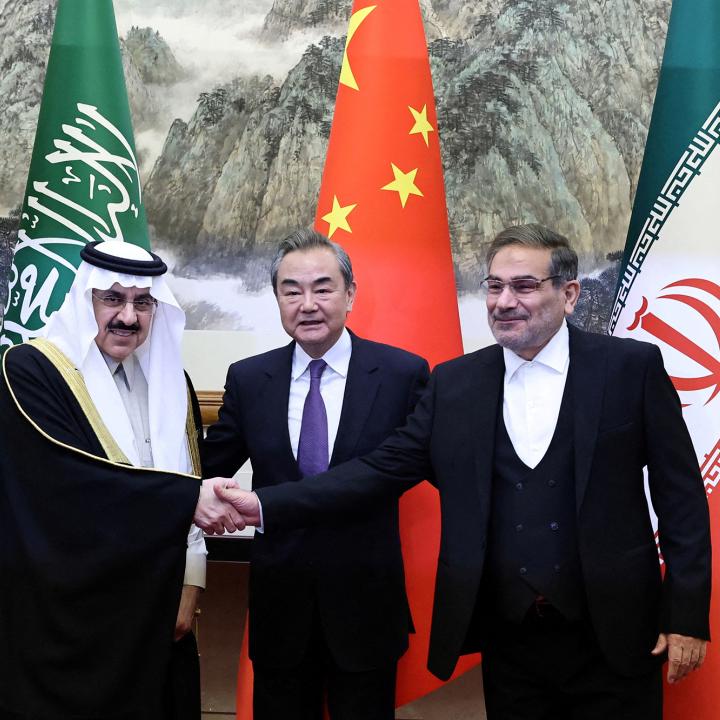
Beijing is just as concerned about its Gulf partners as it is about China’s “old friends” in Tehran.
Ever since the United States and Israel began the war on Iran, China has frequently expressed outrage against them. But when it comes to Iranian reprisals on Arab neighbors, China has been forced to strike a much meeker tone.
Since Iranian missiles have struck ports, energy infrastructure, and U.S. assets across the Arab world, Chinese officials have responded by simply stating that Gulf nations’ territorial integrity should be respected—without clarifying by whom—and praising the Gulf Cooperation Council Ministerial Council’s desire for peace while calling for all sides to deconflict. The uncomfortable truth for Tehran is that despite being Iran’s most important partner in trade, diplomacy, and security, China has spent the past two decades investing in far deeper relationships with Iran’s Arab adversaries in the region.
Iran’s recent apologies to neighboring Arab states will therefore be welcomed with relief in Beijing, and for all we know could well have been encouraged by China’s special envoy or more senior figures. But the situation remains fragile and unresolved, as a strongly worded statement of condemnation from Saudi Arabia made clear on March 9.
China’s public statements on this war so far are thus an easy approach that will frustrate both Iran and Arab states that may be hoping for something more substantial, but they’re also tepid enough not to offend either side. If China could be certain that the regime was about to crumble under domestic uprisings, the truth is that it might say even less. China has frequently demonstrated its capacity for unemotional pragmatism when “old friends,” as Beijing likes to dub its partners, are overthrown, such as President Robert Mugabe in Zimbabwe or President Omar al-Bashir in Sudan.
This is also the logical response from a country that doesn’t do alliances as a matter of principle. China’s default position is essentially that it was never going to intervene on Iran’s behalf, no matter the circumstances. There has been some recent debate in Beijing on whether China should abandon this policy, but so far, the country’s responses to Iran and Venezuela suggest that nothing has yet changed. And in the hierarchy of diplomatic “partnerships” that China has established around the world, Iran never even made it to the top rung of “all-weather” strategic partnerships enjoyed by countries such as Pakistan.
Perhaps more worryingly for Tehran, China can benefit from aspects of this conflict. Back in 1964, the Peking Reviewdescribed the U.S. interventions in the Democratic Republic of the Congo as Washington’s “second South Vietnam,” keeping U.S. military assets tied down and far away from China’s borders. There is no doubt a similar hope in Beijing today at a time of heightened tensions over Taiwan. Furthermore, the longer U.S. interventions in Iran proceed, the more strategic reserves are depleted that might otherwise have been deployed in the Pacific. This conflict also gives China a real-time learning opportunity for how the U.S. operates from a naval command.
More broadly, Iran barely registers as a national security interest for China. This is true of anything that sits outside China’s borderlands and coastline—as defined by Beijing, which sees Taiwan and the South China Sea as well within this sphere. Any significant diversion of military assets or financing toward Iran would be considered a greater risk to China’s core national security interests. For now, China will likely just sell the Iranians weapons and materials that Beijing can afford to part with, and there is little incentive for it to ease these sales in light of Washington’s ongoing weapons sales to Taiwan.
As far as nuclear nonproliferation is concerned, China never viewed Iran as a threat and argues that it should be allowed to develop capabilities for peaceful applications. It’s also another business opportunity for China, as Beijing has frequently sold nuclear technologies to Iran and collaborated on localized development.
Having said all this, China does have concerns around oil flows and oil prices. Some 45 percent of its oil imports come through the Strait of Hormuz, and rising oil prices would hurt in the context of China’s chronic deflation. Moreover, nonsanctioned (i.e., U.S. dollar denominated) oil is expensive for a country that is fighting to keep its currency low to boost exports.
But firstly, China started building up its strategic reserves last year. As of early January, it had reached 104 days of coverage and was projected to reach 140 days to 180 days by the end of 2026. Secondly, Chinese oil demand actually dipped slightly in 2025, which has left hundreds of Iranian oil tankers at sea and waiting to offload since at least December. Thirdly, selling oil to China is Iran’s main source of income right now, so there’s an incentive for the Iranians to find a way to do so even if they run out of the oil currently floating on tankers. And lastly, China still produces enough oil to cover about 27 percent of its domestic consumption, giving it some buffer.
Any diversification of Chinese oil imports will likely benefit its other crude suppliers outside the Gulf—namely Russia, Brazil, Angola, and Canada. However, for the Chinese oil refineries that focus on Iranian crude oil, it will be difficult to switch. The most comparable alternatives come from Saudi Arabia, Iraq, the United Arab Emirates, and Russia’s Urals region. So, while the Strait of Hormuz remains effectively closed, this makes it likely that Russia will be the biggest beneficiary of these upheavals.
In fact, the United States already granted an exemption for India to import from Russia for 30 days in part because it’s difficult for Indian refineries to find a viable alternative. Again, though, for now, China has more buffer than a country such as India, which is estimated to have only 25 days of reserves, and at least its refineries can continue to buy from Russia in renminbi even if the prices go up.
Some may point to the Chinese businesses that stand to suffer, but it’s instructive to compare the more than 3,000 Chinese citizens evacuated from Iran since the fighting began with the 36,000 evacuations from Libya when the United States, the United Kingdom, and France attacked in 2011. The discrepancy is down to China’s much greater success in selling construction projects in Libya. Today, the Middle East represents an impressive 36 percent of China’s overseas construction contracts, but very little of that business is in Iran, despite the signing of a 25-year strategic cooperation agreement in 2021 that touted plans for $400 billion worth of financial commitments from China in Iran. Ultimately, only $2 billion to $3 billion of that total has been accounted for since it launched five years ago.
Of course, none of this means that China will abandon Iran. And in the best-case scenario for Iran, Beijing might yet play a mediating role between Iran and its heretofore Arab targets. But there’s also no realistic scenario in which Beijing would ever take sides against its Arab partners. With friends like these, Iran’s regime may be wondering how it got here and how it might reshape this relationship if it survives these upheavals. But for now, it is forced to suffer the vulnerability of this dependence and take comfort in whatever limited support China bestows upon it.
Henry Tugendhat is a Soref Fellow in The Washington Institute’s Diane and Guilford Glazer Foundation Program on Great Power Competition and the Middle East. This article was originally published on the Foreign Policy website.