Sabina Henneberg is a Senior Fellow at The Washington Institute and director of its Junior Research Program.
Brief Analysis
Although Morocco and Algeria have good reasons of their own to avoid destabilization, active U.S. diplomacy will still be required given the sudden termination of valuable peacekeeping operations, the lack of a clear international mediator, and the potential for disruption by U.S. adversaries.
The October 31 expiration of the UN Mission for the Referendum in Western Sahara (MINURSO)—oddly celebrated by both Morocco, which claims sovereignty over the disputed territory, and the Polisario Front, which claims to represent the local Sahrawi people—marks the beginning of a new phase in a long-running conflict. Rising tensions could spark renewed hostilities in this far west corner of North Africa, just as fears of a return to war in the Persian Gulf are dominating the regional agenda.
Why Did the Mission End?
After operating for thirty-five years, MINURSO saw its mandate lapse last week when Russia vetoed a U.S. draft renewal resolution at the UN Security Council. The resolution would have extended the force’s peacekeeping operation but renamed it “MINUSO,” thereby removing from its mission the idea of preparing for a referendum in which Sahrawis could opt for integration with Morocco or independence. The Trump administration argued that MINURSO was a prime example of a never-ending UN mission that had gradually become an obstacle to development for the people it was meant to assist, including the thousands still residing in five Sahrawi refugee camps in Algeria. The U.S. draft, which received a majority yes vote on the council before Moscow blocked it, also described Morocco’s 2025 “Autonomy Plan” as “the only basis” for continued discussions on the territory’s future—a change from last year’s resolution, which called the plan “a most feasible” solution.
Russia subsequently submitted its own draft resolution calling for a twelve-month technical rollover of the existing mission. Moscow argued that the U.S. proposal sought to frame a potential settlement “exclusively in terms of Morocco’s autonomy plan,” and that it disregarded the Sahrawis’ right to a “just, free, and fair settlement” based on the principle of self-determination. Only three council members supported this draft, however, and time soon ran out on MINURSO.
Rabat has characterized the mission’s closure as a logical consequence of the fact that preparations for a referendum have been stalled for more than twenty years. It also characterized the failure to renew MINURSO as signifying the end of Security Council involvement in the Western Sahara file. Rabat thus appears to have used the Russian veto as an opportunity to not only end the mission, but also strengthen its assertion of sovereignty over the territory.
The Polisario Front celebrated the Russian veto as well, but for a different reason—because it prevented the council from adopting a resolution declaring Morocco’s plan as the only basis for future negotiations. Although Polisario officials had threatened to withdraw from the process following Washington’s presentation of its initial draft on October 20, the group’s chief backer, Algeria, would likely have persuaded them to continue negotiating even if the U.S. resolution was adopted. Moscow’s veto saved them from that unpalatable situation.
On November 1, the UN secretary-general’s spokesperson, Stephane Dujarric, called for a swift and orderly drawdown of MINURSO, including the return of assets to contributing countries. He also noted, “The Secretary-General remains concerned about the security situation throughout the Territory and the risk of escalation of hostilities. He calls on all concerned to exercise maximum restraint and to refrain from actions that could further increase tensions or undermine regional stability.”
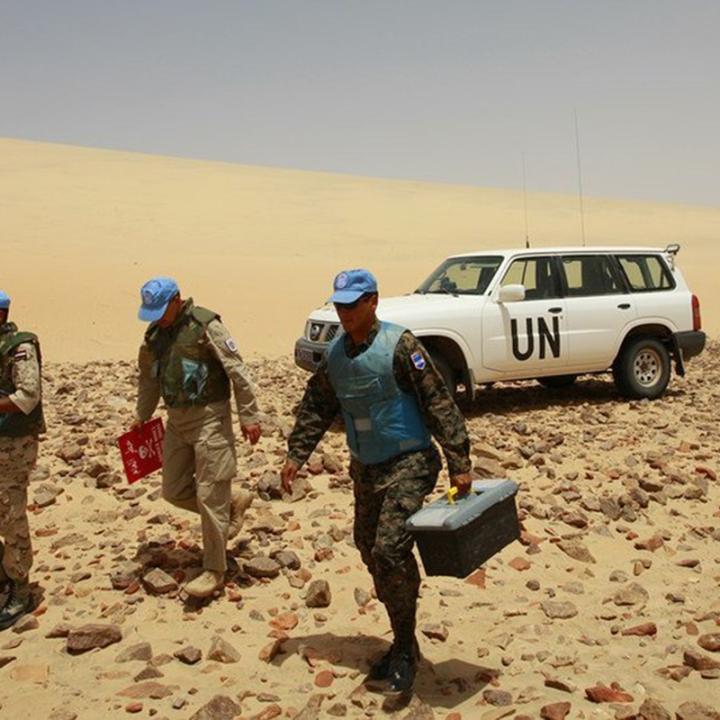
Indeed, both the secretary-general’s October 1 report to the Security Council and his October 13 strategic review concluded that MINURSO’s presence was critical for preventing the resumption of armed hostilities. According to these reports, the mission—which comprises around 160 military observers and 200 civilian personnel—was able to deter escalatory actions and encourage restraint through its ground patrols, aerial reconnaissance, incident monitoring, and overall ability to engage with the parties. Their removal will thus heighten the chances of renewed fighting.
Tension or Conflict?
The demise of MINURSO immediately sparked speculation that Rabat will take advantage of the mission’s imminent departure to move into the remaining portion of Western Sahara not under Moroccan control—that is, around 20 percent of the territory, with an estimated 30,000-40,000 residents. This could trigger fighting not just with Polisario forces, who consider this liberated territory, but also with their Algerian patrons. These fears may be exaggerated, however, because Rabat realizes any such move would complicate its narrative that international recognition, not military occupation, has confirmed its control over Western Sahara. The kingdom is also keen to continue presenting an image of stability ahead of the 2030 World Cup, which it will co-host with Portugal and Spain.
Algeria’s response to any Moroccan incursions will be critical. Algiers has recently displayed an unusual willingness to flex its military muscles while asserting its interests in the broader region. Last month, for example, it deployed troops to Niger to protect its local energy investments—its first foreign deployment in more than fifty years. Much like Morocco, however, Algeria is unlikely to see open conflict with its neighbor as furthering its political and economic interests in the region, which center on stability. Thus, even if tensions seem likely to escalate in the near term, they may remain limited.
The prospects for the medium term are less clear. This week, Guterres indicated that the UN “stands ready to continue supporting efforts to advance dialogue and pursue a peaceful resolution of the conflict” via special envoy Staffan de Mistura. A new secretary-general will take the helm in early 2027 and could reiterate this offer to mediate. Other actors (e.g., the African Union) could also take up the issue, though Rabat and the Polisario would need to agree on their involvement. After many years of UN mediation, however, it is unclear if an alternative mediator could do more than temporarily alleviate tensions.
In any case, Washington’s strategic competitors may try to exploit MINURSO’s demise and the potential increase in regional tensions to their advantage. Russia, for instance, could use the resultant confusion to enhance its presence in North Africa and the Sahel, where it is the largest source of arms for both Algeria and Mali. And China—now the second largest source of weaponry to Algeria—may argue that Washington’s refusal to compromise at the Security Council is the source of any spike in instability over the coming months. Beijing might even offer to mediate between the parties.
U.S. Policy Recommendations
The United States still has a clear interest in preventing the outbreak of conflict in northwest Africa, especially given the potential for bad actors to exploit the end of MINURSO. While ending the mission was a logical consequence of U.S. recognition of Moroccan sovereignty in Western Sahara, the Trump administration must now prepare steps to deal with the repercussions of this policy. To reduce tensions, prevent a return to armed confrontation, and deter outside parties from making the problem worse, Washington should:
Call on all concerned to exercise restraint.
Reaffirm U.S. willingness to continue supporting di Mistura’s efforts to facilitate dialogue.
Dispatch U.S. officials—including senior advisor Massad Boulos—for discussions with Algiers and Rabat.
Use the good offices of U.S. Africa Command (AFRICOM) to engage with the Moroccan and Algerian militaries, counseling restraint along confrontation lines that will no longer be patrolled by third-party peacekeepers.
Support UN agencies, including the Office of the High Commissioner for Refugees, in continuing aid deliveries to Sahrawi refugee camps in Algeria. No UNHCR leader has visited the camps since 2009, so a proposed trip by High Commissioner Barham Salih would be timely and useful.