David Makovsky is the Ziegler Distinguished Fellow at The Washington Institute and director of the Project on Arab-Israel Relations.
Articles & Testimony
A White House meeting facilitated by the senator’s funeral could let Trump and Netanyahu avoid the appearance of a wartime rift.
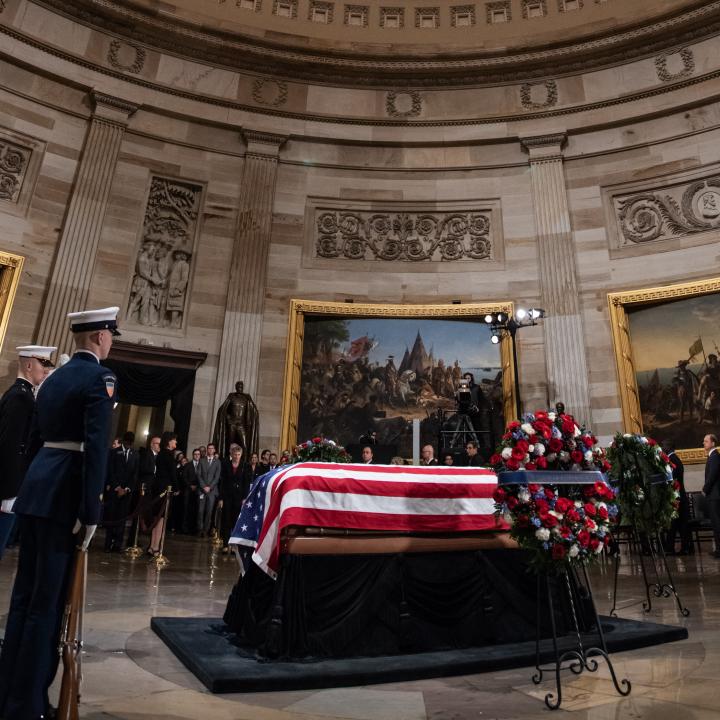
As US-Israel tensions deepen, the hastily announced meeting planned for Tuesday at the White House between President Donald Trump and Israeli Prime Minister Binyamin Netanyahu may offer what the late Senator Lindsey Graham might have sardonically called his first posthumous contribution to US-Israel relations.
Amid extraordinary regional uncertainty and recriminations about the Iran war, Graham’s funeral that day will bring the wartime partners together. The late senator spent decades arguing that America’s adversaries benefited whenever they saw daylight between Washington and Jerusalem. If his funeral prompts the two leaders to narrow that daylight, it would be a fitting final contribution to the US-Israel alliance from one of its most steadfast champions.
The meeting was hardly a foregone conclusion. Trump sounded tepid when asked about meeting Netanyahu if the Israeli leader came to Washington for Graham’s funeral. As American public opinion sours on the Iran war, Trump has sought to create some political distance from Netanyahu, occasionally praising the Israeli prime minister as a wartime leader while also deflecting criticism that Israel has been driving American policy toward Iran. Netanyahu, for his part, has been equally careful, repeatedly emphasizing that Trump alone decides America’s course.
Graham—who became one of Trump’s most trusted foreign policy confidants—would almost certainly have argued for holding the meeting and clearing the air. With Netanyahu facing Israeli elections in October and Trump bracing for the midterms, this is not the moment to negotiate grand bargains. But it is a fine moment to ensure that Washington and Jerusalem are aligned on three urgent challenges—Iran, Lebanon, and Saudi Arabia—that cannot wait until after voters go to the polls.
The Iran war tops the list. Trump told Axios this week that he does not want Israel to join any renewed military escalation with Iran. “We don’t need anybody,” he said. Trump warned of “consequences” if Israel entered the fight and hinted that Iran could retaliate directly against Israel.
Netanyahu appears in no mood to test Trump. Israeli officials also note that during the recent two-week confrontation, Iran largely refrained from attacking Israel directly—a sign, in their view, that Tehran understands Israel can impose even greater costs on the Islamic Republic. But the larger question is not whether Israel joins the next round of fighting. It is whether Washington and Jerusalem share a common strategy for what comes next.
For Trump, the immediate priority is reopening the Strait of Hormuz, avoiding the closure by Iran’s Houthi allies of another naval chokepoint in the Red Sea, and preventing more economic shocks before the midterms. Israeli officials share that concern but are equally focused on another question: what is the long-term strategy for Iran’s stockpile of highly enriched uranium buried beneath the battered nuclear sites at Fordow, Natanz, and Isfahan—and potentially Pickaxe Mountain, which hasn’t yet been bombed? US-Israel tactical coordination is important, but strategic alignment matters even more.
The same imperative applies in Lebanon. The new trilateral framework among the United States, Lebanon, and Israel offers a rare opportunity to begin restoring Lebanese sovereignty. If the Lebanese Armed Forces can gradually deploy into villages in southern Lebanon while Hezbollah withdraws, Israel could eventually reduce its military presence in southern Lebanon without leaving residents of northern Israel to live under the constant threat of Hezbollah attack.
Yet Hezbollah and its Iranian patrons have every incentive to sabotage that process. After Trump’s widely publicized criticism that Israeli attacks in Lebanon have been excessive, renewed Hezbollah attacks on Israel would aim not simply to provoke Israeli retaliation in Lebanon but also to widen the differences between Trump and Netanyahu over Israel’s military response. That would strengthen Tehran’s hand while weakening Lebanon’s fragile government—an outcome that can be prevented only by close US-Israel coordination.
The same need for US-Israel coordination extends to Saudi Arabia. Few issues mattered more to Graham than completing the strategic bargain that would normalize Saudi-Israel relations. Working closely with the Biden administration, he made repeated trips to Riyadh in pursuit of a package linking normalized Saudi ties to Israel to a US-Saudi defense treaty and a civilian nuclear agreement.
This week’s announcement of a civilian nuclear accord between Washington and Riyadh didn’t include normalization. Trump quickly sought to restore the original linkage through a Truth Social post insisting that normalization remains part of the broader deal.
The Saudis will understandably place greater weight on a signed agreement than on a social media post. Yet Trump has made clear that expanding the Abraham Accords remains central to his foreign policy legacy. Riyadh, meanwhile, continues to insist that normalization requires at least a credible Israeli commitment to embark upon negotiations toward ultimately creating a Palestinian state alongside Israel. Saudi officials recognize that Palestinian statehood is unlikely any time soon, especially after the traumatic Hamas terrorist assault on October 7, 2023, but would like to see an effort to at least start down that road. Moreover, the Saudis are equally reluctant to hand Netanyahu a diplomatic prize on the eve of Israel’s October elections.
That makes it even more important that Washington and Jerusalem understand each other’s objectives before negotiations accelerate. No two countries—let alone a superpower and regional power—have identical interests, and policy differences between the countries are certain to flow from those baselines.
Yet Graham often warned that inevitable US-Israel differences over tactics, timing, and even policy must be managed privately and carefully—and should never be allowed to become strategic opportunities for Iran, Hezbollah, Hamas, or any other foe seeking to drive a wedge between the United States and Israel. His funeral has created an unexpected opportunity for Trump and Netanyahu to ensure precisely that—and to ensure that America’s and Israel’s adversaries continue to see two allies determined to confront shared challenges together.
David Makovsky is the Ziegler Distinguished Fellow at The Washington Institute and director of the Koret Project on Arab-Israel Relations. This article was originally published on the Times of Israel website.