- Policy Analysis
- Fikra Forum
Pakistan Steps In: Sudan and the Transformation of Regional Security
A $1.5 billion Pakistani arms deal with Sudan signals a regional shift from diplomacy toward military escalation, which may prolong the war in Sudan.
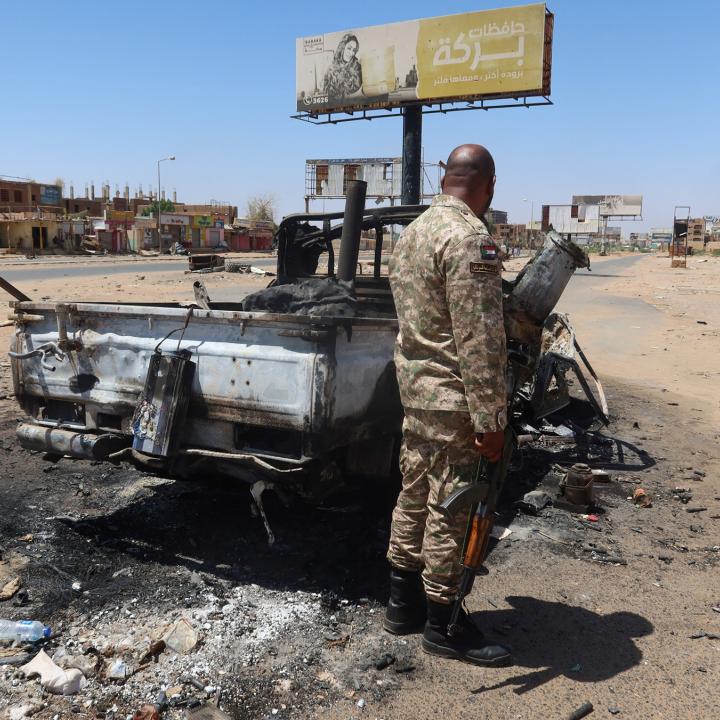
At a moment that should have seen renewed momentum toward a political settlement in Sudan, reports suggest that Pakistan, with Saudi mediation, is nearing completion of a $1.5 billion arms deal with the war-torn country. Far from being a routine arms transaction, the deal encompasses Karakoram-8 aircraft, more than 200 drones, and air defense systems. It also potentially includes JF-17 multirole fighter jets, produced jointly by Pakistan Aeronautical Complex and China’s Chengdu Aircraft Corporation. This development points to a deeper regional shift away from sponsoring dialogue and toward a military resolution to the Sudanese conflict.
Support for a Military Resolution Is Replacing Diplomacy
A coordinated Saudi–Egyptian–Turkish alignment is emerging to strengthen the Sudanese Armed Forces (SAF) against the Rapid Support Forces (RSF). The growing rapprochement among the three, reflected in a series of high-level summits in 2024, increasingly includes Sudan as a core focus. This alignment reflects a shared assessment that control of a country of Sudan’s size and strategic importance by a non-state armed force would set a dangerous precedent for regional stability.
Egypt, which has over five million Sudanese residents and more than half a million refugees, fears the repercussions of prolonged instability for the Grand Ethiopian Renaissance Dam and for Nile water security, and views support for the SAF as an existential matter. In recent months, Cairo has signaled that it may activate joint mechanisms under its mutual defense agreement with Sudan, and the Egyptian Air Force struck an RSF convoy coming from Libya. Turkey, which previously supported Sudan through provision of unmanned aerial systems, sees it as a gateway for expanding influence in Africa and a strategic buffer against the growing Emirati presence in the Red Sea.
Pakistan’s entry into this alignment through a major arms package is particularly noteworthy because it reportedly involves regional intermediaries, most notably Saudi Arabia. This reflects Pakistan’s participation in a broader network of defense understandings, an inseparable part of which is its deep military ties with Riyadh.
In addition, all parties seem to be abandoning the diplomatic track in favor of military escalation. Until recently, Saudi Arabia was widely portrayed as a central supporter of diplomatic efforts to end the Sudanese war through the Quartet framework and the Jeddah negotiation platform, which hosted multiple rounds of talks beginning in May 2023. However, these negotiations failed to produce a durable ceasefire and this, combined with escalating humanitarian violations documented by the UN—including mass killings in Al-Jazira state and the prolonged siege of Al-Fashir—appears to have pushed Riyadh toward a fundamental reassessment.
Current assessments suggest Saudi Arabia increasingly views continuation of the Sudanese conflict as a direct threat to Red Sea stability and fears that Sudan could become a staging ground for cross-border armed groups. Diplomatic sources indicate that Riyadh believes the RSF, backed by the United Arab Emirates, has developed capabilities that encourage it to pursue full military victory. From this perspective, tipping the balance in the SAF’s favor is viewed as necessary to force both sides back toward meaningful negotiation.
The danger is that such military engineering may produce precisely the opposite outcome. Weapons rarely remain instruments of political pressure for long—they rapidly become fuel for expanded warfare. While new alliances and arms flows may temporarily reshape battlefield dynamics, they also significantly narrow the remaining space for diplomatic maneuvering.
Unsurprisingly, the RSF is following these developments with deep concern. Field assessments indicate that the group, despite maintaining extensive control across Darfur and parts of Kordofan, continues to suffer from limited air capabilities. Until now, it has relied on drones supplied through Emirati and Libyan channels, supported by a complex logistics network running through Chad, South Sudan, and the Central African Republic. This arms race will not resolve the war but will transform Sudan into a proxy arena like Libya, where politics becomes tactics, while weapons continue to flow.
Furthermore, this escalation is occurring despite recent American diplomatic engagement. The paradox lies in Washington itself. The United States continues to present itself as a principal sponsor of mediation in Sudan through the Quartet, which comprises the United States, Saudi Arabia, the UAE, and Egypt. Yet arms deals routed through close American partners, which directly fuel military escalation, raise serious questions about this stance.
This escalation is particularly striking given that it follows a high-profile meeting between Saudi Crown Prince Mohammed bin Salman and President Trump, during which MbS reportedly urged greater U.S. involvement in Sudan. Yet on the ground, the situation is moving away from diplomatic resolution.
These questions gained further weight with the 2025 visit to the White House by Pakistan Army chief Field Marshal Asim Munir, described as a significant political and security meeting. This visit an emerging American vision for a broader Pakistani security role. In this context, it becomes increasingly difficult to interpret any major Pakistani military move as a purely commercial transaction detached from wider international calculations. This raises serious questions about the degree of coordination with Washington, or at a minimum prior notification, especially given the scale of existing military cooperation between the United States and Pakistan.
The Illusion of Military Resolution
The question is no longer whether external powers will intervene in Sudan’s war, but whether this intervention will end the conflict or entrench it for years to come. In Yemen, Libya, Syria, and elsewhere, external military interventions have consistently prolonged conflicts rather than resolved them. Each new weapons shipment is justified as a way to shift the balance or impose an outcome, yet in practice it only fuels another cycle of violence and hardens positions.
Sudan now risks following the same trajectory. An accelerating arms race will not end the war; it will instead entrench it as a protracted proxy conflict, where politics becomes a tactical tool, with agreements used to buy time while weapons continue to flow. The choice is stark: pursue genuine de-escalation now, or resign the country to another decade-long quagmire. History’s lesson is clear. The real question is whether anyone is willing to heed it.