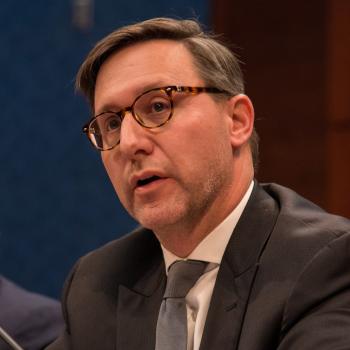
Matthew Levitt is the Fromer-Wexler Senior Fellow at The Washington Institute and director of its Jeanette and Eli Reinhard Program on Counterterrorism and Intelligence. From 2005 to early 2007, he served as deputy assistant secretary for intelligence and analysis at the U.S. Department of the Treasury. In that capacity, he served both as a senior official within the department's terrorism and financial intelligence branch and as deputy chief of the Office of Intelligence and Analysis, one of sixteen U.S. intelligence agencies coordinated under the Office of the Director of National Intelligence. During his tenure at Treasury, Dr. Levitt played a central role in efforts to protect the U.S. financial system from abuse and to deny terrorists, weapons proliferators, and other rogue actors the ability to finance threats to U.S. national security. In 2008-2009, he served as a State Department counterterrorism advisor to the special envoy for Middle East regional security (SEMERS), General James L. Jones.
From 2001 to 2005, Dr. Levitt served the Institute as founding director of its Terrorism Research Program (now renamed as above), which was established in the wake of the September 11 attacks. Previously, he served as a counterterrorism intelligence analyst at the Federal Bureau of Investigation (FBI), where he provided tactical and strategic analytical support for counterterrorism operations, focusing on fundraising and logistical support networks for Middle Eastern terrorist groups. During his FBI service, Dr. Levitt participated as a team member in a number of crisis situations, including the terrorist threat surrounding the turn of the millennium and the September 11 attacks. He has earned numerous awards and commendations for his government service at both the FBI and the Treasury Department.
Dr. Levitt holds a bachelor's degree in political science from Yeshiva University, as well as a master's degree in law and diplomacy and a doctorate from Tufts University's Fletcher School of Law and Diplomacy. He was a graduate research fellow at Harvard Law School's Program on Negotiation and has taught at Georgetown University's Edmund A. Walsh School of Foreign Service, Johns Hopkins University's Paul H. Nitze School of Advanced International Studies, and Hopkins’ Zanvyl Krieger School of Arts and Sciences. Levitt is the 2021-22 Andrew H. Siegel Professor at Georgetown University's Center for Jewish Civilization.
Dr. Levitt has served as an expert witness in several criminal and civil cases, lectured on international terrorism on behalf of the Departments of State, Justice, Defense, and Homeland Security, consulted for various U.S. government agencies and private industry, and testified before the Senate and House on matters relating to international terrorism. He has held fellowships with the Combating Terrorism Center (CTC) at the U.S. Military Academy at West Point and the Center for Cyber and Homeland Security (CCHS) at the George Washington University, is a term member of the Council on Foreign Relations, and serves as a member of the international advisory board for both the Institute for Counter-Terrorism in Israel and the International Centre for Political Violence & Terrorism Research in Singapore. He serves on the advisory board of Foundation for Defense of Democracies' Center on Sanctions and Illicit Finance (CSIF) and formerly served on the academic advisory board for the Emirati Center for Strategic Studies and Research (ECSSR).